 |
| Where does your garbage go? |
| Dealing with waste of all kinds is a very difficult process to deal with. Where does it all go? Unfortunately we have not found completely efficient ways of disposing of our waste. Problems occur when there is no room left for landfills. Garbage may be exported from one state or country to another that is willing to take it. Sadly enough, much of the worlds garbage ends up in the ocean. Some of it sinks to the bottom and some of it washes up on our beaches. Do your part to help clean it up. At some landfills, methane gas is released, which be be used to generate electricity. |
 |
 |
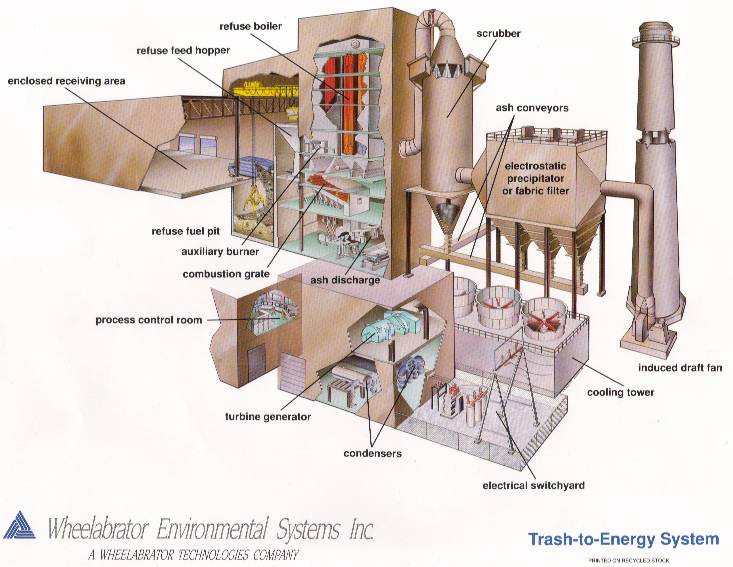
| Trash-to-Energy System Chances are that if you live in the Merrimack Valley your garbage ends up here (photo above) at the Wheelabrator Environmental Systems Inc. Trash-to-Energy System. Here garbage is recieved in an enclosed holding room. Particles of garbage tend to float through the air, so to contain them the air is pulled into the plant where it will be constantly recirculated. Garbage is dumped into a pit where two giant "grab machine" like claws load it into a hopper. Down the hopper the garbage drops into a furnace. The furnace burns all the garbage at high temperatures. The fire heats up water contained above the furnace, which becomes steam and powers a turbine. The turbine generates electricity to be stored and sold privately. The Trash-to-Energy System uses 10% of the electricity it produces to power itself. Ash is collected from the furnace area and sent to a landfill. As it is collected metals are separated from the ash with magnets to be recycled. (5% of volume is reclaimed metal.) At the end of the process the condensed garbage ash is sent to a landfill and is only about 20% of the original volume that arrived. Through a complex chemical process airborne ash particles and chemicals are removed. Virtually all that you see coming from the stack is condensed water vapor. The Trash-to-Energy System produces 35,000 kilowatts, enough to power 30,000 homes. Auxiliary burner temperatures reach up to 2,500 degrees F. Wheelabrator receives waste from 23 different communities and several industrial sites. Is this the best system available? Could it be improved? |