
With three U.S Army divisions prepared to attack the Japanese 62nd divisions Machinato Line, the Americans pounded the 62nd division with bombing from battleships, cruisers, and destroyers, and conducted the largest single air strike of the campaign, with 650 planes targeting numerous areas. Ground-wise, the American 10th Army amassed the greatest concentration of artillery gathered in the Pacific War. Even with this massive concentration of military force, the Japanese remained defiant hiding deeper in their underground shelters and caves, rushing to their battle positions to fire on the advancing American ground troops. This campaign proved to be as difficult as any the Americans had yet fought.
Defense lines surrounded the village of Oki and Shuri, and numerous ridges were extremely difficult to penetrate. The night of April 19 found the XXIV Corps focused on consolidating their troops to prepare for further attack. Strong opposition greeted land forces at every turn. Discovered on a dead Japanese officer was a map locating mines placed on an important road near the Machinato Line. Roads were quickly clear and supplies and tanks moved forward. Continued, yet slow progress was made securing Tombstone Ridge, Nishibaru Ridge, and the Tanabaru escarpment, which finally fell on the 24th of April.
The Japanese 32nd Army made a quick and effective withdrawal to its 2nd Shuri defense line. A regrouping of American troops was strengthened by the cancellation of Phase 2 of Operation ICEBERG, freeing up the III Amphibious Corps to assist in the upcoming attack. General Ushijima, on April 26, ordered his major units to be deployed to the Shuri second defense ring. The Japanese had amassed the largest concentration of enemy firepower ever in the Pacific theater. While delays continued on ground, concern for naval ships offshore grew. With every day the Allied naval forces faced continued air attacks from the Japanese air fleet.
With increase concern about the rising American casualties from Japanese air attacks on the navy, Nimitz requested that land based aircraft be targeted for increased bombing. Finally, by the end of April, Americans had air cover from dawn to dust. Although by the end of April the Japanese high command realized that the fall of Okinawa was inevitable, they hoped that Ushijimas forces would hold out for an extended period of time enabling the Japanese command to bolster forces and defense on its homeland shores.
On May 11, the 10th Army took control of operations in Okinawa, but would find that progress was extremely slow along its offensive line. The belief was that Ushijimas 32nd Army would choose Shuri as its fight to the death, but they began troop movements as early as May 22, retreating to the Yaeju Dake-Yuza Dake Ridge. The 10th Army misinterpreted the Japanese movement and on May 30th, actually realized that only a skeleton force separated them and Shuri. Ushijimas hope was that by retreating, he could delay the imminent defeat, tying up the Allied forces for as long as he could.
Ushijima was aided in his tactical retreat by 12 inches of rain that fell over the last day of May, native Okinawan assitance and low cloud sealing, which prevented American forces from accurately observing the retreat. The 10th Army now redefined its mission to pursue the Japanese combatants in the very south end of the island.
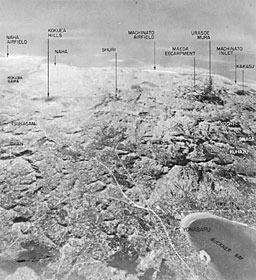
The Last Battle, p. 186
The Last Battle, p. 188
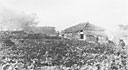
The Last Battle, p. 199