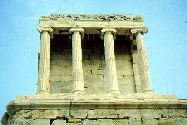
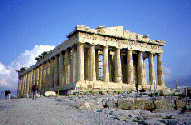
Greek architecture organized space so that it was not too complex to be easily and fully understood. Simplicity and clarity of parts were two essential elements in the design of Greek temples and government buildings. The mathematics of geometry (ratio and proportion) was applied to the design of the interior and exterior to create a sense of balance and visual harmony.
Greek architecture emphasized these main elements.
Symmetry
Balance
Unity
Order
Harmony
The Greek developed and used three orders (The design of columns): -
Doric (No base and plain capital)
Ionic (Simple base and scrolled top)
Corinthian (simple base and acanthus-leaf top)
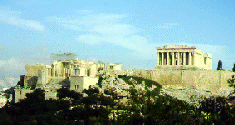
The Ionic style of architecture became the dominant mode for construction in the classical period. This was when a lot of temples and complexes were constructed. The Athena temple was built between 467-449 B.C; temple of Zeus (Olympia) between 465-457 B.C; The Theseum (Temple of Hephaestus) between 448-440 B.C; Parthenon between 447-432 B.C; Propylea between 437-432 B.C; Temple of Athena Nike between 427-424 B.C; The Erectheum between 421-409 B.C;
Some of the materials in this page were from Hum 100 class at Robert Morris College (Mr. Bejcek is the instructor)
Ionic columns were more graceful and less massive than Doric columns. Ionic capitals employed a scroll-like motif
 Greek Art
Greek Religion
Greek Index Page
Greek Art
Greek Religion
Greek Index Page