Jenny's Story: My Life with Crouzon Syndrome
Growing Up with Crouzon Syndrome
Being an Adult with Crouzon Syndrome
Being a Mother with Crouzon Syndrome
Dealing with Unexpected Crouzon Syndrome
Helping Your Child to Cope with Teasing
~~~~~
Jenny's Inspirational Sayings II
~~~~~


Operation 5 - December 2004
After the dura and skull operation the neurosurgeon told us that the problem had been caused by hydrocephalus. He told us that the build up of cerebrospinal fluid in Melissa's brain was the cause of the brain being pushed up and out of the back of her head. The neurosurgeon told us that she needed to have a shunt inserted as soon as possible to help drain the excess fluid. He was going to do it before we went home but he had to do a baby urgently so we were told to go home and we would be contacted to come back in the next week to have it done.
This was a shock to hear. Though when we thought about it, we remembered that we were told that Melissa had hydrocephalus before her bifrontal orbital advancement at 18 months but the operation was supposed to have rectified it. Obviously it had not. It had not been mentioned since that operation which is why we had forgotten about it.
~~
What is hydrocephalus?
From my research I've found that cerebrospinal fluid is found within the brain and surrounds the brain and the spinal cord. It is a clear, watery substance that helps to cushion the brain and spinal cord from injury. This fluid circulates through channels around the spinal cord and brain, constantly being absorbed and replenished. It is within hollow channels in the brain, called ventricles, where the fluid is produced. A specialized structure within each ventricle, called the choroid plexus, is responsible for the majority of CSF production. The brain normally maintains a balance between the amount of cerebrospinal fluid that is absorbed and the amount that is produced. Often, disruptions in the system occur. Hydrocephalus occurs when there is a blockage in the pathways through which the fluid normally travels or it results from an overproduction of fluid or a difficulty in absorbing the fluid that is produced. Because the brain is enclosed within the bony skull, the extra fluid, trapped by blocked pathways, has no escape. This extra fluid within the brain will produce increased pressure symptoms: headaches, vomiting, drowsiness and in some cases, confusion. (http://www.neurosurgerytoday.org/what/patient_e/anatomy1.asp)
~~
We did not hear from the hospital until the Friday of the next week. I had tried during the week to find out from the hospital if an appointment had been made but my enquiries led nowhere. We were just about to get in the car to go to the hospital to see the craniofacial clinic when we got the appointment in the mail. Melissa was to go in the following Tuesday.
We didn't know what a shunt was and hadn't had the operation explained to us, so the neurosurgeon's registrar showed us what a shunt was and explained its purpose and what would be happening in the operation.
We found out that a shunt is a drain. It is placed in the middle of the brain in the ventricles where the cerebrospinal fluid collects and it takes away the excess fluid. The drain takes the fluid down to the stomach. See the diagram.
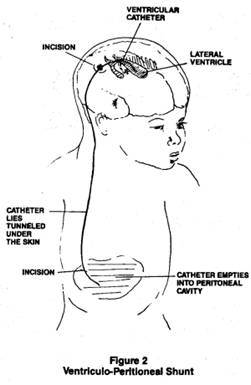
We were uneasy about Melissa having a shunt but again there was no alternative. If she did not have a shunt we were told she could have more blow outs of her dura and skull, requiring more surgery, more pressure on her brain would occur and pressure would also be placed on the back of her eyes which could lead to blindness.
After the operation the neurosurgeon said that the shunt was definitely needed as it had started to drain before they had finished inserting the bottom end into the stomach.
Melissa was wobbly for a few days and went off her food. She had a very sore tummy for a few weeks but got back to her old self slowly. She had the stitches taken out of her head and tummy 9 days after surgery.
The operation took about 2 hours and she was in hospital for 4 days.
We were given information on shunts and what the warning signs to look for are because shunts can become blocked. These are things like vomiting, headaches, loss of appetite, excessive sleepiness, irritability, dizziness, fever, double vision, clumsiness, change of personality. We will be watching Melissa closely.