
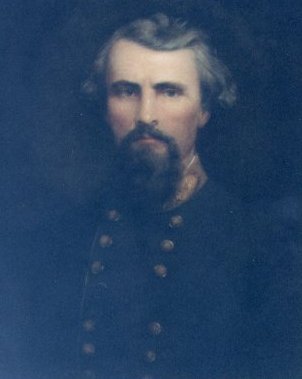

Nathan Bedford Forrest was the first of twelve children born to an illiterate blacksmith in Bedford County, Tennessee. Born on July 13, 1821 Forrest's father died when he was only 17 which left him as the head of the family and chief bread-winner. Uneducated, he worked hard and finally brought his family out of the poverty they had lived in most of their lives. When he was 20 he went into business with his uncle in Mississippi and when that uncle was killed by outlaws Forrest shot two of the men and wounded two more with a knife. He was a tough man, raised hard and never backed down from a fight. Eventually, Forrest made himself successful and became the owner of several plantations and trading slaves and horses. He always provided for his mother and put his younger siblings through college. By 1861 he was a millionare and when fighting between the north and south erupted he promptly enlisted as a private but shortly thereafter raised an entire battalion of cavalry at his own expense, putting up broadsides which invited anyone who wanted to kill Yankees to ride with Forrest. His ranks quickly filled and the impressed Governor of Tennessee commissioned him a colonel of cavalry.
The giant man with the sharpened sword first saw major combat at the battle of Ft Donelson in early 1862. He led a daring charge that captured a Union battery and managed to cut his way through the enemy forces surrounding the fort. When told that escape was impossible and that the garrison would surrender Forrest refused to listen and stormed out, leading 4,000 men through the Union lines to fight another day. After the Confederate defeat at Shiloh, Forrest successfully covered the retreat of the army, performing one of his most legendary feats of battlefield courage. After leading a reckless charge against the Union line he found himself isolated from his men. He emptied both his pistols, then began hacking away with his saber. When a Union soldier shot him in the pelvis, Forrest grabbed the man by the neck with one hand and threw him over his shoulder to act as a human shield as Forrest rode back to his own lines. He was soon given a brigade command.
In conjunction with the Confederate counter-offensive into Tennessee General Braxton Bragg dispatched Forrest on a raid behind Union lines which he conducted brilliantly. He took the city of Murfreesboro on his birthday, destroying or capturing all federal troops in the area and forcing the Yankees to pull men away from the force confronting General Bragg. Forrest had established himself as a master cavalryman and never lost a battle until the very end of the war when he was overwhlemed by superior numbers. He seemed to have an instinctive understanding of mobile warfare and how to use the terrain to his advantage. When once asked the secret of his success he famously replied, "get their first with the most men". His simple words covered what took a great deal of skill to accomplish.
In late 1862 General Forrest led another raid that reached as far north as the Ohio River, out-running, out-fighting and audaciously bluffing the Union forces opposing him. He actually came back with more men and better equipment than when he left and forced General Grant to postpone his attack on the vital Confederate city of Vicksburg, Mississippi. In 1863 Forrest thwarted and hounded a force of 3,000 Union cavalry sent to tear up Bragg's supply lines through Alabama and Georgia only to have 1,700 of them become Forrest's prisoners. He fought bravely and to great effect at the stunning Confederate victory at Chickamauga and like many officers urged and immediate follow-up attack on Chattanooga. When Bragg refused Forrest cursed his commanding general and threatened to kill Bragg if he ever crossed his path again. The government then gave Forrest an independent command in Mississippi from which he raided and harassed Union forces in the surrounding area.
On April 10, 1864 Forrest fought what was to be his most controversial battle at Ft Pillow on the Mississippi River in Henning, Tennessee. General Forrest had the garrison outnumbered and demanded their immediate, unconditional surrender, otherwise he would put all men "to the sword". Such threats were fairly customary for Forrest when demanding a surrender. Unfortunately, the garrison did not surrender and when Forrest attacked the Union command broke down entirely. In the end 574 of the 600 Union troops in Ft Pillow were killed, compared to only 80 Confederates. Especially because of the number of black troops at the fort, many on the Union side have accused Forrest of conducting a massacre at Ft Pillow, killing men who had surrendered or who were trying to. Forrest and all his men denied anyone was killed unjustly and attribute the casualty figures to the fact that the Union troops were inexperienced, poorly trained and improperly led. Even a Union investigation led by the north's most brutal commander, William T. Sherman, cleared Forrest of any blame.
Certainly General Sherman had no reason to be kind to Forrest. Despite the vast numerical superiority of Sherman's Union armies Forrest made his life a living hell. At the battle of Brice's Crossroads in July of 1864 General Forrest confronted a Union force twice as large as his own, utterly defeated it and inflicted some 2,500 Yankee casualties while losing only 492 of his own. Actions such as this drove the high-strung Sherman to distraction. Forrest's raids around Memphis and Johnsonville cost the Union millions of dollars and tied up thousands of soldiers. After the Confederate invasion of Tennessee under General John Bell Hood ended in defeat it was Forrest who covered the retreat and fought brilliant rear-guard actions that saved the remnant of the army from total destruction. Because of his skill and heroism he was promoted to lieutenant general.
When the end of the war came Forrest was in Alabama, still full of fight but reduced to so few troops as to be unable to have much of an effect on the progress of the war. After learning of the surrender of General Robert E. Lee some suggested riding to Mexico rather than surrender, but Forrest adamantly refused. He surrendered his command on May 9, 1865 and retired to private life. His post-war years were not to be free of controversy either though. He built a house in Memphis, but the war had wiped out his fortune and he was once again penniless. Such a southern hero as Forrest however was never in need of friends and he got a job with the Selma, Marion & Memphis Railroad. He continued to support the Confederate cause by speaking out on the issues for which the South fought and by taking care of destitute Confederate veterans. His most controversial action though was joining the newly formed Ku Klux Klan, ultimately becoming their commander of "Grand Wizard". What must be remembered though is that the original KKK was basically a vigilante group of mostly Confederate veterans trying to protect their friends and families from Union occupation forces, carpetbaggers and anyone who would molest them. It bore very little resemblence to the racist, nationalistic group that came back in the 1920's preaching hatred against anyone who was not an Anglo-Saxon Protestant. In any event, when members of the Klan began to move from scare-tactics and intimidation into acts of violence, Forrest promptly resigned and ordered the organization to disband. Forrest contracted diabetes and died in 1877.
Nathan Bedford Forrest remains a man for which one must have strong feelings. Everyone who knows anything about him either admires him or detests him, there is never anything in between. Critics will point out his violent temperment, the fact that he personally killed 31 men during the war, the rumors of massacre at Fort Pillow and his association after the war with the Klan. Others however draw attention to the fact that no one who ever knew him, slave or free, accused him of being a cruel man. He started out with absolutely nothing and through natural skill and hard work became one of the richest men in the south, going on to defeat the most highly educated, West Point-trained generals in the war, earning himself a matchless reputation as a man who invented the basics of mobile warfare a century before its time. He was certainly one of the very best that the Confederacy had, and a fair estimation of his talent comes from the fact that Confederate General Lee called him the south's most brilliant commander and his arch-rival through most of the war, General Sherman, called him "the very devil"; certainly a good indication of how hard he made life for his enemies.