
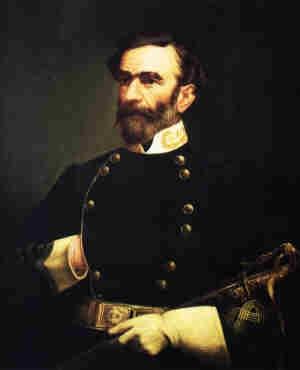


Braxton Bragg was a native of North Carolina, graduated from West Point in 1837 and fought later in the Seminole War. During the Mexican War he gained great fame and revolutionized battle tactics through the rapid, effective use of his "flying artillery". During his U.S. Army career Bragg gained a reputation for being a stickler for rules and regulations that it was famously said that he fought with him while serving as a post commander and quartermaster -requesting supplies for himself, then denying his own request, then protesting the denial and finally overruling himself. Needless to say, he was a "by the book" soldier to the extreme. He was living as a planter in Louisiana when the war broke out and held successive commands in Louisiana and Florida before being made chief of staff of the Army of the Mississippi by General Albert Sidney Johnston. He commanded a corps at the battle of Shiloh and was afterward promoted to full general by his friend President Jefferson Davis.
After the loss of Corinth, Bragg replaced General Beauregard and renamed his command the Army of Tennessee. His first order of business was to whip the army into shape -and he meant that to be taken literally. Discipline was harsh and rigidly enforced with all of the methods typical of the day: flogging, branding and death by firing squad. The men complained mightily but had to admit that General Bragg had made an effective and well disciplined army out of the mob of civilian soldiers he started out with. Bragg also had big plans and was a very aggressive general. Spurning defensive tactics (which he lacked the patience for) Bragg took his army north to retake Tennessee and liberate Kentucky where Confederate sympathizers promised many new recruits to swell his ranks.
In 1862 Bragg launched his campaign and executed one of the most brilliant strategic movements of troops yet seen in the war. He totally surprised his primary enemy, Union General Don Carlos Buell, who was also General Bragg's brother-in-law. Working in conjunction with Lt. General Edmund Kirby-Smith Bragg invaded Kentucky, capturing Munfordsville and 4,000 prisoners. He oversaw the inauguration of Kentucky's Confederate Governor, but the hoped for recruits did not materialize. At the battle of Perryville on October 8, 1862 he defeated Buell in a hard fought battle but withdrew south and abandoned Kentucky. In a follow-up campaign in Tennessee he fought Union General Rosecrans to a stalemate at Stones River at the end of the year, but retreated the following day. Bragg's officers were furious with him and becoming quite insubordinate. There were complaints to the President but Davis could not bring himself to dismiss his friend and tried to pass the buck to General Johnston, the department commander. However, Johnston refused to do Davis' work for him, he found an army that was disciplined, in good shape and saw no signs of any gross incompetence on Bragg's part. Trouble with subordinates was nothing new for Bragg. In the course of his career as a Confederate general his subordinates Longstreet, Hill, Polk, Smith and others urged his removal, General Forrest cursed him to his face and General Breckinridge considered challenging him to a dual.
Nevertheless, Bragg remained in command and through the maneuverings of Rosecrans was forced out of Tennessee and into Georgia. At that point, Bragg turned to attack and aided considerably by the arrival of Longstreet's corps from Virginia, administered a crushing defeat on the Union army at the battle of Chickamauga on September 19 & 20 of 1863. However, Bragg failed to press his advantage and when his siege of Chattanooga ended in failure, President Davis had no choice but to replace Bragg or face a mutiny. He made Bragg his chief advisor and head of military operations in Richmond, putting General Johnston in command of the Army of Tennessee. Later, in 1865 Bragg was given a field command again. He was to scrape together what defenses he could in the area of North Carolina and aid Generals Johnston and Beauregard in hindering the advance of General Sherman. Regardless of any actions of Bragg it was a hopeless campaign and ended with Johnston's surrender at Durham, North Carolina.
Bragg accompanied Davis in his attempted escape from the Union forces and after the war accepted a succession of civilian jobs. He ran the waterworks in New Orleans, Louisiana; became chief engineer in Mobile, Alabama and later moved to Texas where he took a job as a railroad inspector. He died while walking with a friend in Galveston, Texas on September 27, 1876. Fort Bragg in North Carolina is named in his honor which is the home base of the elite Delta Force and the 82nd Airborne Division