|
| Main page |
| About me |
| Medical Health Tour |
| Travelling Tour |
| Photogallery |
|
Sign my GuestBook |
| View my GuestBook |
| E-mail: [email protected] |
| © Alexander Pliashkov, 2002 |
| Design © Vytautas Zilaitis, 2002 |
Travelling tour
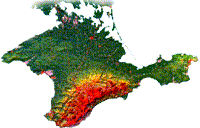
THE CRIMEA is a wonderful part of our land. This peninsula washed by the Black Sea and the Sea of Azov has a unique variety of natural conditions and landscapes: lifeless salines and boundless fertile steppes change to the south into green valleys and mountain chains, while along the southern coast, behind high mountains, stretches a narrow strip of land with a subtropical climate. These parts were populated from time immemorial. During half-forgotten millennium and centuries well known in history, numerous tribes and peoples lived on the Crimean land; here states emerged and died, settlements and cities appeared and disappeared. Here main civilizations of antiquity (Ancient Greek and Roman, Persian, and Judaist) and of the Middle Ages (Byzantine, Moslem, Italian, Old Rus and Armenian) met and came into contact with traditions of indigenous peoples. The Crimea happened to be a unique historical-cultural preserve.
A few kilometers away, beyond the mountain passes, a snow-storm may rage, while on the South Coast loquat and honeysuckle are in bloom. Naturally, frosts do occur, sometimes snow falls, but on the whole, the winter here is more like the autumn in the Central Belt of Russia. This phenomenon is accounted for both by the mountains and the warm sea. The Crimean Mountains are not high (the highest point being 1545 m) but they stand in the way of the north winds to uncommonly good advantage, reliably sheltering the coast.
The sea somewhat abates the heat in summer and delivers the accumulated warmth in winter, mitigating the temperature fluctuations. The mean annual temperature of the air in Yalta is +13 degrees C, average monthly being +3 degrees in February and +23.7 degrees in July.
It is an essential fact that despite the vicinity of the sea the place is noted for the low humidity of the air.
The South Coast is generally known as a strip of land stretching from Cape Aya (the highest on the Black Sea) to the Kara-Dag mountain massif, a volcano extinct long ago. However this book deals with a somewhat smaller, traditional health resort area. It extends from the settlement of Foros near the extreme southern point of the peninsula to Sudak at roughly the same latitude as that of Genoa in Italy.
This mention of the Mediterranean town is not casual. The nature of the South Coast has long since been evoking the comparison with the Mediterranean, French and Italian Riviera. This corner as contrasted to the proportions of our-country is rather small, but albeit there is much in common peculiar to it solely, its separate parts differ from each other a great deal. Both the microclimate and the results of human activity are responsible for this.
As far back as the first Russian explorers of the Crimea made their observations, the particular traits of the seaside valleys' microclimate were noticed and in the last century the outstanding figures in medical science — Professor Sergey Botkin and Doctor Vladimir Dmitriyev generalized the observations and put forward the fruitful ideas of using this land for treatment.
The climatotherapy is the fundamental instrument' of the local doctors. Combining it with other means they succeed very much in treating pulmonary, cardio-vascular, urological diseases, nervous disorders as well. Located in Yalta is the Ivan Sechenov Scientific Research Institute handling the problems of resort resources, physical methods of treatment and medical climatology.
The green wealth of Yalta is really large. The mountains are covered by the magnificent pine and beech woods, the parks skirt the seashore. There are lots of endemic plants, nonetheless the work for further enriching the Crimean flora has long been and is being carried out. The leading part in this field is played by the State Nikitsky Botanical Garden, situated in the vicinity of Yalta. Over 28 thousand species, hybrids, varieties have been collected here. Much is being done for growing new highly productive fruit, essential oil-bearing and decorative plants.
The Nikitsky Botanical Garden was laid out in 1812 on an area covered by the remains of forest shrubbery and pastures. A considerable part of the local flora has been preserved and this principle of combining the Crimean plants with the exotic ones has produced a wonderful effect. At present the work of reviving and growing forests, laying out and expanding parks is in full swing particularly in theeastern part of the Crimea.
This area, lying to the east of Alushta has a peculiar landscape striking one now with the ochre sun-scorched hills, covered by stunted vegetation, now with the ruins of old-time towers, seashore steeps and romantic canyons. The landscape with all its diversity invariably bears the stamp of something inconceivably ancient. It is called "Cimmerian" as a tribute to the two masters — Konstantin Bogayevsky and Maximilian Voloshin. The former in painting and graphic arts, the latter in verse and water-colours glorified the south-eastern Crimea as the legendary land of Cimmeria.
Touching upon the subject one must keep in mind not only artistic but also historical aspects. The Cimmerians were the most ancient of the peoples inhabiting the peninsula that were mentioned in the written sources. Then Tauri lived here; Scythians, Hellenes, Sarmatians, Goths, Huns, Romans, Byzantines, Khazars, Tartars, Turks came and were gone in sequence. And each nation left a trace. This book likewise highlights the complicated history of the South Coast full of dramatic events.
Taurica — so the Crimea was called in the antiquity, had a rare fortune. The first mention of it dates back to the times of the antique myths, to the times of Homer, of the stories about the Trojan War. The authors of the periples — ancient books on navigation — referred to the South Coast. The scholars, for instance, argue to this day about the location of Krioumetopon — Cape "Ram's Forhead" mentioned for the first time in the sailing directions as far back as the 4th c. B. C. Some identify it as Ayu-Dag — Bear Mountain, others — as the present-day Cape Ai-Todor where one of the sights of the coast — the Gothic castle (now a cafe) "Swallow's Nest" is situated...
The guidebook tells about the monuments of the past, important events, outstanding personalities whose life and activity turned out to be associated with the Crimea. Many people of such character, the pride of the Motherland, were here. It is hard to mention them all, to call just a few names would be sufficient.
In the battle by Alushta in the summer of 1774, lieutenant-colonel Mikhail Kutuzov, the future great Russian field-marshal was wounded.
Young Alexander Pushkin spent in 1820 three weeks in Gurzuf, then he rode a small horse through all the western part of the Crimea's South Coast and crossed the famous mountain pass the so-called Devil's Stairs. Subsequently he often recalled that time and called it the happiest in his life.
Lev Tolstoy visited the South Coast and in 1901-1902 he lived and worked here, in Gaspra.
Anton Chekhov and Maxim Gorky, Fyodor Chaliapin and Konstantin Stanislavsky, Fyodor Vasiliev and Konstantin Korovin, Lesia Ukrainka and Mikhail Kotsiubinsky, Ivan Bunin and Vladimir Mayakovsky and many other celebrated names could have been listed.
As a result of the Russo-Turkish Wars, in 1783, the Crimea was joined to Russia. This greatly promoted the development of the peninsula and determined the destiny of the peoples inhabiting it. Before long the best South Coast lands came into the hands of the Russian aristocracy. Estates were springing up, palaces were being built, roads laid out. In the second half of the 19th c. Livadia (on the South Coast near Yalta) became the czar's summer residence. That gave rise to a new boom in construction. A fashionable bourgeoisies landlord resort, a "reserve for the rich" arose. Among the buildings of that period are remarkable edifices — Alupka and Livadia palaces, housing museums nowadays.
In the years of the October Revolution and the Civil War the Crimea underwent severe trials.
And once again the Crimea became the extreme southern flank of a huge front, a scene of great battles and severe trials for Soviet people. When speaking of fighting Hitlerites in the Crimea, first of all the hero-cities of Sevastopol and Kerch are recalled. The Defence of Sevastopol that lasted many months, the unparalleled fortitude of Kerch have entered the history. And the South Coast from November 1941, when the invaders came here to April 1944, when they were driven away also was a frontline, a battlefield, a place of the struggle against the hateful aggressors. Here operated the reconnaissance groups of the Black Sea sailors, tactical landings were made, despite the terror unleashed by the Nazi secret resistance organizations and partisan detachments were actively fighting the enemy.
In the spring of 1944 the troops of the 4th Ukrainian Front, the Detached Maritime Army and the Black Sea Fleet brought liberation to the Crimea.
In February, 1945, the Conference of the Heads of the Governments of Great Britain, the USA and the USSR that determined to a great extent the future of the postwar world, was held in Yalta. Likewise the Crimea has been the place of important summit meetings many times ever since.
What is the South Coast like at present?
Its central part lying between Simeiz and Alushta is a highly developed district with numerous sanatoria, holiday homes, pensions, tourist and children's camps. Some of these establishments — the Artek All-Union Young Pioneer Camp for example — are indeed unique.
If formerly the look of the coast was accounted for by the old palaces and villas, now it is characterized by the high-rise buildings, numerous shore-protecting structures, cable-ways, lifts linking sanatoria with beaches. By the way, many beaches put into operation lately are man-made. The district has a well-developed network of roads and when the navigation is at its height frequent boat services are provided and hydrofoil pleasure trips offered.
Yalta, the "capital" of the South Coast is a comparatively small, but wisely laid out town with all amenities. It spreads over the valleys of the two mountain rivers and adjacent slopes. Here are the bus station, interurban trolley-bus station, seaport. The nearest airport and railway station are in Simferopol 80 km away.
At the eastern outskirts of Yalta, amid a gorgeous park overlooking the sea, a complex for the accommodation of foreign tourists has been erected, which includes the high-rise "Yalta" Hotel, a beach, a swimming pool, a concert hall and the restaurant of 7 halls along with bars and cafes. Apart from it Intourist runs in Yalta "Oreanda" Hotel (restaurant and bar) in the center of the town on the Embankment and the "Fairy-tale Glade" Camping Site in the scenic frame of the pine-clad mountains.
The second important town — Alushta — has been known since the 6th c. A. D., the times of the Byzantine Emperor Justinian I. The Alushta resort zone has lately been developing at a rapid rate.
Considerable construction is going on in the extreme western (Foros) and eastern districts of the South Coast resort area. However there are quite a few places at the seaside whose development is as yet at its outset. One of the reasons keeping back the construction is the shortage of fresh water. In Yalta the problem has been settled on the whole — storage lakes have been created on the northern slopes of the mountains. A tunnel 7 km long connects them with the town. Other reservoirs are either in project or under construction. Bringing water of the Dnieper to the South Coast is also contemplated.
The South Coast is mainly known as a health resort. But at the same time it is an important agricultural area where grapes, fruits, tobacco, essential oil-bearing plants are grown. And they yield top-quality crops. The South Coast wines have won a high praise. This credit is largely due to natural conditions which enable raising particularly valuable varieties of grapes with a high percentage of sugar. The traditions and experience are of no less importance. In 1978, (New World) Winery producing champagne well-known in the West celebrated its 100th anniversary. The same year the 150th anniversary of the Magaratch Scientific Research Institute of Vineculture and Wine-Making at Yalta was marked an our main wine-making firm “Massandra” has a great and glorious history as well.
The South Coast vine-growers and wine-makers readily and use the latest achievements of science. The result is evident – a series of high awards of International fairs. The ”WHITE MUSCAT OF RED STONE”, "RED PORT”, “TOKAYS”, “PINOT-GRIS”, “BASTARDO” and some other wines, it may be safely said, have no equals.
Such is this land — the South Coast. Ancient and at the same time young. Rich in traditions and yet not lagging behind the spirit of our days.
You may visit it time and time again and never lose interest.
You are welcome!