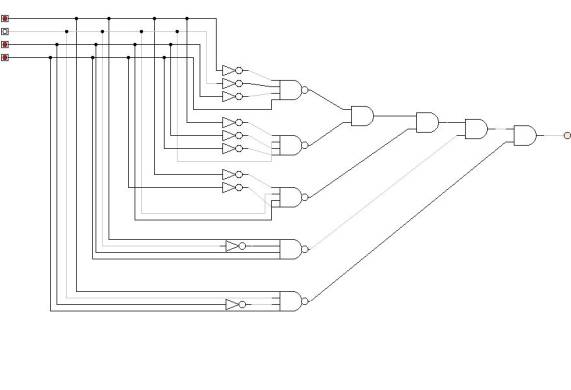


What are the required components?
If we take each number
individually, we can see that for example, the decimal number 4
|
A |
B |
C |
D |
|
0 |
1 |
0 |
0 |
needs to produce the output
|
a |
b |
c |
d |
e |
f |
g |
|||||||
|
0 |
1 |
1 |
0 |
0 |
1 |
1 |
|
|||||||
A possible solution with NAND
gates is
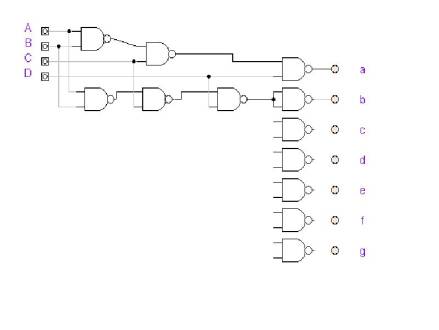
Check the truth table
When ABCD is 0100 a is zero and b
is 1.
However, we need to check for all
inputs.
For the hex number A, ABCD is 1010
and the truth table for the circuit gives a as 1 and b as zero.
This is not the required output as
both a and b need to be 1.
Evaluate the circuit design
Our original attempt was to take each number individually and use gates to produce the output.
We need to go back and look at the
bigger picture or perhaps research other circuits
|
• recognise
the cyclical approach to circuit design |
|
Segment a is at logic 1 for the hex numbers 0,2,3,5,7,8,9,A,C,E & F and zero for 1,4,6,b & d.
So if our inputs are any one of these then a should result in a zero
|
0 |
0 |
0 |
1 |
|
0 |
1 |
0 |
0 |
|
0 |
1 |
1 |
0 |
|
1 |
0 |
1 |
1 |
|
1 |
1 |
0 |
1 |
This circuit only looks at the a segment