 |
 |
 |
|
| Comments by readers... |
|
| HEALTH TRACKS ON MIAMI.COM Our new Health channel has information, links to the top health sites, interactive features and more WASHINGTON -- The nearly 100 million Americans who turn to the Internet for medical advice should get a second opinion. While generally accurate, online health information is often incomplete, confusing or contradictory, according to a study reported Tuesday and published in this week's Journal of the American Medical Association. The problem is worse on Spanish-language websites, experts concluded. |
| This information is reprinted in part. For the full story, contact www.herald.com and look up the archives for 23 May 2001. The article is reprinted her in an excerpted form to assist you, the reader, in understanding the comments and to facilitate you in commenting on the issue. |
BEST INTERNET HEALTH SITES A recent RAND Corp. study appraised Internet health sites on the basis of their information about four health problems: breast cancer, childhood asthma, depression and obesity. The two sites that were clearly best were Oncolink.com for cancer and a depression site at www.Nimh.nih.gov. English-language sites were markedly superior to Spanish-language sites, without exception. Among the strongest were these English-language sites for: Breast cancer: Oncolink.com, Cancernet.gov, Webmd.com, Cancer.org Childhood asthma: www.NHLBI.nih.gov, www.Myasthma.com, DrKoop.com, Onhealth.com Depression: www.NIMH.nih.gov, Intelihealth.com, Webmd.com, CBSHealthWatch.com Obesity: CBSHealthWatch.com, Intelihealth.com, www.NLM.nih.gov, Webmd.com Some leading Spanish-language sites were: Breast cancer: Cancernet.gov, Salud.com Childhood asthma: www.NHLBI.nih.gov, Salud.com Depression: Salud.com, Graciasdr.com Obesity: Salud.com, Saludlatina.com SOURCE: RAND Corp., Herald Washington Bureau |
| Center Comments The Future of Health appears to require professionals to make room for the "self-educated non-professional". There are numerous examples that can be given where an expert knows less than a non-professional who has studied a lot of the literature. EXAMPLE Marvin Belli, who studied a lot about a vaccine related to polio, was challenged by a doctor in a seminar. "How can a lawyer know more than a doctor about this disease?" "Well, sir," Belli replied, "Have you read the recent Lancet article?" The problem is that most doctors and lawyers don't have tiem to read everything in their profession, so it's often possible for one of their highly motivated clients to know more than they do about a particular issue. |
|
| Extract from an editorial by David Broder "Reason to Hope on Health Care" Click here to see the full version of the article ..[T]he head of nursing at one of the participating hospitals said, "Nurses now serve the hospital, not their patients," distracted by other duties from being the front-line caregivers. Another example: Medical records now are kept in the offices of doctors and hospitals, often unavailable to others. The consortium is working with electronics firms to develop a "smart card" with an individual's entire medical history and background on it, including not only allergies but whether he or she uses a seat belt and has a smoke alarm. Each person would decide what information to share, but an attending physician could be alerted not to order tests already performed elsewhere and not to give a drug that wars with one already being taken. Click here for the full article |
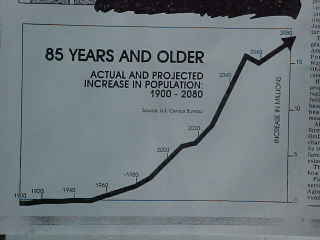 |
| The number of people 85 years or older are increasing... The graph shows the INCREASE in population of people over 85 years old. Critique of the graph: Imagine that there were 10 schools in 1990. If I tell you that there are 20 schools in 2000,, it's an increase of 10 schools in 10 years. Situation A: Imagine that there were 10,000 students in 1990 and 15,000 students in 2000. Students per school Year 1000 in 1990 750 in 2000 In other words, so what if there's an increase in the number of schools? The entire population has to be examined. CONSIDER a different Situation: Situation B: Imagine that there were 10,000 students in 1990 and 30,000 students in 2000. Students per school Year 1000 in 1990 1500 in 2000 |
| 15 million |
| 10 million |
| 5 million |
| 0 |
| Year US population Number of people Ratio of people over 85 85 years and over |
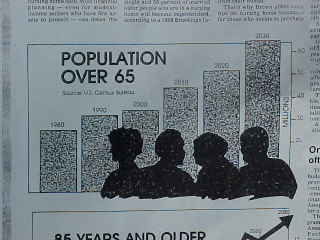
| See photos below of graphs for the discussion on June 28 about HEALTH |
 |
| Population Figures http://www.people.fas.harvard.edu/~jtownsen/zpg-boston/zappers.html |