




There are several methods for building a fire, each of which has its advantages and disadvantages.
The situation you are in will determine which fire to use.
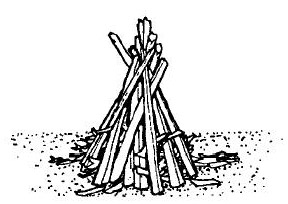
To make this fire (Figure 1), arrange the tinder and a few sticks of
kindling in the shape of a tepee or cone. Light the center. As the tepee
burns, the outside logs will fall inward, feeding the fire. This type of fire
burns well even with wet wood.
Tepee

To lay this fire (Figure 7-5), push a green stick into the ground at a
30-degree angle. Point the end of the stick in the direction of the wind.
Place some tinder deep under this lean-to stick. Lean pieces of kindling
against the lean-to stick. Light the tinder. As the kindling catches fire
from the tinder, add more kindling.
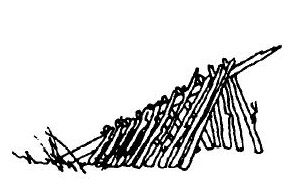
Lean-to
Cross-Ditch
To use this method (Figure 7-5), scratch a cross about 30 centimeters in
size in the ground. Dig the cross 7.5 centimeters deep. Put a large wad
of tinder in the middle of the cross. Build a kindling pyramid above the
tinder. The shallow ditch allows air to sweep under the tinder to provide
a draft.
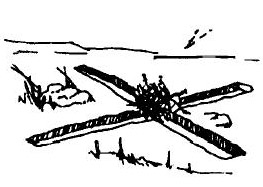
Cross-ditch
Pyramid
To lay this fire (Figure 7-5), place two small logs or branches parallel on
the ground. Place a solid layer of small logs across the parallel logs. Add
three or four more layers of logs or branches, each layer smaller than
and at a right angle to the layer below it. Make a starter fire on top of
the pyramid. As the starter fire burns, it will ignite the logs below it.
This gives you a fire that burns downward, requiring no attention during
the night.
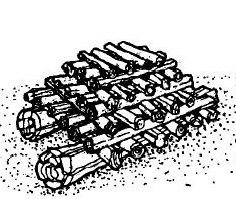
Pyramid