Unchaining a ischaemic episode by posture in extension-medial rotation
with splints
Producing micro traumatic stress on the hip with a vibrating tool over the bend knee and hip.
Nuno Craveiro Lopes M.D.
Head
of Orthopedic and Traumatologic Department
Garcia de Orta Hospital, Almada - Portugal
Any comment, suggestion or contact can be done to: [email protected]
PAPER PRESENTATION
Legg-Calvé-Perthes disease after repeated extension-internal rotation posture of the hip, followed by micro trauma. An experimental study in the growing rabbit. (1993)
Various authors have experimentally induced lesions similar to Legg-Calvé-Perthes disease (LCPD) in puppies and growing rabbits, using the repeated interruption of intra capsular circulation by surgical techniques. This confirms the idea that repeated ischaemic episodes are of fundamental significance in the origin of the disease.
We studied the effect of prolonged posturing in extension and medial rotation, every other day, followed by micro traumatic stress over the hip, with no surgery.
|
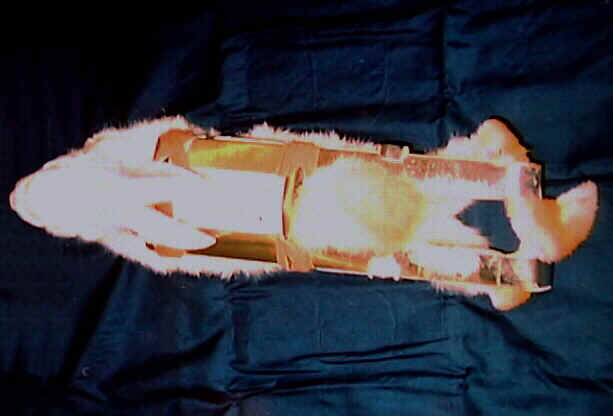
Unchaining a ischaemic episode by posture in extension-medial rotation with splints |
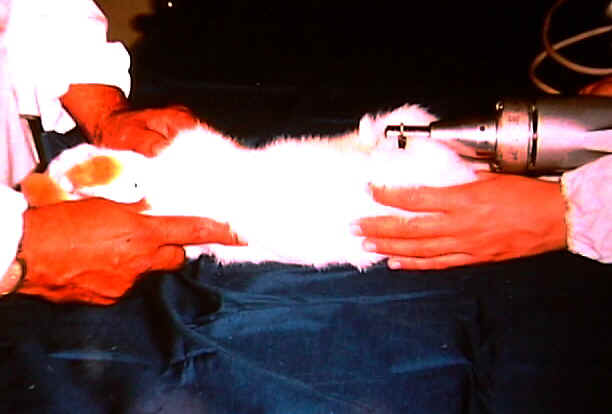
Producing micro traumatic stress on the hip with a vibrating tool over the bend knee and hip. |
The
positioning in prolonged and repeated internal rotation and extension, induced a
sufficient increase of joint pressure to provoke a ischemic episode and a
epiphyseal necrosis of the femoral head.
After
this necrosis, a process of rapid reconstruction was observed, with
revascularization and primary rehabilitation of the necrotic structures, without
loss of mechanical resistance and distortion of the structure of the epiphysis.
The
repetition of the ischemic episodes, establishes a unique pathologic entity with
particular characteristics, that behaves as an intermittent ischemic disease, we
named "Ischemic Disease of the Growing Hip" (IDGH). The repetition of
those ischemic episodes leads to a distortion of the osteogenic replay, with
weakness of the mechanical structure of the epiphysis.
Under
these conditions, the existence of microtraumatic
aggression over the hip, led to the collapse of the epiphysis, with compaction of
the trabecular structure and the destruction of the primitive vascular network
and formation of a true bone sequestrum, which constitute the beginning of
Legg-Calvé-Perthes Disease.
On this stage, the epiphyseal reconstruction, include a slow substitution of the bone sequestrum by mesenquimatous tissue with profusion of fibroblasts from the surrounding viable myeloid tissue and cartilaginous tissue from the deep layer of the articular cartilage, thus initiating the fragmentation stage of LCPD.
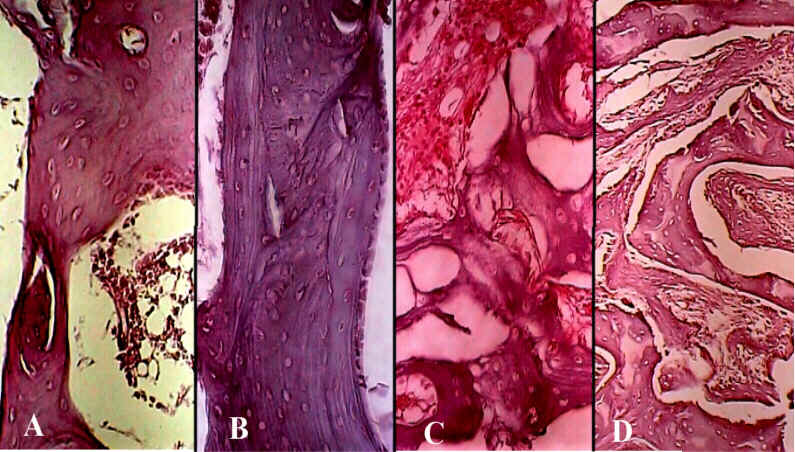
With this experimental model it was possible to induce macroscopic and microscopic lesions comparable to LCPD in 75% of the hips after the 2nd week. In the hip subjected to posture alone, we could find only microscopic evidence of simple necrosis and repair, without macroscopic deformity, in 25% of the cases.
|
A) Normal bone. B) Simple necrosis and repair. C) Necrosis over necrosis and owen bone D) Perthes disease |
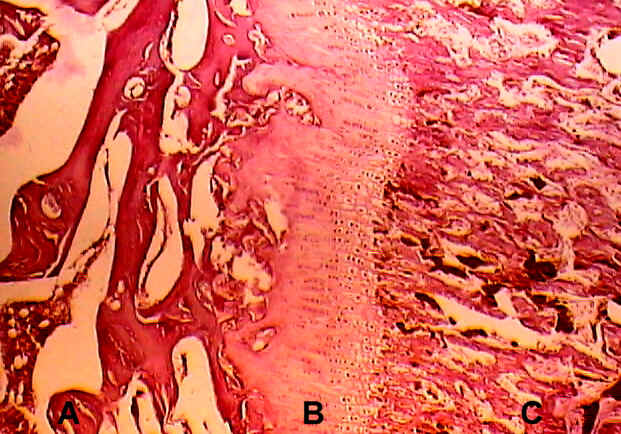
A) Metaphyseal normal bone. B) Distortion of the growth plate. C) Epiphyseal necrotic bone. |
|
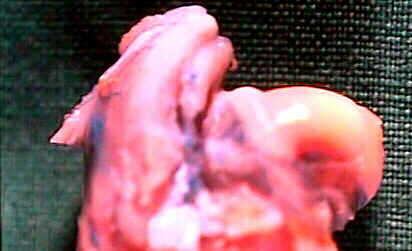
Lateral head collapse after onset of Perthes like disease. Macroscopic specimen |
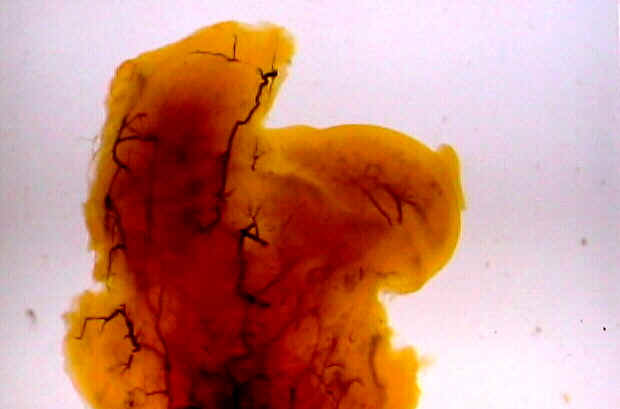
Lateral head collapse after onset of Perthes like disease. Diaphanized specimen.
|
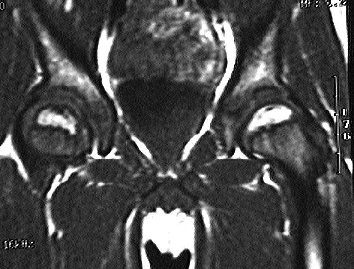
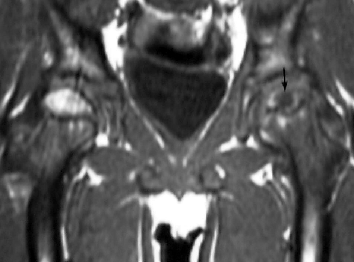
CLINICAL RELEVANCE: Repeated posture in extension and medial rotation, is a common posture in a child with femoral anteversion, that sleeps in ventral decubitus. This may result in high intra capsular pressure and intermittent ischemia with fractional sequential simple necrotic episodes of the femoral head. This may explain the cases of "cold spot" detected by nuclide or magnetic resonance bone scans, that do not progress to LCPD, and some authors have called " ghost Perthes". We have found that this situation correspond to a true new etiopathogenic entity, we called "Ischemic Disease of the Growing Hip" (IDGH).
In a certain sequence of events, if a new ischemic episode occurs during the remodeling process of a previous ischemic episode, the femoral head gets mechanically weakened and if on those circumstances, it is subjected to traumatic stress, a pathologic fracture may develop, with the onset of Legg-Calvé-Perthes disease.
|
Typical pattern of bilateral IDGH on T1 weighted MRI bone scan. |
Typical pattern of LCPD at right, on T1 weighted MRI bone scan. |
Data from this experimental researsh permitted us to develop a screening protocol to detect IDGH and introduce measures to prevent the onset of Legg-Calvé-Perthes disease.
The protocol can be seen at http://www.geocities.com/craveiro01/pagedlcp/index.html
The experimental model which permitted the development of the preventive procedure can be seen at http://clientes.netvisao.pt/nfrancac/lcpd02.htm