|
Testicular cancer is the
most common malignancy in young men between the ages of 20
and 34. There are about 7500 new cases yearly, with approximately
350 deaths per year in the US.
Testicular cancer is more common
in white men than black or Asian.
Although it accounts for only
about 1 percent of all cancers in men, it is the number one
cancer killer among men in their 20's and 30's.
Most testicular cancers are
self-discovered by patients as a painless or uncomfortable
lump in the testicle. About 1- 3% of testicular neoplasms
are bilateral.
Pure seminomas constitute roughly
40% of all testicular cancer cases. Forty percent of the testicular
cancers have mixture of histology.
The cancer risk for boys with
a history of undescended testicles is about 10-40 times higher
than normal individuals. The risk of developing the disease
was estimated at 1 out of 20 for a testis retained in the
abdomen and 1 out of 80 if it was within the inguinal canal.
The risk remains elevated after surgical correction. Both
testis are at higher risk, not just the undescended one.
If found early, testicular
cancer is almost always curable.
Early stage testicular cancer
can be treated with surgery and radiation therapy. Late stage
testicular cancer can be treated with the combination of surgery,
radiation therapy and/or chemotherapy.
The prognosis for men with
testicular cancer is very good, even with late stage disease.
The chances of recovery are excellent with surgery and radiotherapy
for early stage disease. Combined modality is used for treatment
of late stage disease with good results.
More than 90% of testicular
cancer patients are cured by their initial treatment, and
many of those who have recurrent disease can also be cured
with chemotherapy or radiation.
TESTICULAR
CANCER FACTS SELF EXAMINATIONS
 "Diagnosis
of testicular cancer usually starts with self-discovery,"
says S. Bruce Malkowicz, co-director of urologic oncology
at the University of Pennsylvania Medical Center. He advises
men of all ages to do TSEs, not just those in the prime
risk group of ages 15 to 34. TSE is best performed after
a warm bath or shower. Heat relaxes the scrotum, making
it easier to spot anything abnormal. The National Cancer
Institute recommends following these steps every month: "Diagnosis
of testicular cancer usually starts with self-discovery,"
says S. Bruce Malkowicz, co-director of urologic oncology
at the University of Pennsylvania Medical Center. He advises
men of all ages to do TSEs, not just those in the prime
risk group of ages 15 to 34. TSE is best performed after
a warm bath or shower. Heat relaxes the scrotum, making
it easier to spot anything abnormal. The National Cancer
Institute recommends following these steps every month:
Stand in front of a mirror.
Check for any swelling on the scrotum skin.
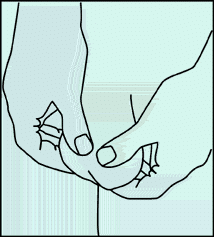
Examine each testicle with
both hands. Place the index and middle fingers under the testicle
with the thumbs placed on top. Roll the testicle gently between
the thumbs and fingers. Don't be alarmed if one testicle seems
slightly larger than the other. That's normal.
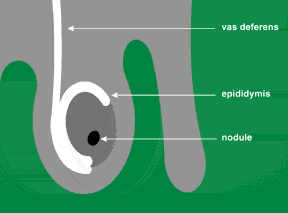
 Find
the epididymis, the soft, tubelike structure behind the testicle
that collects and carries sperm. If you are familiar with
this structure, you won't mistake it for a suspicious lump.
Cancerous lumps usually are found on the sides of the testicle
but can also show up on the front. Find
the epididymis, the soft, tubelike structure behind the testicle
that collects and carries sperm. If you are familiar with
this structure, you won't mistake it for a suspicious lump.
Cancerous lumps usually are found on the sides of the testicle
but can also show up on the front.
If you find a lump, see a doctor
right away. The abnormality may not be cancer, but if it is,
the chances are great it can spread if not stopped by treatment.
Only a physician can make a positive diagnosis. [1]
|