| ACTC3 Christian Belief | ||
 |
||
| Seminar 2 | Jesus Christ | |
| ACTC3 Christian Belief | ||
|
|
||
| Seminar 2 | Jesus Christ | |
| Old Testament Names | |
| The Seed of the Woman | Genesis 3:15 |
| The Angel of Jehovah | Genesis 22:15 |
| Siloh (Peacemaker) | Genesis 49:10 |
| The Stone of Israel | Genesis 49:24 |
| Manna | Exodus 16:31 |
| The Meat (Meal) Offering | Leviticus 2:1-10 |
| The Peace Offering | Leviticus 3:1-5 |
| A Star | Numbers 24:17 |
| A Sceptre | Numbers 24:17 |
| The Captain of the Host of the Lord | Joshua 5:14 |
| The Rock of my Salvation | 2 Samuel 22:47 |
| My Glory | Psalm 3:3 |
| The Lifter Up of Mine Head | Psalm 3:3 |
| Fortress | Psalm 18:2 |
| A Worm and No Man | Psalm 22:6 |
| My Shepherd | Psalm 23:1 |
| Restorer | Psalm 23:3 |
| The Strong and Mighty Jehovah | Psalms 24:8 Rv. |
| Jehovah, Mighty in Battle | Psalms 24:8 Rv. |
| King of Glory | Psalm 24:10 |
| My Strong Rock | Psalm 31:2 |
| My Rock and My Fortress | Psalm 31:3 |
| The Rock that is Higher Than I | Psalm 61:2 |
| A Strong Tower | Psalm 61:3 |
| A Stranger and an Alien | Psalm 69:8 |
| The King's Son | Psalm 72:1 |
| Rain Upon Mown Grass | Psalm 72:6 |
| Showers Upon the Earth | Psalm 72:6 |
| My First-Born | Psalm 89:27 |
| The Head Stone of the Corner | Psalm 118:22 |
| My High Tower | Psalm 144:2 |
| Wisdom | Proverbs 8:12 |
| Excellent | Psalm 148:13 |
| Understanding | Proverbs 81:4 |
| A Friend that Sticketh Closer than a Brother | Proverbs 18:24 |
| Ointment Poured Forth | Song of Solomon 1:3 |
| Bundle of Myrrh | Song of Solomon 1:13 |
| Cluster of Camphire | Song of Solomon 1:14 |
| A Rose of Sharon | Song of Solomon 2:1 |
| The Lily of the Valleys | Song of Solomon 2:1 |
| Him Whom my Soul Loveth | Song of Solomon 3:2 |
| The Chiefest Among Ten Thousand | Song of Solomon 5:10 |
| Altogether Lovely | Song of Solomon 5:16 |
| The Branch of the Lord | Isaiah 4:2 |
| Jehovah of Hosts | Isaiah 6:3 |
| The Child | Isaiah 7:16 |
| A Sanctuary | Isaiah 8:14 |
| A Great Light | Isaiah 9:2 |
| Wonderful | Isaiah 9:6 |
| Counsellor | Isaiah 9:6 |
| The Mighty God | Isaiah 9:6 |
| The Everlasting Father | Isaiah 9:6 |
| The Prince of Peace | Isaiah 9:6 |
| The Light of Israel | Isaiah 10:17 |
| A Rod Our of the Stem of Jesse | Isaiah 11:1 |
| A Branch Our of His Roots | Isaiah 11:1 |
| The Root of Jesse | Isaiah 11:10 |
| The Ensign of the People | Isaiah 11:10 |
| My Strength and My Song | Isaiah 12:2 |
| A Nail Fastened in a Sure Place | Isaiah 22:23 |
| A Glorious Throne to His Father's House | Isaiah 22:23 |
| Strength to the Poor and Needy | Isaiah 25:4 |
| A Shadow From the Heat | Isaiah 25:4 |
| A Refuge From the Storm | Isaiah 25:4 |
| The Rock of Ages | Isaiah 26:4 |
| A Crown of Glory | Isaiah 28:5 |
| A Diadem of Beauty | Isaiah 28:5 |
| The Foundation | Isaiah 28:16 |
| A Sure Foundation | Isaiah 28:16 |
| A Tried Stone | Isaiah 28:16 |
| A Covert From the Tempest | Isaiah 32:2 |
| As a Hiding Place From the Wind | Isaiah 32:2 |
| Shadow of a Great Rock in a weary Land | Isaiah 32:2 |
| As Rivers of Water in a dry Place | Isaiah 32:2 |
| The King in His Beauty | Isaiah 33:17 |
| Our Lawgiver | Isaiah 33:22 |
| Jehovah | Isaiah 40:3 Rv. |
| The Lord Jehovah | Isaiah 40:10 Rv. |
| The Everlasting God | Isaiah 40:28 |
| A Light of the Gentiles | Isaiah 42:6 |
| Mine Elect | Isaiah 42:1 |
| The Polished Shaft | Isaiah 49:2 |
| The Holy One of Israel | Isaiah 49:7 |
| A Root Out of a Dry Ground | Isaiah 53:2 |
| A Man of Sorrows | Isaiah 53:3 |
| My Righteous Servant | Isaiah 53:11 |
| My Maker | Isaiah 54:5 |
| The God of the Whole Earth | Isaiah 54:5 |
| A Witness to the People | Isaiah 55:4 |
| A Leader | Isaiah 55:4 |
| A Commander | Isaiah 55:4 |
| The Redeemer | Isaiah 59:20 |
| Thine Everlasting Light | Isaiah 60:20 |
| The Angel of His Presence | Isaiah 63:9 |
| Our Potter | Isaiah 64:8 |
| Balm of Gilead | Jeremiah 8:22 |
| My Physician | Jeremiah 8:22 |
| My Portion | Jeremiah 10:16 |
| The Hope of Israel | Jeremiah 14:8 |
| A Righteous Branch | Jeremiah 23:5 |
| David, Their King | Jeremiah 30:9 |
| Resting Place | Jeremiah 50:6 |
| The Shepherd of Israel | Email 34:23 |
| Feeder | Email 34:23 |
| A Plant of Renown | Email 34:29 |
| A Stone Cut Without Hands | Daniel 2:34, 35 |
| Ancient of Days | Daniel 7:13, 14 |
| The Prince of Princes | Daniel 8:25 |
| The Hope of His People | Joel 3:16 |
| A Ruler | Micah 5:2 |
| Strong-Hold | Nahum 1:7 |
| Wall of Fire | Zechariah 2:5 |
| My Servant, the Branch | Zechariah 3:8 |
| King Over All the Earth | Zechariah 14:4-9 |
| The Branch | Zechariah 6:12 |
| Jehovah My God | Zechariah 14:14 Rv. |
| The King | Zechariah 14:16 |
| The Messenger of the Covenant | Malachi 3:1 |
| Refiner | Malachi 3:3 |
| Purifier | Malachi 3:3 |
| The Sun of Righteousness | Malachi 4:2 |
| New Testament Names | |
| Jesus Christ | Matthew 1:1 |
| The Son of David | Matthew 1:1 |
| Son of Abraham | Matthew 1:1 |
| Jesus | Matthew 1:21 |
| Emmanuel | Matthew 1:23 |
| A Governor | Matthew 2:6 |
| The Young Child | Matthew 2:9 |
| A Nazarene | Matthew 2:23 |
| Friend of Sinners | Matthew 11:19 |
| The Servant of Jehovah | Matthew 12:18 |
| My Beloved | Matthew 12:18 |
| A Sower | Matthew 13:37 |
| The Christ | Matthew 16:16 |
| Jesus the Christ | Matthew 16:20 |
| My Beloved Son | Matthew 17:5 |
| The Prophet of Nazareth | Matthew 21:11 |
| Master | Matthew 23:8 |
| The Bridegroom | Matthew 25:10 |
| The Holy one of God | Mark 1:24 |
| Our Brother | Mark 3:35 |
| Thou Son of the Most High God | Mark 5:7 |
| The Carpenter | Mark 6:3 |
| The Son of Mary | Mark 6:3 |
| Good Master | Mark 10:17 |
| Son of Man | Mark 10:33 |
| A Ransom | Mark 10:45 |
| One Son, His Well Beloved | Mark 12:6 |
| Christ, the Son of the Blessed | Mark 14:61 |
| The King of the Jews | Mark 15:2 |
| The Son of the Highest | Luke 1:32 |
| God my Saviour | Luke 1:47 |
| Horn of Salvation | Luke 1:69 |
| The Highest | Luke 1:76 |
| The Dayspring from on High | Luke 1:78 |
| Christ, the Lord | Luke 2:11 |
| The Babe | Luke 2:12 |
| The Consolation of Israel | Luke 2:25 |
| The Lord's Christ | Luke 2:26 |
| The Salvation of God | Luke 2:30 |
| A Light to Lighten the Gentiles | Luke 2:32 |
| The Glory of Thy People Israel | Luke 2:32 |
| A Sign | Luke 2:34 |
| The Child Jesus | Luke 2:43 |
| Physician | Luke 4:23 |
| Lord of the Sabbath | Luke 6:5 |
| A Great Prophet | Luke 7:16 |
| The Christ of God | Luke 9:20 |
| A Certain Samaritan | Luke 10:30 |
| The Master of the House | Luke 13:25 |
| A Guest | Luke 19:7 |
| A Certain Nobleman | Luke 19:12 |
| The Chosen of God | Luke 23:35 |
| A Prophet Mighty in Deed and Word | Luke 24:19 |
| The Word | John 1:1 |
| The Light of Men | John 1:4 |
| The True Light | John 1:9 |
| The Only Begotten of the Father | John 1:14 |
| The Lamb of God | John 1:29 |
| The Son of God | John 1:34 |
| Rabbi | John 1:49 |
| The King of Israel | John 1:49 |
| His Only Begotten Son | John 3:16 |
| The Gift of God | John 4:10 |
| Messiah | John 4:25 |
| The Christ, the Saviour of the World | John 4:42 |
| The True Bread from Heaven | John 6:32 |
| The Bread of God | John 6:33 |
| The Bread of Life | John 6:35 |
| The Living Bread | John 6:51 |
| The Light of the World | John 8:12 |
| I AM | John 8:58 |
| The Door of the Sheep | John 10:7 |
| The Good Shepherd | John 10:11 |
| One Shepherd | John 10:16 |
| The Resurrection | John 11:25 |
| The Christ, the Son of God | John 11:27 |
| A Grain of Wheat | John 12:23,24 |
| Master | John 13:13 |
| The Way | John 14:6 |
| The Truth | John 14:6 |
| The Life | John 14:6 |
| The Vine | John 15:5 |
| The Overcomer | John 16:33 |
| Our Keeper | John 17:12 |
| The Sent of the Father | John 17:18 |
| The Man | John 19:5 |
| My Lord and My God | John 20:28 |
| A Man Approved by God | Acts 2:22 |
| Thine Holy One | Acts 2:27 |
| The Holy One and Just | Acts 3:14 |
| The Prince of Life | Acts 3:15 |
| The Holy Child Jesus | Acts 4:27 |
| A Prince and a Saviour | Acts 5:30, 31 |
| The Just One | Acts 7:52 |
| Lord Jesus | Acts 7:59 |
| Lord of All | Acts 10:36 |
| The Judge of Quick and Dead | Acts 10:42 |
| That Man Whom He Hath Ordained | Acts 17:31 |
| Jesus of Nazareth | Acts 22:8 |
| Jesus Christ our Lord | Romans 5:21 |
| The First-Born Among Many Brethren | Romans 8:29 |
| His Own Son | Romans 8:32 |
| God Blessed Forever | Romans 9:5 |
| Lord Over All | Romans 10:12 |
| The Lord | Romans 10:13 |
| The Deliverer | Romans 11:26 |
| Lord Both of the Dead and the Living | Romans 14:9 |
| Minister of the Circumcision | Romans 15:8 |
| The Power of God | 1 Corinthians 1:24 |
| The Wisdom of God | 1 Corinthians 1:24 |
| Righteousness | 1 Corinthians 1:30 |
| Sanctification | 1 Corinthians 1:30 |
| Redemption | 1 Corinthians 1:30 |
| The Lord of Glory | 1 Corinthians 2:8 |
| The Foundation | 1 Corinthians 3:11 |
| Our Passover | 1 Corinthians 5:7 |
| That Spiritual Rock | 1 Corinthians 10:4 |
| The Head of Every Man | 1 Corinthians 11:3 |
| The First-Fruits of Them That Sleep | 1 Corinthians 15:20 |
| The Last Adam | 1 Corinthians 15:45 |
| The Lord from Heaven | 1 Corinthians 15:47 |
| A Quickening Spirit | 1 Corinthians 15:45 |
| The Image of God | 2 Corinthians 4:4 |
| The Unspeakable Gift | 2 Corinthians 9:15 |
| Christ | Ephesians 1:3 |
| Head Over All Things | Ephesians 1:22 |
| He That Filleth All in All | Ephesians 1:23 |
| Our Peace | Ephesians 2:14 |
| One Lord | Ephesians 4:5 |
| The Head | Ephesians 4:15 |
| An Offering | Ephesians 5:2 |
| A Sacrifice to God | Ephesians 5:2 |
| A Sweet-Smelling Savour | Ephesians 5:2 |
| A Servant | Philippians 2:7 |
| The Lord Jesus Christ | Colossians 1:2 |
| His Dear Son | Colossians 1:13 |
| The Image of the Invisible God | Colossians 1:15 |
| The First-Born of Every Creature | Colossians 1:15 |
| Creator of All Things | Colossians 1:16 |
| The Head of the Body | Colossians 1:18 |
| The Beginning | Colossians 1:18 |
| The First-Born from the Dead | Colossians 1:18 |
| Hope of Glory | Colossians 1:27 |
| Christ our Life | Colossians 3:4 |
| All and in All | Colossians 3:11 |
| The Lord Christ | Colossians 3:24 |
| Lord of Peace | 2 Thessalonians 3:16 |
| Our Hope | 1 Timothy 1:1 |
| Christ Jesus | 1 Timothy 1:15 |
| The Mediator | 1 Timothy 2:5 |
| The Man Christ Jesus | 1 Timothy 2:5 |
| God Manifest in the Flesh | 1 Timothy 3:16 |
| Blessed and Only Potentate | 1 Timothy 6:15 |
| The Judge of Quick and Dead | 2 Timothy 4:1,2 |
| The Righteous Judge | 2 Timothy 4:8 |
| The Great God | Titus 2:13 |
| God Our Saviour | Titus 3:4 |
| Heir of All Things | Hebrews 1:2 |
| The Brightness of His Glory | Hebrews 1:3 |
| The Express Image of His Person | Hebrews 1:3 |
| The Upholder of All Things | Hebrews 1:3 |
| The Sin Purger | Hebrews 1:3 |
| God | Hebrews 1:8 |
| The Captain of Our Salvation | Hebrews 2:10 |
| The Seed of Abraham | Hebrews 2:16 |
| The Apostle | Hebrews 3:1 |
| The High Priest | Hebrews 3:1 |
| The Builder | Hebrews 3:3 |
| The Great High Priest | Hebrews 4:14 |
| A Priest Forever | Hebrews 5:6 |
| Author of Eternal Salvation | Hebrews 5:9 |
| The Forerunner | Hebrews 6:20 |
| King of Righteousness | Hebrews 7:2 |
| King of Peace | Hebrews 7:2 |
| The Surety | Hebrews 7:22 |
| Our Intercessor | Hebrews 7:25 |
| Separate from Sinners | Hebrews 7:26 |
| Higher Than the Heavens | Hebrews 7:26 |
| The Minister of the Sanctuary | Hebrews 8:2 |
| Mediator of a Better Covenant | Hebrews 8:6 |
| The Testator | Hebrews 9:16 |
| He That Shall Come | Hebrews 10:36, 37 |
| A Rewarder | Hebrews 11:6 |
| The Finisher of Faith | Hebrews 12:2 |
| The Author of Faith | Hebrews 12:2 |
| Mediator of the New Covenant | Hebrews 12:24 |
| My Helper | Hebrews 13:6 |
| Jesus Christ the Same | Hebrews 13:8 |
| The Great Shepherd of the Sheep | Hebrews 13:20 |
| That Worthy Name | James 2:7 |
| A Lamb Without Blemish or Spot | 1 Peter 1:19 |
| A Chief Corner Stone | 1 Peter 2:6 |
| A Living Stone | 1 Peter 2:4 |
| An Elect Stone | 1 Peter 2:6 |
| A Precious Stone | 1 Peter 2:6 |
| A Stone of Stumbling | 1 Peter 2:8 |
| A Rock of Offense | 1 Peter 2:8 |
| The Bishop of Souls | 1 Peter 2:25 |
| The Just | 1 Peter 3:18 |
| The Chief Shepherd | 1 Peter 5:4 |
| The Day Star | 2 Peter 1:19 |
| Lord and Saviour Jesus Christ | 2 Peter 3:18 |
| The Word of Life | 1 John 1:1 |
| That Eternal Life | 1 John 1:2 |
| The Advocate | 1 John 2:1 |
| Jesus Christ the Righteous | 1 John 2:1 |
| The Propitiation | 1 John 2:2 |
| The Son | 1 John 4:14 |
| The Saviour of the World | 1 John 4:14 |
| The True God | 1 John 5:20 |
| Eternal Life | 1 John 5:20 |
| The Son of the Father | 2 John 3 |
| Jesus Christ | Revelation 1:4, 5 |
| The Faithful Witness | Revelation 1:5 |
| The First Begotten of the Dead | Revelation 1:5 |
| The Prince of the Kings of the Earth | Revelation 1:5 |
| The Alpha and Omega | Revelation 1:8 |
| The Almighty | Revelation 1:8 |
| The First and the Last | Revelation 1:17 |
| He That Liveth | Revelation 1:18 |
| The Morning Star | Revelation 2:28 |
| The Hidden Manna | Revelation 2:17 |
| The Amen | Revelation 3:14 |
| The Faithful and True Witness | Revelation 3:14 |
| The Beginning of the Creation of God | Revelation 3:14 |
| The Lion of the Tribe of Judah | Revelation 5:5 |
| The Root of David | Revelation 5:5 |
| Holy and True | Revelation 6:10 |
| The Lamb in the Midst of the Throne | Revelation 7:17 |
| The Lamb Slain | Revelation 14:8 |
| King of Saints | Revelation 15:3 |
| Lord of Lords | Revelation 17:14 |
| King of Kings | Revelation 17:14 |
| Lord God Omnipotent | Revelation 19:6 |
| Faithful and True | Revelation 19:11 |
| Word of God | Revelation 19:13 |
| The Temple | Revelation 21:22 |
| The Light of the City | Revelation 21:23 |
| The Offspring of David | Revelation 22:16 |
| The Bright and Morning Star | Revelation 22:16 |
| The Testifier | Revelation 22:20 |
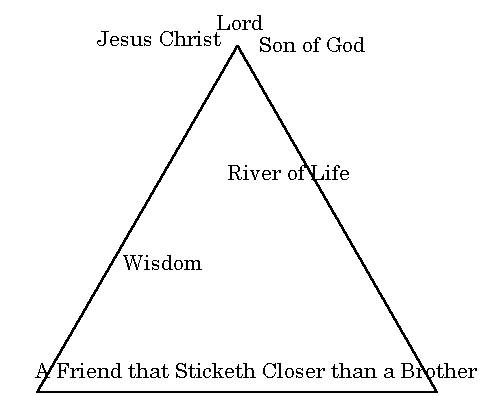
d. So, where do you begin when explaining Jesus
The place to begin explaining Jesus to someone who does not know him,
is not necessarily at the top of the hierarchy. Rather, it is the place
where you can connect with that person, as any part that connects with
that person may give us an 'in'. You might not personally find the picture
of Jesus as a 'Mother Hen' that helpful, but if you are talking to a poultry
farmer who thinks that mother hens are great in the way they act and protect
their chicks, it might be the ideal place to start. As a person comes to
understand more about Jesus, they will understand more of the descriptions
of him within this hierarchy we have set up. Over time some concepts may
come to mean more than others. As we mature in Christ, we gain a picture
of how these concepts interrelate to each other and build up a broader
picture.
c. Jesus' Childhood
We have very little on Jesus' childhood, outside of one visit to Jerusalem.
We can safely assume that as a child, his upbringing was in line with the
Jewish customs of the time.
d. The Political and Religious situation at the time
e. Wisdom Teacher and Miracle Worker
Jesus was seen as a teacher with great wisdom. He talked
in parables and performed many miraculous signs. His popularity increases,
and crowds follow him everywhere. What he says and does are signs that
the Kingdom of God has come.
f. Growing Opposition and Prediction of Death
There is growing opposition to Jesus as he is seen as a destabilising
force. Those who were seen to be destabilising were dealt with quickly
and promptly by the Romans. Within this, you have Jesus predicting his
own death. After the raising of Lazarus, those opposed to Jesus plot his
downfall;
h. Resurrection
Within the gospels, there are two types of narratives. These describe
the two aspects to the story. The first type is the Empty Tomb narratives,
which tell us that he was no longer in the tomb. The second type
are the Appearance narratives, which tell of his appearances
to his followers after he was raised from the dead. Sometimes it is hard
to piece together exactly what happened and it's sequence. While this is
normal when there are several eye witnesses, the basic facts all line up
against each other.
i. Session and Return
The term Session simply means that he is 'seated with
the Father'
a. Substitute
The concept of Jesus being a substitute is drawn from
Old Testament sacrificial imagery. When people turn away from God in sin,
something has to die. This was well understood by Jesus' followers. Jesus
becomes the sacrificial Lamb of God, who, being without sin
or blemish, was able to be the final sacrifice for sin. No more sacrifices
were needed as Jesus has dies the death we deserve. One of the key concepts
within this is that of Propitiation. The sins of humanity
have incurred the wrath of God, and God can only turn away from that wrath
because Jesus offered himself as a perfect sacrifice.
We find that Jesus became the curse that we should have become ourselves
Galatians 3:13
|
1 John 2:2
|
Hebrews 9:11-14
|
1 Peter 2:24
|
1. Over Death.
1 Corinthians 15:55-57
|
Hebrews 2:14-15
And the devil who had deceived them was thrown
into the lake of fire and sulfur, where the beast and the false prophet
were, and they will be tormented day and night forever and ever.
Revelation 20:10
|
1 Peter 1:3,4
|
1. Impossible that he should stay dead
In Jesus was life. That which is life cannot stay dead. Despite this,
Jesus displays great faith in that He is following the command of his Father.
It was an extreme act of obedience.
We are witnesses to all that he did both in Judea and in Jerusalem. They put him to death by hanging him on a tree; but God raised him on the third day and allowed him to appear, not to all the people but to us who were chosen by God as witnesses, and who ate and drank with him after he rose from the dead. He commanded us to preach to the people and to testify that he is the one ordained by God as judge of the living and the dead. All the prophets testify about him that everyone who believes in him receives forgiveness of sins through his name." While Peter was still speaking, the Holy Spirit fell upon all who heard the word.