Syria
Damascus
Damascus is the oldest continuously inhabited
city in the world. It has occupied a position of importance in
the fields of science, culture, politics, art, commerce, and
industry from the earliest times. It has been called 'al-Fayha'
(the 'Fragrant city'), al-Sham, Jollaq, and 'Pearl of the
Orient'as the Emperor Julian named it. It was mentioned in the
Holy Qur'an an as 'the many-columned city of Aram', whose like
has never been built in the land.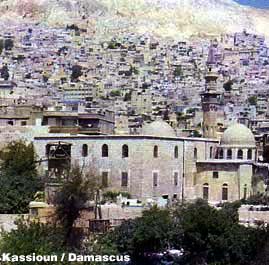 Early references to
the city, such as those in the Ebla tablets, confirm that
'Dameski' (i.e Damascus) during the third millennium B.C. was as
a city of immense economic influence. Ancient Pharaonic scripts
refer to it as 'Dameska'. It enjoyed great prominence during the
second millennium B.C. as the centre of an Aramic kingdom under
the name of 'Dar-misiq' ('the irrigated house') Damascus became
the capital of the first Arab state at the time of the Omeyyads
in 661 A.D. This marked the beginning of its golden epoch, and
for a whole century it was the centre of the youthful Islamic
Empire. This reached its peak of expansion during this period,
and came to stretch from the shores of the Atlantic and the
Pyrennese in the west, to the river Indus and China in the east.
Following the decline and fall of the Omeyyads, Damascus went
through a period of neglect and deterioration. It suffered
disaster and destruction, seeing only temporary prosperity,
depending on whose domination it was subjected to. However, when
Independence was achieved in 1946, the city started to regain its
importance as a significant cultural and political centre in the
Arab world.
Early references to
the city, such as those in the Ebla tablets, confirm that
'Dameski' (i.e Damascus) during the third millennium B.C. was as
a city of immense economic influence. Ancient Pharaonic scripts
refer to it as 'Dameska'. It enjoyed great prominence during the
second millennium B.C. as the centre of an Aramic kingdom under
the name of 'Dar-misiq' ('the irrigated house') Damascus became
the capital of the first Arab state at the time of the Omeyyads
in 661 A.D. This marked the beginning of its golden epoch, and
for a whole century it was the centre of the youthful Islamic
Empire. This reached its peak of expansion during this period,
and came to stretch from the shores of the Atlantic and the
Pyrennese in the west, to the river Indus and China in the east.
Following the decline and fall of the Omeyyads, Damascus went
through a period of neglect and deterioration. It suffered
disaster and destruction, seeing only temporary prosperity,
depending on whose domination it was subjected to. However, when
Independence was achieved in 1946, the city started to regain its
importance as a significant cultural and political centre in the
Arab world.
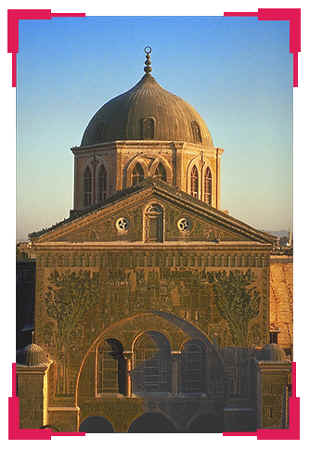
The Ommayad Mosque
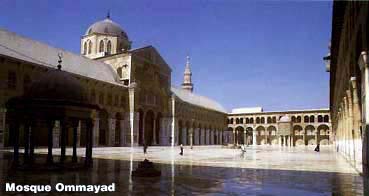 This great Mosque stands
at the heart of the Old City at the end of Souq al-Hamidiyeh. It
was built by the Omayyad Caliph al-Walid ibn Abdul Malek in 705
A.D. when Damascus was the capital of the Arab Islamic Empire.
When al-Walid decided to erect an impressive mosque suited to the
grandeur of the Arab state 'whose like was never built before,
nor will ever be built after' as he is reported to have said, he
negotiated with the Christian community of Damascus, and
undertook to construct a new church for them (St.John's) and
allot several pieces of land for other churches, if they
relinquished their right to their part of the Mosque. They
agreed. It took ten years and eleven million gold dinars, as well
as a huge number of masons, artists, builders, carpenters,
marble-layers, and painters to complete. It became an
architectural model for hundreds of mosques throughout the
Islamic world.
This great Mosque stands
at the heart of the Old City at the end of Souq al-Hamidiyeh. It
was built by the Omayyad Caliph al-Walid ibn Abdul Malek in 705
A.D. when Damascus was the capital of the Arab Islamic Empire.
When al-Walid decided to erect an impressive mosque suited to the
grandeur of the Arab state 'whose like was never built before,
nor will ever be built after' as he is reported to have said, he
negotiated with the Christian community of Damascus, and
undertook to construct a new church for them (St.John's) and
allot several pieces of land for other churches, if they
relinquished their right to their part of the Mosque. They
agreed. It took ten years and eleven million gold dinars, as well
as a huge number of masons, artists, builders, carpenters,
marble-layers, and painters to complete. It became an
architectural model for hundreds of mosques throughout the
Islamic world.
Souk
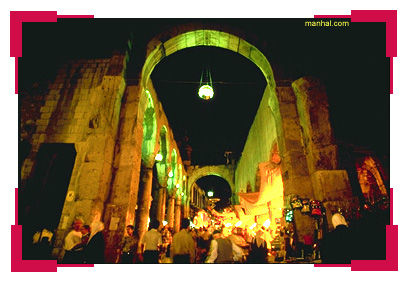
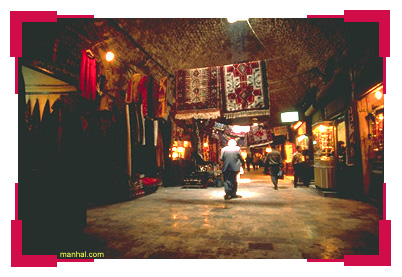
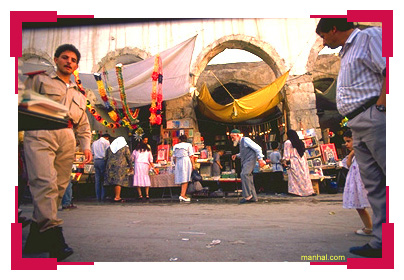
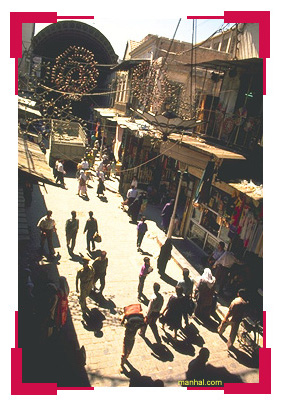
The old covered souqs of Damascus have a unique flavour you can savour with eyes closed. As you walk about in the warm darkness of these streets with their fragrant scents, spices, and colourful merchandise spilling out of the shops onto the pavements, you enter the strange world of exotic legends. Most prominent of these souqs is the SOUQ AL-HAMIDIYEH which follows a straight line from the west to the Omayyad Mosque. It dates back to 1863, to the rule of the Ottoman Sultan Abdul-Hamid, after whom the souq was called. It is covered with high iron vaulting, so old that sun rays filter through it into the darkness of the souq. The shops here sell everything from tissues to leather-work, from sweets and ice-cream to exquisite handmade brocades, mosaic, and copper inlaid with silver.
Just out side the Souk is a Statue of Saladdin
A military leader of Kurdish descent, Saladdin
led the Muslim forces against the Crusaders in an attempt to
regain their lands. At the end of the third Crusade,
Saladin returned to Damascus in triumph, having won back
Jerusalem and all the lands conquered in the first Crusade,
except for the coastal strip and its fortresses. He died
the following year, 1193, worn out by fighting at the age of
fifty-six. It is said that at his death his fortune
consisted of only forty-seven dinars and one gold piece.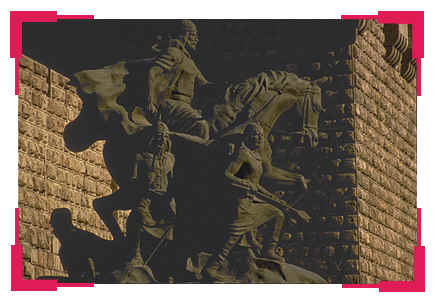
Azem Palace
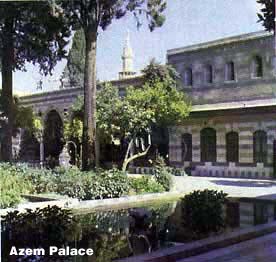 This
also stands at the heart of the Old City, on the southern side of
the Omayyad Mosque, and very close to it. It is an astonishing
example of a Damascene house, where the simple, almost primitive,
exterior contrasts rather sharply with the beauty and
sophistication of the interior. Here one finds a sense of space,
a wealth of polychrome stone, splendid marble, cascading
fountains, and fragrant flowers. The palace was built in the
mid-eighteenth century for the Governor of Damascus.
This
also stands at the heart of the Old City, on the southern side of
the Omayyad Mosque, and very close to it. It is an astonishing
example of a Damascene house, where the simple, almost primitive,
exterior contrasts rather sharply with the beauty and
sophistication of the interior. Here one finds a sense of space,
a wealth of polychrome stone, splendid marble, cascading
fountains, and fragrant flowers. The palace was built in the
mid-eighteenth century for the Governor of Damascus.
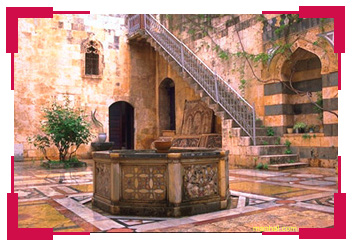
The
street called Straight
is straighter than a corkscrew,
but not as straight as a rainbow.
St. Luke is careful not to commit himself;
he does not say it is the street which is straight, but
"the street which is called Straight."
It is the only facetious remark in the Bible,
I believe.
Mark
Twain
The Innocents Abroad ,
1869
 THE
NATIONAL MUSEUM:
THE
NATIONAL MUSEUM:
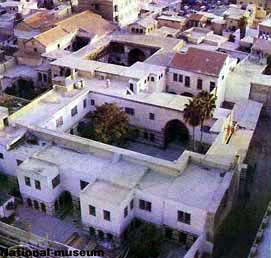
The National Museum of Damascus is generally recognised as one of the finest of its kind in the world. Visitors can see artifacts of the great civilisations that emerged and flourished in Syria. There are thousands of statues, stamps, pieces of jewerelly, weapons, precious stones; sculpture, masks, tablets, textiles, mosaics, glass-work and earthenware, coins, and manuscripts from the ancient Syrian kingdoms of Ebla, Ugarit, Palmyra, Tel Sukas, Mari, Doura Europos, Bosra, Shahba and others.
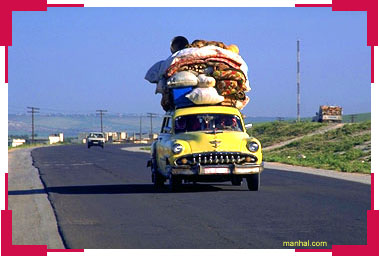
The roads and driving in Damascus is unlike any place on earth. You'll see things here that will make you laugh or cry, and probably scream.

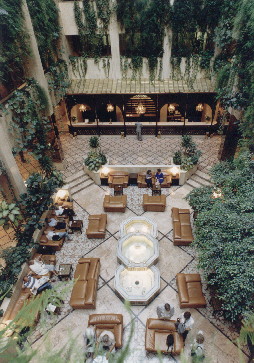
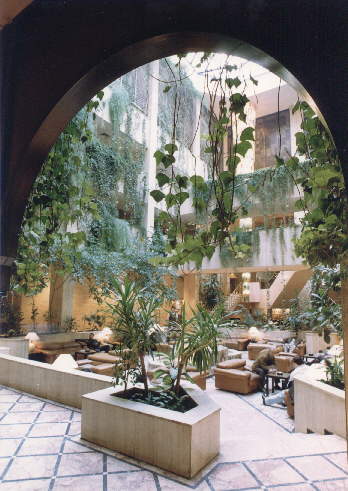
Cham Palace
Janet and I stayed at this hotel on our visit to Damascus. This is just the lobby.
Bosra
It is an extremely ancient city mentioned in the
lists of Tutmose III and Akhenaten in the fourteenth century B.C.
The first Nabatean city in the second century B.C., it bore the
name Buhora, but during the Hellenistic period, it was known by
the name of Bustra.Later the Romans took an active interest in
the city, and at the time of the Eperor Trajan it was made the
capital of the Province of Arabia (in 106 B.C) and was called
Neatrajana Bustra.The city saw its greatest period of prosperity
and expansion then, became a crossroads on the caravan routes and
the official seat and residence of the Imperial Legate. 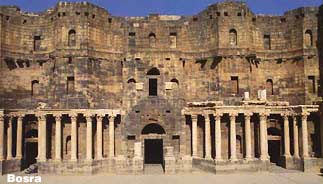 After the decline of the
Roman Empire, Bosra played a significant role in the history of
early Christianity.It was also linked to the rise of Islam, when
a Nestorian monk called Bahira, who lived in the city, met the
young Muhammad when his caravan stopped at Bosra, and predicted
his prophetic vocation and the faith he was going to initiate.
The most interesting part of the city today is the famous Roman
theatre built in the second century A.C.,which seats 15 thousand
spectators, and is considered one of the most beautiful and well
preserved of Roman amphitheatres in the world. Every summer, it
hosts Arab and international performers who entertain audiences
during the Bosra Art Festival against a majestic background of
Roman columns and arches.
After the decline of the
Roman Empire, Bosra played a significant role in the history of
early Christianity.It was also linked to the rise of Islam, when
a Nestorian monk called Bahira, who lived in the city, met the
young Muhammad when his caravan stopped at Bosra, and predicted
his prophetic vocation and the faith he was going to initiate.
The most interesting part of the city today is the famous Roman
theatre built in the second century A.C.,which seats 15 thousand
spectators, and is considered one of the most beautiful and well
preserved of Roman amphitheatres in the world. Every summer, it
hosts Arab and international performers who entertain audiences
during the Bosra Art Festival against a majestic background of
Roman columns and arches.
Crac de Chevaliers
The most famous medieval citadel in the world,
Qal'at Al Hosn is 65 km west of Homs and 75 km south-east of
Tartus. It is 650 meters above sea-level. It was built in order
to control the so called Homs Gap, the gate-way to Syria. It was
through this passage that Syria communicated with the
Mediterranean.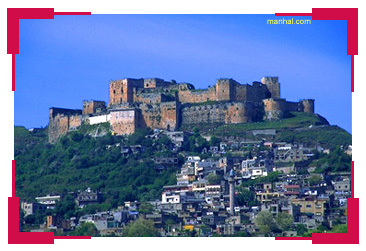 In ancient time the importance of
the strategic corridor was immense. It was crucial importance to
the Crusaders and other foreign invaders in their conquest of the
coast. Conflict over the Crac des Chevaliers continued through
the ages. It was a fierce and bloody dispute, but in the end,
Sultan Beybars managed to recover it in 1271 through a military
trick and one month of fighting. Crac des Chevaliers was built on
the site of a former castle erected by the emirs of Homs to
accommodate Kurdish garrisons; 'Crac' is a modification of the
Arab word 'Qal'a'. The citadel covers an area of 3000 sq m and
has 13 huge towers, in addition to many stores, tanks, corridors,
bridges and stables. It can accommodate 5000 soldiers with their
horses, their equipment and provisions for five years.
In ancient time the importance of
the strategic corridor was immense. It was crucial importance to
the Crusaders and other foreign invaders in their conquest of the
coast. Conflict over the Crac des Chevaliers continued through
the ages. It was a fierce and bloody dispute, but in the end,
Sultan Beybars managed to recover it in 1271 through a military
trick and one month of fighting. Crac des Chevaliers was built on
the site of a former castle erected by the emirs of Homs to
accommodate Kurdish garrisons; 'Crac' is a modification of the
Arab word 'Qal'a'. The citadel covers an area of 3000 sq m and
has 13 huge towers, in addition to many stores, tanks, corridors,
bridges and stables. It can accommodate 5000 soldiers with their
horses, their equipment and provisions for five years.
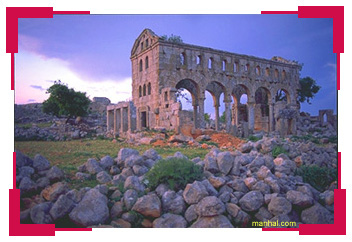
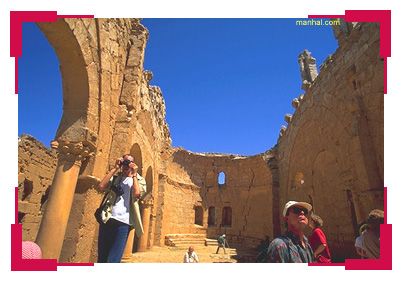
The remnants of some three hundred "dead towns" of the Byzantine era lay scattered over the face of Northern Syria. Their basilicas, convents, hostelries, villas, and necropolis are admirable examples of Syro-Byzantine architecture.
VISIT