Australia
 ™
™
C.P.Chuah's
Home
 |
 |
 |
 |
 |
 |
 |


Victoria
Most people harbour a particular image of Australia, such as the Opera House or Uluru, formerly known as Ayers Rock. Yet these famous icons do scant justice to the richness of Australia's natural treasures and its cultural diversity. Australia offers a wealth of travel experiences, from the drama of the outback and the spectacle of the Great Barrier Reef to the cosmopolitanism of Sydney and arguably the best beaches in the world. Australia is an enormous country, and visitors expecting to see an opera in Sydney one night and meet Crocodile Dundee the next will have to re-think their grasp of geography. It is this sheer vastness, and the friction between the ancient land steeped in Aboriginal lore and the New World culture being heaped upon it, which gives Australia much of its character.
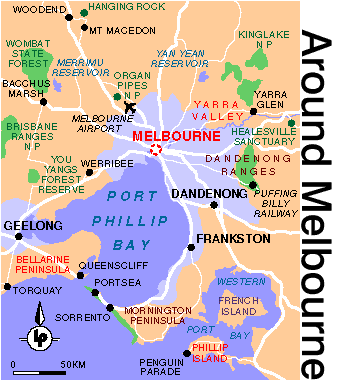
Australia is my vacation place that I have chosen for my summer holiday after completing my second year of university. Its partly chosen because my girlfriend is studying in Monash University, Melbourne. That's makes it easier to decide where to go. Well I stayed in Melbourne for 2 months. Yes I do know how the things works here and almost every street in here by now. Melbourne is Australia's second largest city, with a population of 3 million people. There's a couple of places I visited during my vacation here. I went to a few places such as Great Ocean Road, ballarat, Philip Island, Mt Buller.
Full country name: Commonwealth of Australia
Area: 7,682,300 sq km
Population: 18,600,000 (growth rate 1.4%)
Capital city: Canberra (pop: 311,000)
People: 94% European descent, 4% Asian, 1.5% Aboriginal
Languages: English, Aboriginal languages (plus Italian, Greek and numerous other European and Asian languages)
Religion: 75% Christian, 1% Muslim, 1% Buddhist, 0.5% Jewish
Government: Independent member of the British Commonwealth
Prime Minister: John Howard
Governor-General: Sir William Deane
GDP: US$555 billion
GDP per head: US$29,652
Annual growth: 4.5%
Inflation:1.6%
Major products/industries: Minerals, oil, coal, gold, wool, cereals, meat. Major trading partners:Japan, ASEAN, South Korea, US and the EU.
Australia's second city is a place of contradictions and hidden charms. A leafy, bayside community on the 'upside-down', brown Yarra River, it is cosmopolitan, suburban, cultivated, football crazy, conservative and a haven for the avant-garde. Visitors come for its shopping, restaurants, nightlife and sporting calendar, encouraging many Melburnians to believe that they live in one of the most civilised cities in the world.
Population: 3.4 million
Country: Australia
Time: GMT/UTC plus 10 hours
Telephone Area Code: 03
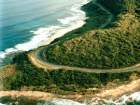
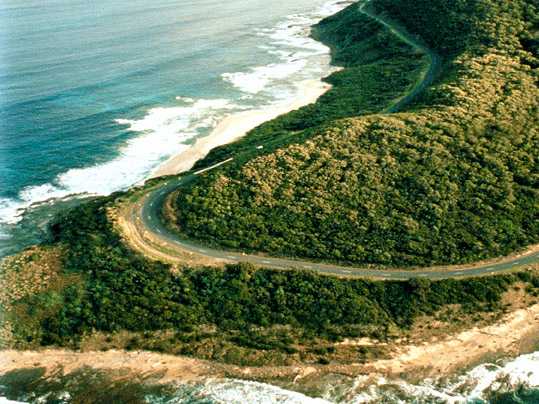
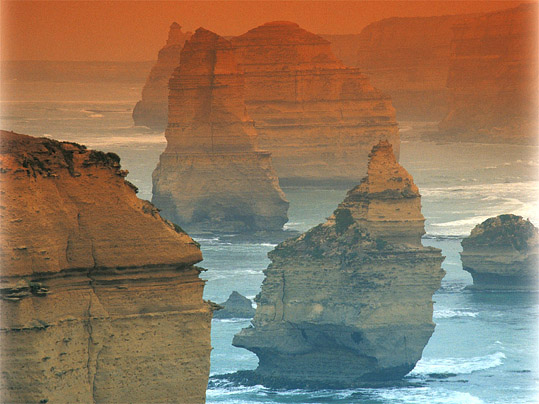
The famous Great Ocean Road hugs the highway passing sweeping beaches, sleepy coastal resorts and spectacular views. I drove from Melbourne to Geelong and start my Great Ocean Road experience from there. Great Ocean Road, Victoria's most sensational road is a twisting 400 km route stretching from Torquay, Australia's Surf Capital to Port Campbell. The first stop is Bell's Beach, international recognised for its waves and hosts the Rip Curl Pro surfing competition every year. Oouch..... the water is clear blue and the weather is just perfect. That's the first taste of Great Ocean Road. I drove along the coastal line from there passing through Anglesea, Lorne, Apollo Bay, Otway National Park, Cape Otway, 12 Apostles, Loch and Gorge and finally Port Campbell. Lorne is a busy holiday spot embracing sandy beaches and the cool rainforest of the Otway ranges. A number of charming villages line the coast between Lorne and Apollo Bay, with marvelous views from Cape Patton. On the edge of the Otways, Apollo Bay is ideal for swimming, boating and fishing. From Apollo Bay, the road leaves the coast, through Cape Otway to Lavers Hill. From Lavers Hill to Port Fairy, one of Victoria's earlist ports, The Shipwreck Trail marks 25 known wreck sites along the Shipwreck Coast's treacherous waters. At Port Campbell National Park, natural wonders formed by the sea include majestic stone pillars of the Twelve Apostles, Loch and Gorge, The Blowhole and the Grotto. The last stop of Great Ocean Road is Nelson just before the South Australian Border. Must see pics !
Ballarat is a little town full of history. The main attraction there is Sovereign Hill nickname "Gold Town" inhabited by craftsmen in the 1850s when gold was found. The area includes The Diggings (1851-1855), Chinese Village (1859), Township (1854-1861) and Mining Museums (1860-1918). There are also people dresssed up as in the 1850s and walking around the area working and doing demonstration. Another popular site is the Ballarat Wildlife Park. Here you can see kangaroos, Tasmanian Devil, Swan, Koalas and a whole lot more from amphibians to reptiles to mammals. I certainly enjoyed myself there.
Philip Island, located in south east Victoria that begins in the Great Dividing Range then descends into the placid green valleys of country Gippsland is an island famous for penguins and seals. The valiant shearwaters fly between Aleutian Island near Alaska and Philip Island every year and thousands of seals cavort around Seal Rocks. Also equally famous is the endless honey-coloured sands of Ninety Mile Beach where the surf curls in with its calming rhythm.
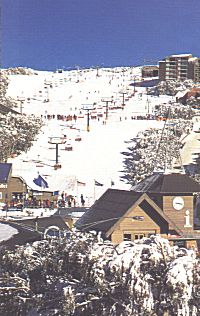
Mt Buller Alpine Resort is 250km north east of Melbourne and rises to an altitude of 1804 metres above sea level. The Resort embodies some of Victoria's most spectacular alpine and sub-alpine terrain. It offers 180 ha of ski trails as well as wide open spaces above the tree line, with the longest trail being 2.5km. Winner of the Australian ski Award for "Best Year Round Resort" two years running, Mt Buller offers a multitude of activities in both summer and winter.
Copyright © 2000. All Rights Reserved. This page is protected under the copyright laws. Please do not copy any of the content of this page for commercial use. Please e-mail me at [email protected]
Last updated Saturday, December 1, 2001 11:03