 |
|
|
|
|
|
|
|
|
 |
 |
 |
|
|||||
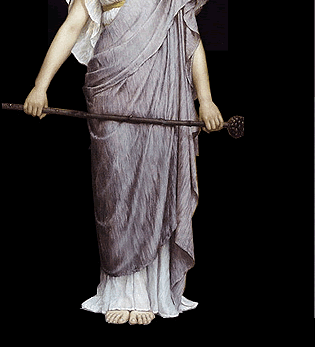 |
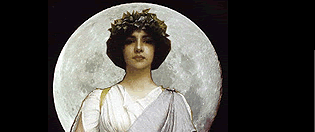
About Hecate, HekateHecate is Queen of the Night, the Spirit World, and Witchcraft. Her epithets include "She Who Works Her Will." Although today most associated with Greek mythology, her name, meaning "influence from afar," acknowledges her foreign origins. Generally believed to have first emerged in what is now Turkey , she was not an obscure goddess. Hecate was at one time chief deity of Caria, now western Turkey , and was eventually widely worshipped throughout Europe, Western Asia, and Egypt . Records of formal worship date from eighth century BCE to the fourth century CE, although as magic fell from grace she became an increasingly disreputable spirit. All Hecate's myths clearly identify her as a witch and matron of magical arts. Hecate holds dominion over life, death, regeneration, and magic. She rules wisdom, choices, expiation, victory, vengeance, and travel. Hecate guards the frontier between life and death. She is an intermediary between the spirit world and that of humans. She is the witness to all crimes, especially those against women and children. Hecate has been known to assume the shape of a black cat, a bear, a pig or a hen but most typically manifests as a mature woman or black dog. She has a particularly strong bond with dogs. Even when manifesting in human form, Hecate is usually accompanied by hounds. Somehow there will be a canine reference. When manifesting as a woman alone, Hecate often circles in the manner of a dog. Artistic renderings of Hecate usually attempt to capture her spiritual essence. She may be depicted with three bodies, each facing a different direction. One hand holds the knife that is the midwife's tool, another holds a torch to illuminate the darkness, the last bears a serpent representing medical and magical wisdom. Sometimes Hecate is depicted with a woman's body but three animal heads - those of a dog, a horse, and a lion. Hecate's sacred time is black night. All her festivities and ceremonies are held after dark, the only acceptable illumination is candles or torches. She only accepts offerings and petitions at night. Hecate is identified with the Dark Moon, the time of her optimum power. The last day of each month is dedicated to Hecate. She also shared a festival with Diana on August 13 th in Italy . Modern Wiccans, for whom Hecate is an important deity, celebrate November 16 th as Hecate Night. Her sacred place is the crossroads, specifically three-way crossroads. Among her name is Hecate Trivia. That doesn't indicate that Hecate is trivial or that worshipping her was a trivial persuit: Trivia literally means "three roads." Hecate is Spirit of the Crossroads: her power emenates from their point of intersection. Hecate's image was once placed in Greek towns wherever three roads met. Sacred Creatures: Dogs, toads, snakes, dragons Hecate is most prominent in Greek myth-ology for being the sole deity to voluntarily assist Demeter in her search for her abducted daughter, Persephone. Later, after Persephone eats Death's six pomegranate seeds and is condemned to spend half the year in Hades, it is Hecate who accompanies her as Lady-in-Waiting. In some legends, she even becomes Hades'co-wife. Ceberus, three-headed hound of Hades, may be Hecate in disguise. Hecate becomes Persephone's link to her mother and the land of the living. She guarantees that Death cannot break the bond between mother and daughter. Hecate is the Matron of Necromancy. Hecate, daughter of the Titans Perses and Asteria, is older than the Olympian spirits. The eight-century BCE Greek poet Hesiod writes that Hecate's power dates "from the beginning." Zeus was crazy about her: he eliminated all other pre=Hellenic deities (the Titans) but, havingb fallen madly in love with Hecate, he let her be. Hecate is understood to be a triple goddess by herself, appearing as maiden, mother, and crone. She is also part of a lunar triplicity with Artemis and Selene, and also with Demeter and Persephone. Hecate dances in Dinysus' retinue and is a close ally of Kybele. Alongside her intense lunar identification, Hecate is also associated with the element of water: her first love affairs were with sea gods including Triton. Her great-grandfather was Pontus the Sea. Her maternal great-aunt was the sea monster Keto. Hecate is also related to the Gorgons and Sirens and may be the mother of Scylla, who was transformed into a sea monster by another relative, Circe. Prior to her transformation Scylla was a beautiful woman from head to waist, with canine hips terminating in a fish tale. Hecate led a host of shape-shifting female spirits known as Empausas, whose usual manifestation was as a beautiful woman with one brass leg and one donkey's leg; Hecate herself sometimes takes this form. The Empusas patrolled roads and apparently sometimes had fun terrorizing travelers. If one invoked Hecate, however, they left you alone. Devotees feted the goddess by holding rituals known as Hecate's Suppers at the end of each month at a crossroad. (The end of the month in lunar calendars corresponds to the Dark Moon, the new month begins with the first sighting of the new moon). The Church was still trying to eradicate Hecate's Suppers in the eleventh century. Post-christianity, Hecate became among the most intensely demonized spirits, her very name synonymous with "witch". Her symbols (toad, cauldron, broom) are inextricably linked with stereotypes of witchcraft. What were symbols of fertility became symbols of evil. Her sacred dogs were converted into the Hounds of Hell. This denigration served to camouflage Hecate's origins as a deity of Healing and Protection.
|
|
||||||
 |
|
|||||||
 |
 |
 |
 |
 |
 |
|
||
 |
 |
 |
|
|||||