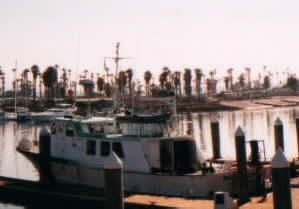
 M/V Pacifc Ranger |
Cove Diver's Journal--Kelp
Forest Monitoring
Day 1--June 25,
2001--Getting Ready
Seven of us boarded the National Park Service vessel, Pacific Ranger, that Monday morning in June. Our destination was one of several locations in the Santa Barbara Channel Islands where, for the last two decades, researchers have documented the health of the kelp forest ecosystem. Actually, we didn’t really "board" the vessel, for that connotes walking across a gangway with one or two bags and a backpack. "Moved on board" better captures what we did that morning.
M/V Pacifc Ranger |
Upon our arrival PR (as she’s called in the acronym-intense world of government) more resembled a bare boat charter than a research vessel ready to leave port. We outfit and provision her for the five-day voyage during which we need to be self sustaining. For two hours, using two-wheeled hand carts, we stevedore everything needed to support ourselves and conduct the investigations including food, water, oxygen, instruments, dive gear, all items, essential and mundane, large and small. Overlooking the smallest crate could mean that a critical item left dockside dooms a major part of the week’s effort.
The low tide that morning gives the ramp to the floating dock an especially steep slope. Two people must take the heavier loads cart-first down the ramp, lest a grip on the handle be loosened sending the cart careening out of control down the ramp. With one hand on the cart handle and one on the ramp railing, we brake against the force of gravity, thankful for the traction provided by the rough aluminum surface of the ramp.
Everything brought on board has a place. We hang wetsuits in the dive locker; toss packaged food into galley cupboards or stuff them into under-the-seat drawers in the salon; and place perishables and drinks in large ice chests on the deck under a shelf, on top of which sets several laundry baskets with personal dive gear. Recently filled air tanks placed in racks stand in formation at attention near the air fill station. They are quiet now as the boat is in the glassy-calm waters of the harbor. But as soon as we get in any kind of swell, the tanks will bang together, the clang-Clang, Clang-CLANG marking the cadence of the swell.
Berth assignments are less precise, a mixture of first come, first served, and roommate roulette where the people sharing your cabin may be determined as a matter of choice, chance and fate. A week at sea could be a mini "Real World" for marine biologists. PR features berths for eight passengers. The forward cabin holds four bunks, two per side, with two bunks in each identical port and starboard cabin. I prefer an upper berth for various reasons, so I opt for port side cabin and stake my claim by depositing my sleeping bag on the rack. A few years ago, I had a lower and got up quickly in the night imprinting the grid pattern of the upper into my forehead. With only six passengers on board this trip, two berths remain empty, used as additional storage space for personal effects. (The skipper sleeps on a divan in the wheelhouse).
At 1030, we slip the moorings that hold PR fast in her berth. After a quick stop at the fuel dock, the skipper, Derek, points the bow toward the Ventura Harbor breakwater and the islands beyond. A quick radio call to Channel Islands National Park Dispatch announces the beginning of the voyage with seven POB (people on board, which is more polite than calling us souls on board). If all goes according to plan, a similar radio call will announce our arrival as we enter the breakwater on a reverse heading five days from now, little worse for the wear, provisions nearly spent but fat with data.
On the trip over, the expedition leader, Dave, explains the various protocols we will use in the coming week to accomplish the work. He notes that because we are short staffed on this trip, work assignments may have to be adjusted to balance buddy teams with the each person’s ability to do the job. For example, my range of expertise is relatively narrow compared to that of the other divers. I am a trained scientist but I am not a marine biologist. So, my efforts will be concentrated on executing only a few protocols. Nevertheless, these need to be accomplished at every site. So while I do the more basic protocols, others are available to accomplish those that require more detailed knowledge of the organisms that inhabit the kelp forest-rock reef ecosystem.
Dave emphasizes the need for safety, safety, and more safety in the orientation. He reviews the general dive profiles and reiterates the need to stop our ascent 15 feet from the surface for three to five minutes as a precaution. Oxygen will be available at the so-called decompression bar hung at that depth to help us "off gas" the nitrogen which over five days of multiple dives will build up in our tissue, increasing our susceptibility to decompression sickness (a.k.a. "the bends"). Oxygen also reduces the fatigue encounter by divers making repetitive work dives. But, he cautions that oxygen can be toxic to divers at depths not much deeper that 15 feet. Oxygen toxicity can cause blackouts and convulsions, serious symptoms anyplace but underwater nearly always fatal. We hear the "safety first" emphasis of the informally professional briefing loud and clear.
One of the first protocols executed at each site is the roving diver fish count. Starting at descent, for 30 minutes (divided into six, five-minute segments) the diver keeps track of the species encountered and their relative numbers (single, few, common, many) which converts a continuous variable, the number of fish, into a categorical variable. This technique simplifies data collection and reduces measurement error. While the protocol calls for recording all species we can positively identify, it lists 18 species of particular interest. During the trip to our first site, I review the species of interest using Paul Humann’s very thorough and well-illustrated field guide, Coastal Fish Identification, California to Alaska.
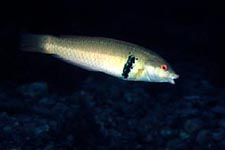 Rock wrasse. Is it male (terminal phase) or female (initial phase)? It's a boy! |
I know these species through years of diving. Some so familiar, like the kelp bass, garibaldi, and gobies, as they are constant companions on nearly every dive I have ever made. Others less frequently encountered are less familiar. I feel like I am looking through the yearbook prior to a high school reunion in anticipation of meeting a less familiar classmate, one who I cannot readily match a name to a face, although both will be familiar. After all, without prior reference, what is the difference between a male and a female rock wrasse? And like the pictures in the yearbook, fish pictures may or may not bear a resemblance to the real thing. |
| We arrive at our first site, Yellowbanks, off the southeast coast of Santa Cruz Island. This area of the island encompasses the latest addition to the CINP. The map indicates one of the aspects of sailing in the islands, the adoption and mutation of place names. Are we at Yellow Bank, Yellow Banks, or Yellowbanks, an area that takes its name from the brownish yellow strata seen in the cliffs which loom over the area. People throw about a place name until it comes into popular usage through repetition. Yet the consequences are more than linguistic. Confusion over place names can lead to delays when a distress call goes out. For this reason, the Coast Guard maintains a database of all the names for a given location. | 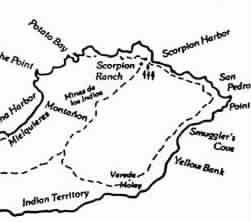 |