Cove Diver's Journal--Kelp
Forest Monitoring
Day 1--June 25, 2001--The Diving
The first team entered the water at
1320. After they set the Pelican buoys that mark the middle and
two ends of the 100-meter transect, the boat begins to anchor, a
signal that other teams need very soon to enter the water to
start the fish count. Surface conditions are great for diving:
flat seas, and a warm and sunny day with just a wisp of a cooling
breeze. While the advance team sets up the site, the other divers
begin to gear up to enter the water.
The first operation of a trip is always
tentative. In many cases, the crew is a "boat of
strangers" in that each person has idiosyncrasies in gearing
up and diving that are initially unknown to the others. I dive
quite a bit with the CINP, so my dive competency is not
questioned. However, I "suck air like a Hoover" using a
95 cubic foot tank while my partners find the standard 72 cubic
foot tank provides sufficient air to accomplish whatever task
has been assigned. The additional weight of the larger, heavier
tank combined with the buoyancy of a new wetsuit means that my
weight packs needs to be fine-tuned.
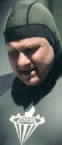 |
Head
down, I utter silent pleas to the sea sprites
"please don't let me screw up, make sure all my gear
is here." Leaving a crucial piece of dive gear on
the mainland creates a case of terminal embarrassment
that may negate any contribution one makes to the effort.
I personally know that sinking feeling of near panic that
comes from the realization that something crucial was
left behind. |
On my first trip to do shipwreck
surveys with CINP more than a decade ago, I failed to pack my
wetsuit bottoms. Unwilling to admit that I could make such an
error, I checked and rechecked my dive bag, somehow hoping that
divine intervention would make the missing garment mysteriously
appear where none had been just a short time before. If
meteorological conditions had not forced operations to an early
termination, I wonder if I would have been asked back. For want
of a nail....the battle was lost.
For want of a nail .... And if we
remembered to bring it all, we hope all equipment works. As gear
is hooked up for the initial dive, everything is checked and
double-checked, then checked again. While hooking up gear,
someone discovers that the connector from one of the hoses is not
compatible with the fitting on the b.c., necessitating a swap of
hoses or fittings. As tank valves are opened, the regulator and
power inflation hoses jump and become rigid as we hear the
familiar-and- reassuring-but-tinny psssst of air rushing in to
fill the hoses.
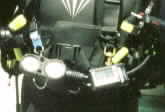 The bare
essentials, dive computer, depth gage and pressure gage
(compass not shown).
|
The divers turn on
their personal dive computers which keep track of depth
and time, functions vital to planning and executing safe,
multiple dives over several days. Many divers on board
carry a primary and backup computer. This redundancy will
allow them to continue to dive in the event of a rare
malfunction or the more common problem--depletion of one
of the computer’s battery before the end of the
cruise. I have a single computer. |
If a computer malfunctions, according
to the manufacturer’s instructions and safe diving
practices, I must stay out of the water for at least 24 hours at
which time my dive profile should be clear. Sure, I can try to
reconstruct my repetitive group on the Navy dive tables using the
techniques learned so long ago in basic scuba and relied upon by
all divers until the advent of reliable and inexpensive dive
computers. If not by the end of the first day then surely at some
point during the second day, divers will often be "off the
tables" using the manual computations. This manual
computation method assumes that the entire dive was made at the
deepest depth encountered from beginning of descent to end of
ascent. Since most dives occur over a range of depths, the dive
computer figures no decompression limits in real time. At the
beginning of the next dive, the computer-derived safe diving time
is invariably longer than that determined by manual computation.
The staccato clanking of the anchor
chain paying out announces that it is time to saddle up and get
in the water. The water at Yellowbanks this find June day is a
pleasant 62 degrees, warm enough to wear my jumpsuit without the
step-in outer suit. This two-piece arrangement gives the suit a
lot of versatility over a wide range of conditions that one can
encounter in year around diving in California. Many instructors
tell students that if you can dive in California, you can dive
anywhere. I agree. California conditions vary from diving in a
surf suit with tropic-like visibility to cold water and surge
with five feet of visibility. On the first dive we encounter the
latter. Visibility on the bottom ranges from five to 10 feet.
This fish census will be confined to the area of limited vision.
Twenty feet away dolphin could be playing tag with seal lions and
bat rays and we would be oblivious to it for if it is not in our
field of vision, it does not exist. This is not to say we are
unaware of something out there. Low visibility creates ephemeral
shadows that take form in the mind long before we encounter
whatever is there. In an environment that lacks many of the
familiar cues by which we subconsciously order and define
reality, the mind works overtime to bring some definition to what
our senses tell it.
I recently attended a lecture by diver
and writer Carlos Eyles. He advocates learning to take the many
cues the ocean provides which are otherwise overlooked when our
minds, operating with a terrestrial frame of reference, discount
any stimuli that does not square with its constructed reality.
Undoing the hardwiring of many eons of evolution requires time
and a willingness to look at things as they are, not as they
appear. Of course, Eyles would contend that the scuba diver is at
a disadvantage to do this compared to a free diver because of the
noise-generating mechanics of the aqualung which creates a bubble
curtain which further masks some stimuli. Yet, many on this
expedition are very aware of the marine environment, and find
species that a casual diver might overlook. Knowing the
connections between the parts allow these observers to see
critters that hide in plain sight. Humann’s guidebook warns
that many species of reef fish are wary of divers. Plowing into
the area with the undersea equivalent of a bag pipe corps means
that the critters will be long gone before they are within the
range of our senses.
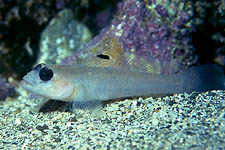 |
The roving diver
fish count is uneventful. The area here is devoid of
kelp, a far changed seascape from when I first dived in
this area nearly 20 years ago. Then, kelp was thick and
the area supported a number of pink abalone. No more.
Besides a few common reef fish and what seems like armies
of black-eyed gobies, the area seems to be overpopulated
by white, purple, and red urchins. |
The intervening years have turned this
formerly kelp rich section of the rock reef into an urchin
barren. The cause of the demise is not entirely understood. Many
theories are proffered, including a succession of extremely harsh
El Nino events which can be especially devastating to kelp
forests, much like an out-of-control wildfire to pine forests
onshore. Yet, attributing the decline of a patch of healthy
ecosystem to a single cause oversimplifies the complexity of the
ocean. Other El Nino events have been equally devastating to
resources and the people who depend on them. Some anthropologists
theorize that the scarcity of food following an El Nino drove
many of the natives living on Santa Cruz and dependent on coastal
resources into the California Mission system. Still others assert
that human hunting of the California sea otter that so devastated
their populations allowed the abalone populations to explode
because it removed the shellfish’s chief predator.
When we return to the boat and shed our
gear. The sun feels great. We compile the results of the count
for later entry into the database. Several of the observers
consult the fish guides, not sure of what lesser common variant
of rockfish they observed. Soon a small discussion ensues in
which others offer suggestions as to the identification of the
critter. All fish have two names referred to as the scientific
name, usually with a faux-Latin and Greek style (hence the term
Latin name). The family name comes first and the species name
second. It would be like us writing our names last name first.
For all rockfish, the genus name is sebastes, followed by
a second name that identifies the particular species.
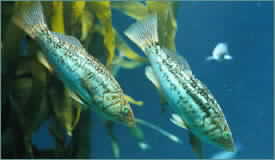 |
Scientific names
are important for they simplify communication between
scientists and remove uncertainty that results from the
use of common names which are the human equivalent of
nick names. For example, paralabrax clathratus
goes by four common names: bull bass (the really big
ones), calico bass, kelp bass, and cabrilla (in Spanish),
whereas paralabrax nebulifer is a.k.a. the barred
sand bass, sand bass or cabrilla, (in Spanish). |
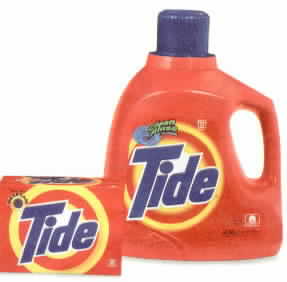
| Between dives I
surface swim to attach floats made of a clip and empty
orange Tide laundry bottles to the Pelican buoys. This
extra marker serves two purposes. The larger size and
brighter color of the Tide float makes locating the
Pelican buoy easier. Furthermore, the extra buoyancy
provided by the bottle makes it more difficult for the
Pelican buoys to be pulled under in a strong current.
Bottles work great, the boxes not so good. |
 |
On the second dive, I swim around area
getting familiar with the lay of the bottom while my partner
finishes collecting data from a previous protocol, the random
point contact, that remained unfinished at the end of a previous
dive. The RPC describes the organisms that encrust the bottom,
with bare sand or bare rock reported when no organisms are
present. When the last few points of the RPC are completed, my
team does 5-meter quadrats. This protocol requires the diver to
count and record all adult and sub adult kelp plants at least one
meter high and knobby stars within one meter of the 100-meter
transect line and record the results in five-meter segments.
Divers actually carry a meter stick on this exercise. Red tabs
mark the five-meter tics on the tape measure secured along the
transect line. Since this area is pretty much devoid of kelp, the
dive becomes a census of knobby star residing in the 100 square
meter area on either side of the line. A preprinted tally table
carried on slates by the divers make for easy compilation. Use of
these preprinted sheets by all divers helps reduce recording and
reporting errors.
At the end of the day, we head for the
anchorage at Scorpion. Depth and the lateness of arrival on site
combine to limit the number of dives that can be done on the
first day. Yet, we are soon in the shadows of the sun setting
behind the island as we secure the boat for the evening. One of
the expedition members decides to kayak back to the anchorage
from Yellowbanks. The kayak, stored out of the way on the top of
the cabin, is deployed and the diver- turned-paddler sent on his
way. By the time he arrives at the anchorage, dinner preparation
is well underway. All on board seem to be involved in one way or
another in the effort to put dinner on the table. Woe to the
person who comes on board thinking that they have won a five-day
respite from such domestic duties. I stay out of the way, as my
culinary skills, limited largely to peeling and chopping, are not
as well developed as my appetite. I am the voyage’s
dishwashing specialist. While the small galley is the domain of
the chef de jure, it is my realm after the meal. Anacapa to the
east is a prominent gray silhouette when I start the dishes and
is faintly outlined when I am done.
 |
As
the last light flees the anchorage, the salon tables
cleared of dinner dishes become workstations. Data is
recorded and checked. The day’s data collection
sheets, which have been drying in the boat’s
wheelhouse, are assembled, checked, and filed. Once the
official data is compiled, personal logbooks appear. We
pass around the dive log so each person can enter the
information on dive depth, time, and activity. Personal
observations are scribbled in these field journals. |
The collective private effort and data
record is euphemistically called "the gray literature"
ostensibly because it is not published in black and white in
scientific journals. Actually, I think the real meaning comes
from the time the data is recorded, in the gray of the evening
just before people retire for the night and the lights on the
ship go out, save for the white mast light which marks our
location.
Just before going below, the radio
crackles with an appeal for any vessel in the vicinity of Cojo
anchorage to render assistance to a vessel in some unspecified
distress. I wonder what the problem might be. Cojo anchorage,
near Point Conception is an anchorage a refuge, a place where
vessels can put in and anchor after coming through the maelstrom
of rock, coastline, fog, current and wind between Point
Conception and Point Sal. Called the "Graveyard of the
Pacific" by mariners and chroniclers alike, its reputation
is well deserved. And Cojo is the last chance waiting room before
entering hell or a haven after existing from it, depending on the
direction of travel. Still, Cojo can be a dangerous place if the
number of ships that have wrecked there is any indication. A few
years back, one of the Truth Aquatics boats out of Santa Barbara
was in the anchorage to let divers explore the wreck of an
offshore drilling vessel, HM1, that had come to grief in the area
40 years earlier. The dive master took a down line to attach to
the wreck, obscured by a plankton bloom. As the diver came out of
the murk at about 40 feet, he found himself nose-to-nose with a
great white shark. The diver hit the surface, shedding dive gear
that all of a sudden seemed like a very expensive encumbrance as
he swam to the boat. The gear was not recovered, but a memorial
fund established by friends and family of Nejat Ezal, who had
died while free diving at Catalina in 1994, helped the diver
replace the gear. I fall asleep hoping all will be right for the
mariner needing assistance on this dark night.
Click here to go to Day 2 of the Journal
Click here to return to Cove Diver's homepage.