 |
 |
Cove Diver's Journal--Kelp Forest Monitoring
Tuesday, June 26, 2001
The first thing that the skipper, Derek, does this morning is check the weather, paying particular attention to the wind speed and wave height reports from a number of buoys strung in an arc through the Channel, around Point Conception, and to the north. Originally placed to provide oceanographic data needed for evaluation of offshore oil and gas activity, the locals quickly came to depend on these reporting stations to provide real time data and a number of rules of thumb evolved which mariners use to guide their cross- and trans-Channel travel. The information constrains some movements and sanctions others. PR is like a Queen on the chess board, with a theoretically unrestrained ability to move in a straight line to any square on the playing board of the ocean surface. The number of sites to be surveyed becomes the tactical objective, within the time and budget collected, the strategic objective. She will make seven trips this season. In other words, she has a limited number of moves. Where she goes and when are contemplated based on weather, wind, and seas. A second consideration is the ability of the divers on board and the tasks they perform based on individual abilities and limitation. (I hesitate to continue the chess analysis lest I be cast in the role of "pawn.")
A small rain squall materializes seaward. It seems that we are pinched between two areas of good weather to the north and south. The prognosis is that we can expect high winds and building seas today, especially as one gets closer to the west end of the Channel. This information determines where we go, and it isn’t west. We will return to Yellowbanks and then run to Pelican on the north side. We stay put at Santa Cruz. Now it is up to David to figure out who will do what when we get to the site.
On the first dive, I am tasked to collect 100 each of the red, purple, and white urchin. My partner will collect an equal number. We will work side-by-side, cleaning out an entire section at a couple of points along the transect. Since yesterday, the current has increased, but so has the underwater visibility. We descend following the stern anchor line and can begin to make out the bottom about half the way down the line. As we approach bottom, we drop off the anchor line and quickly locate the transect and set about collecting. In the time allowed by my air consumption, I am only able to collect about 60 percent of my goal, so we make a second dive to complete the task. Conditions have improved dramatically, the current has dropped, and the horizontal and vertical visibility approaches a near-perfect 25 feet. The last team out is assigned the task of collecting the Pelican buoys and winding up the 100- meter measuring tape.
|
|
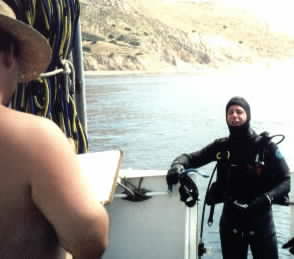
Sal checks us in and out of the water, runs the deck, assists in anchoring, all the things necessary to run a boat. Try running one without someone to do theses things. In fact, he's usually the last one we see leaving the boat and the first we see returning, immediately recognizable by the straw hat. I wonder if the hat will last the season. Probably not. A fist size hole has worn through the back of the hat. Something about diving and hats. I prefer baseball caps to brim hats when working topside during the underwater video program. Thinning hair over my scalp has an spf of about 2, meaning that it will sunburn in two minutes instead of one. I get a new cap at the beginning of every dive season. By the end of the season, it is given a hard-earned retirement.
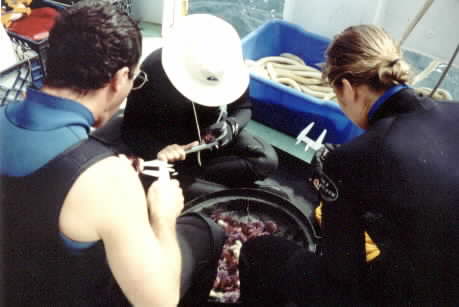
While the others measure the urchins, I rewind the line onto the Pelican buoy. For some reason, I find this task strangely satisfying. The thin yellow poly line must be wound correctly, otherwise it will not deploy correctly on its next use. By the end of the trip I have become the designated buoy line rewinder. From each according to their ability . . . The urchins are placed back on the bottom (actually they are tossed over the side and gravity does the rest). I can only wonder what it would be like to be on the bottom only to have urchins come raining down.
| We pull anchor and head for the site near Pelican Bay, eating lunch and completing other shipboard chores en route. We have plenty of time, as we have to travel about one-third of the length of the island. Pelican is a shallow site, about 25 feet deep along the transect line. At these depths, air consumption decreases as does the possibility of developing the bends by staying too deep for too long. |
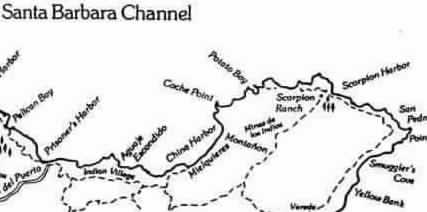 |
In what now is a well-rehearsed routine, the first team goes over the side to locate the transect lead line, deploy the Pelican buoys to mark the beginning and end of the route, and extend the tape measure along the line. The rest of us gear up and hit the water to do the roving diver fish count for the site. On this dive, my partner sees a puffer fish, a species more common to Baja. While not unknown, these fish are rarely seen in the northern Channel Islands, the extreme limit of their range. Santa Cruz is the boundary between two biogeographic provinces. As such, one may encounter critters that become more common (and sometimes larger) as one heads south or as one heads north, depending on the species.
| Execution of the random point contact protocol at this site is assigned to Kate, who using surface supplied air, will be tethered to the boat and in communication with Sal, who will record her observations while monitoring air supply and other factors. An orange case contains the heart of the system, a junction box for air hoses from the tanks to the diver, along with two-way communication, all through a 100 yard umbillical. Today the mike in the diver's face mask provides regularly intermittent contact. | 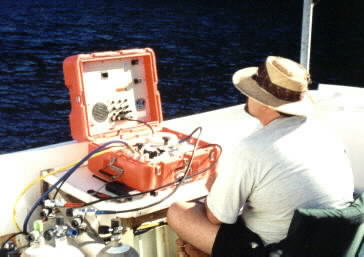 |
I will not be diving. However, I linger on deck for a while in my wetsuit ready to assist Kate in the unlikely event that a problem will develop. None does, and I shed the neoprene suit, which now seems like a second skin. At the end of her dive, as she does a safety stop at the decompression bar I offer to sing her a song of her choice. I have a nice medley of Jimmy Buffet songs that I learned doing karioke in a pizza parlor on Catalina. But my specialty is belting out "Dancing Queen" by Abba, the rendition of which I mastered spending an evening in that same pizza place on Catalina singing backup for some slightly inebriated Norwegian divers. I was told by some in the audience that the performance bought tears to their eyes. Whether this was caused by our choir of angelic voices or our assault on their auditory system was never specified. The question remains unresolved as Kate graciously declined my offer. Probably just as well, the rig she was using transmits sound by vibrating the bone behind the ear (hence its name "bone phone") rather than using speakers, an arrangement that would decrease my fine tonal quality. Someone once told me I had a "trained voice." I just never figured out what it was trained to do.
That evening, as I cleaned the dinner dishes, I was treated to a breathtaking view from the galley window. The mainland mountains are clearly visible in the waning light and the view of the island is spectacular. We are anchored a dozen or so yards off the western point of Pelican. Calm seas are gently rocking the boat, but not so much as to raise a clink, much less a clank, from the tanks in their rack on the rear deck. This site was made famous the camp run by the Ira and Margaret Eaton, so wonderfully described in the book, "Diary of a Sea Captain’s Wife." The pages of my copy of the book are well worn from repeated readings. Yet, it is only now in the fading light of the day that I truly appreciate the magic of the place. I hope that this is a feeling that all readers of the book will someday be able to experience.