Cove Diver's
Journal--Kelp Forest Monitoring
Wednesday, July
26, 2001— Hump Day
 |
Pick
up any one of several more detailed books on sailing and
it will enumerate the several definitions of
"dawn" a point that is driven home as I
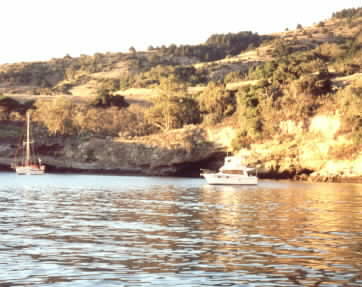
struggle to full consciousness watching the morning light
turn a guano-covered wash rock from a dark grey
silhouette to a multihued white capped pinnacle, like
some snow-topped Sierra peak. Sounds change as well.
While never completely silent, the night time anchorage
is not as rich in sound as the daytime anchorage. |
More and more island birds join in the
reveille chorus, starting with the pleasantly melodic chirping of
birds in the bluff-side pine forest and ending with the
nails-across-the-chalkboard multiple echoscreetch of wakening
gulls. Like an artist experimenting with colors, as the sun rises
the color on the canvas of the rock wall changes.
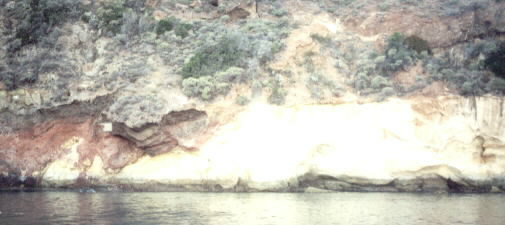 |
| Shifting and
intensifying light reveals patterns in the rocks. While
geologically permanent (at least in human time scale)
they are nonetheless temporary. Since all the variables
that make up this moment will never be reproduced, this
view is mine and mine alone this morning. While awestruck
at the view, I am saddened for like all thing beautiful,
it is best when a shared experience. A photo could not do
this justice. And for me it is transitory, never having
developed the artist’s ability to recreate the
colors. Nature's rock art but for a moment ever lost to
nature! |
Just as the island comes to life with a
building cacophony of sound, so does PR. Mumbled good mornings,
sounds of coffee being brewed, teeth being brushed, water
running, cereal being poured, and normal conversation crescendo
to noise with the start of the generator. Time to get up and go
to work.
There is a ritual that the crew follows at
the start of the day on a boat. With the number of people on
board, there is a certain choreography to progress of the day.
For example, six people gearing up to enter the water becomes a
ballet done in neoprene booties instead of toe shoes with all
manner of wetsuits and gear taking the place of leotards. Yet
like a ballet, one missed step can bring the whole production to
an abrupt halt. I won’t report much of the movement, but
only note that the dance goes on.
I have one rule in keeping the journal
and reporting the flow of the daily life-cycle of the voyage:
most of what happens on the boat, stays on the boat. There is
much personal interaction that occurs between the crew, usually
among people who have known each other or worked with each other
for a period of time. Any attempt to try and replicate this
interaction in any detail suffers from several deficiencies:
- Dialog can only be reconstructed,
never recalled or recorder verbatim.
- Nuances can never be captured to
explain the context of the situation.
- The observer cannot hope to gage
the sub text of the situation.
- For a week this boat is an island.
Knowing their off-the-cuff remarks are being recorded
would have people on edge and end up with me being
shunned, placed overboard in the dingy for the duration
of the voyage, or banished.
- On a boat conducting diving
operations, in the space of a week, people are bound to
do something silly. Such silliness is randomly
distributed throughout the occupants, so no one really
cares. Unless, that is, by recording and reporting
situations, the diarist turns the boat into a setting for
the Ed Show or Real TV.
 |
So
many situations are not recorded, and therefore not
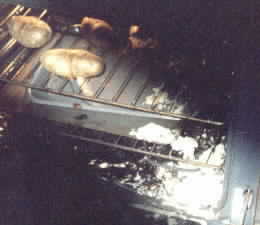
reported. Having said that, I must report the incident of
the exploding baked potato. The item blew up in the oven
while being prepared for last night’s meal of pork
and chicken, corn-on-the-cob, salad, and cobbler with ice
cream. While only a minor explosion, I never considered
donning a life jacket. Damage was contained to the
immediate interior of the oven and consisted of the
potato being reduced to pulp. Photographs were taken of
the scene. The cause of the incident is undetermined.
This incident is reported because, as all mariners
understand, any explosion at sea is cause for grave
concern and noteworthy in and of itself, without regard
for the reputations of the people involved. |
The number of trained observers and
scientists onboard this boat creates the setting in which some
mighty interesting conversations take place about the nature of
things in the ocean, from individual critters to ecosystem
health. I notice that when presented with a species here-to-fore
not encountered, the diver carefully records the critter’s
characteristics and uses guidebooks and field guides to make a
positive identification. Others may offer their advice to aid in
the identification. Inevitably, something new is learned and
someone will be shown something new on the next dive. Lots of
learning takes place on these cruises, the field guides are well
worn from use. Imagine moving down a 100-meter transect line, and
at certain intervals doing a census of critters in a certain
area. For the time of the dive, sometimes going longer as one and
1/4 hours, the area surveyed is a microcosm of the ocean. Much
may be happening beyond the periphery of the survey area, which
is maybe a couple hundred yards, maximum. The diver, while not
totally oblivious to the yonder discounts it’s reality. The
observer cannot afford to break concentration on the task at hand
to examine phenomena or creatures outside of the survey area.
On the first dive of the day at Pelican
Bay, I collect red, white, and purple urchins with Dave. I’m
getting more efficient at this, and complete the task well within
the safety limits of my 2600 psi, 95 cubic foot air supply. We
are finished at the site. Back on board, I grab a set of calipers
and begin to measure the urchins. Joining me in this effort are
two or three others who measure and one who records the
measurement. It’s almost like a game of reverse bingo, where
three people call out the numbers and one person marks them down.
Quickly, the task is completed and the urchins returned to the
sea. We are done at this site. We move west to Fry’s Harbor.
En route I again rewind the Pelican buoys.
The Fry’s Harbor site is a short
distance from the plunging vertical walls that characterize this
part of the island. Despite anchoring right up against the
island, this is a relatively deep site. Teams working abreast on
opposite sides of the transect can have a vertical depth difference
of 20 feet! On the fish count, we move along the deep side of the
line for the first half of the dive and the shallower side of the
line for the second half of the dive. While on the dive, I
encounter a large harbor seal inspecting the remains of an arm
that has tumbled and broken open. I wonder what force could have
caused the arm, a rather robust structure, to be split open as it
had been?
Back on the boat, I posed that question
to Derek. He speculated that it may have been wave surge from
winter storms that moved the ARM, someone anchoring on it, but it
also could be from rock slides that plague this area. Image the
force generated by a sizeable rock slide from a 100-foot cliff.
There are reports that a similar slump as Cuyler Harbor at San
Miguel Island caused as sailing vessel to roll to shore wrapping
its anchor chain around the ship in the process.
On the third and final dive of the day,
I do 5 meter quadrats with Derek to measure knobby stars and bat
stars. The work of measuring the longest arm of each critter goes
quickly. The recording less so. My dive mask, while equipped with
corrective lenses, does not have bifocals. As a result, I must
move the caliper to just the right spot in order to accurately
read the scale. The seal still seems to be inspecting the
destroyed ARM. I can only guess what fascination the structure
holds for the naturally curious marine mammal. I recall the old
adage about seals in the water being the early warning system
against large sharks. If there are seals or seal lions around and
all of a sudden they disappear, beware! While they may have just
moved on, something lurking nearby may have caused them to move
on.
A small rigid hull inflatable is moving
back and forth just offshore as if looking for something or
someone. It motors over to us and the driver asks if we have had
any contact with the mother ship. The boat was towing the
inflatable while cruising from Santa Rosa Island to Santa Cruz
Island earlier in the day. Since the tow was difficult to control
in the high winds and building seas, the boat skipper decided to
send the inflatable ahead. Now the inflatable was a lost lamb
trying to find the flock. We had heard no radio traffic from the
mother vessel. The inflatable went off to check other boats in
the anchorage. After a short time it was reunited with the slower
mother ship. Good thing, as the sun was beginning its slide
toward the horizon. We pulled the hook and returned to Pelican
for the night. Pelican was a good choice as it kept us from
rocking and rolling in the wind and swell all night. There seemed
to be a lot of requests for assistance traffic on the marine
radio that night. Most of us have no business being on the
Channel at night in high winds and high seas.
Dave recalls that earlier this year,
when PR was at Santa Barbara Island, another vessel joined them
in the anchorage. The next morning, PR left early to go to the
survey site. The second boat from the anchorage soon joins them
and the skipper asks PR to confirm that "this is Santa
Barbara Island." They then asked for a heading to Catalina!
Oops, I guess someone slept through the navigation portion of
their sailing instruction, assuming they ever had any. I am long
past being surprised at the ignorance of many sailors. The
guardian angels of mariners must be working overtime nowadays.
 |
For example, a day or two earlier, a
power boat had transited the area between PR and
the island, right over the transect, despite the fact
that the our vessel was flying the customary red with
white diagonal "divers down flag" and the less
recognized but more legally recognized blue and white
Alpha flag. I know from research and experience that the
dual dive flags offer only a little legal protection and
no reliable actual protection to divers. |
 |
The California Safe Boating Course
book, which defines the minimum knowledge that mariners should
have about boat operation and such things states, "if a
divers flag is spotted while boating, be careful and do not
approach out of courtesy. Maintain a distance of at least 100
hundred feet between the flag and your vessel when boating on
inland waters. In bays and open waters, stay at least 300 feet
away. Also, keep a sharp lookout for air bubbles breaking the
surface near the boat. It is possible for divers to accidently
stray from the safe area of the flag." Great advice if
everybody follows it. In recreational diving class we are warned
against believing the mythology that the dive flag is sacrosanct,
that the safety zone it provides impenetrable protection against
boat props, keels, and collisions with personal water craft. I
recall too many incidents where it does not. A few of the more
notable ones include:
- A few years ago, a local yacht
club had an "around the island race" in which a
line of sailboat passed between our dive boat and the
island, right over the divers. We yelled, they waved
back. How they did so without hitting our divers or the
reef is unknown.
- When I spoke to a yacht racer
about this, he said he didn’t recognize the diver
flag "as conferring any exclusive use of ocean
space. He went where he wanted to go. Getting clipped was
just one of the potential risks of diving." Turns
out his attitude is not all that uncommon and legally,
not far from the mark.
- At Refugio State Beach on the
mainland coast of the Channel, a small inflatable boat
motored up to a dive flag that marked the location of a
dive class. He grabbed the flag and pulled it into his boat and continued to pull in the line until the
small anchor was on the surface. He then dropped it back
down. The anchor didn’t set and the flag started to
drift with the down coast current. When the driver
beached the inflatable, I asked him why he had pulled the
flag up. He responded that he thought "it was a
lobster pot and wanted to check it out."
- Last year a sailboat entered the
anchorage at one of the Channel Islands. Nearby, an
urchin diver was on the bottom. The sailors reported that
they saw the diver surface as if to motion or say
something before dropping back down. He never resurfaced.
A Coast Guard inquiry concluded that the sailboat’s
keel snagged the diver’s air line dragging him to
the surface before severing the line. However, no
culpability was found on the part of the sailboat because
the diver’s vessel was not displaying the dive flag.
Yet, the alpha flag which signals other vessels that,
"I have tethered divers in the water and have
restricted ability to maneuver, confers the right of way
to the vessel as a means of avoiding collision." It
has nothing to do directly with diver safety.
Bottom line is flying the dive flag is
the right thing to do. But, depending on the boater it will
provide little protection and may actual mark the spot where they
can come and get you depending on their state of intoxication and
hostility.
Click
here to go to Cove Diver's Journal--Day 4
Click here to
return to Cove Diver's home page.