 |
Cove Diver's Journal--Kelp Forest Monitoring
Day 4, Thursday, June 28, 2001
|
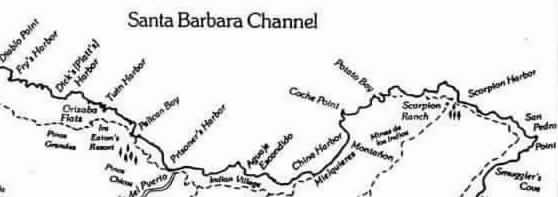
We return to Fry’s Harbor after a peaceful night at anchor in Pelican Bay. Today, because of winds and current there is a bit of a problem with anchors holding. Satisfied that the anchors are solidily set and able to hold, my team enters the water to recover the contents of two ARMS. The operation is complicated by the position of one of the ARMs which is upside down, overturned by the same forces which destroyed its nearby brother. We need to place it upright before we can retrieve the contents, a maneuver that is not as easy as it first appears. On the bottom, Derek and I take opposite sides of the ARM. Derek signals to stand upright and bend from the knees to overturn the cube cage. Not an easy position to assume, but it would be a mistake to underestimate the weight of the ARM. We wrestle it over and into a secure place. I have a new appreciation for UPS delivery drivers who must handle oversized packages.
The wind seems intent on challenging PR to a contest of "red rover" to see if it can break the integrity of the anchor lines. Eventually, our stern anchor begins to drag. The winds, which seem to come from all points of the compass, seem to spin the boat in the arc defined by the main anchor. We can’t be too careful here. We are close to the plunging wall of the island. The wind also makes for cold divers and cold divers make for less efficient data retrieval. But, the critters from the ARMs have to be classified, measured, and the data recorded. So, the divers stay warm as best they can, utilizing the galley and its plentiful supply of food and warm drinks.
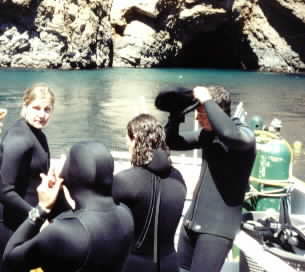 Gearing up for dive at Fry's Harbor. |
On the second dive, we replace the contents of the ARMs, securing the top in place with additional cable ties to hold it secure until next year’s survey. We check other cable ties on the structure and replace the ones that appear worn. Dave and Kate move some of the ARMs to locations not as exposed to surge and other forces. They use lift bags to float the ARMs in the water column. It looks a bit like an underwater hot air balloon. My team recovers the tape and Pelican buoys. We are done on this site and not a moment too soon. The fickle winds have played havoc with the anchors, unsuccessfully testing the seamanship of Derek and Sal. Anchors have dragged, lines have stretched, and patience worn thin. They have kept us safely on station but it is time to pull the hooks and go. |
Derek cautions that the 1 ½ hour trip to Smugglers Cove will take us right into the slop. He delays the start of that leg to allow all to get out of their wetsuits and to secure all the gear. We will be running cross and down a pretty good northwesterly swell. Upon leaving the site, we will not be in calmer seas until we get into the lee provided by the east end of the island. En route to Smugglers, we pass a Coast Guard cutter that seems to be engaged simultaneously in some type of search and rescue and law enforcement action. It is all very mysterious. The Channel Islands National Park dispatcher advises us to give the cutter a wide berth for reasons that are still not completely clear. We are hailed by the cutter via radio and identify ourselves as a Park Service vessel and offer any assistance. They query us as to any vessels we may have seen that day and decline our offer of assistance. We respond and continue on our way. PR soon rounds the east end of Santa Cruz Island and head to the anchorage. Coast Guard and U.S. Navy helicopters circle overhead identifying vessels in the area while a C-130 flies a pattern over the Channel, further evidence of a substantial mission. Radio traffic indicates that the authorities three possibly connected events, a missing vessel out of Channel Islands harbor for which nothing is known except the name, an incursion into U.S. waters of a Costa Rican military vessel, which may or may not be chasing a drug runner who may or may not have taken over the missing vessel in an act of piracy. No, I am not making any of this up, yet it has all the makings of Peter Benchley’s novel, The Island.
At anchor at Smuggler’s (a name that now takes on an ominous as well as sinister meaning given the unfolding events) several of the group decides to do a survey dive on the kelp forest to have what the British would call a look-see. No data collection, no instrumentation, no straight line transect, just a wander through the forest to have a look see. Conditions are near-perfect, flat seas, clear water, and a sun on its way to set. Just as the group is gearing up, a Navy helicopter circles overhead. Something tells me they are not seeking to determine if we are pirates. Lucky for me that I left my parrot onshore and my eye patch and peg leg below decks. The radio chatter indicates the Coast Guard out of Long Beach is trying to raise the Costa Rican vessel on the hailing frequency, Channel 16.
I chose to sit this dive out for no other reason than I don’t feel like going. With my compadres in the water, I am treated to more than an hour of solitude as the sole occupant of the boat. I am captain, mate, and crew. I savor the quiet. Is that running water I hear? I check the heads for a stuck valve and realize I hear the current-driven movement of the water against the hull. Soon, the divers return to the boat, with an infectious enthusiasm for the wonders they have seen, including a black sea bass. Even before they have removed their spent air tanks, the divers excitedly start tossing about the scientific names in reference to the critters encountered on the dive. These scientists still get energized about the prospect of seeing new natural history phenomena or rediscovering those previously seen and perhaps forgotten. Ironically, they can quickly revert to common names. I recall one of the scientists wondering if she had seen "a bunny rabbit" on one of the islands.
The animated conversation after a dive provides an insight into the folks I have spent a week with on board PR. These quality people take their jobs seriously, even in less serious moments. Yet, they maintain a certain playfulness in their approach to the task. Abraham Maslow, a social scientist who first developed the concept of the hierarchy of needs, noted that work and play can be indistinguishable under the right conditions, and these folks have found it. You would be mistaken to classify these people like this as "nerds" as our culture has conditioned us to do when thinking about scientists and what they do. They are not, as their conversations during the week have revealed. Many who come on these trips do so on their own time. While expenses are minimal for the participants on these trips, the opportunity lost cost for these busy people must be considerable. The work may be intense, sometimes arduous, sometimes tedious, but it gets precisely done with a minimum of fuss, no complaint, and no thought about on what other pursuits this time would otherwise have been spent. The workday is longer than eight hours, it goes on in their dreams while the boat is at peaceful anchor.
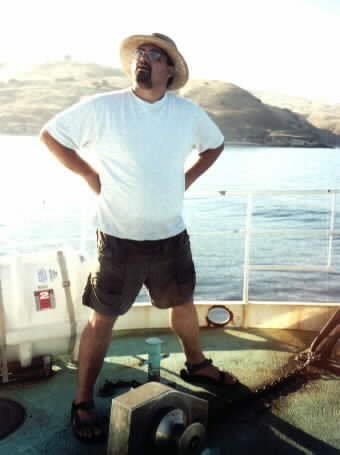 Sal looks toward the wheelhouse for signal to let the anchor go. |
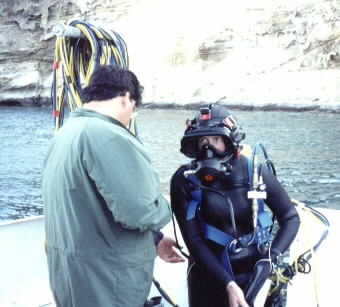 Sal assists diver into surface supplied air diving dress for random point contact protocol |
Take for example, Sal volunteering as deck hand for all trips this season (as in "without pay or cost to the taxpayers"). His on-the-beach job of high school math teacher is in remission from classes for the summer. Sure, six weeks at sea gives him a chance to recharge his batteries, get a little sun, and do a more than a few dives. But consider that on this day he must have anchored at least 12 times. His other glamour tasks include pumping effluent from the holding tanks overboard, checking us in and out of the water, running the on-deck console and air supply for the diver doing random point contacts and so on. Yet Sal typifies the caliber of volunteer in the Park. How does the organization continue to attract people like this? I don't know, they just do.
Click here to go to Cove Diver's Journal, Day Five
Click here to go to Cove Diver's webpage.