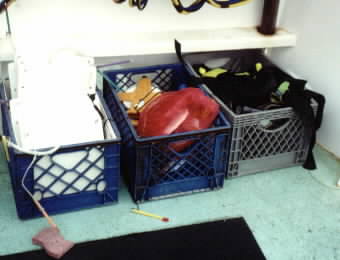
 KFM Still Life. Slates, tape measure reels, and weight belts secure for homeward voyage. Oxygen rig lashed and collection bags stowed. |
 |
Cove Diver's Journal--Kelp Forest Monitoring
Day Five, Friday, June 29, 2001
The last day! I see fatigue in the face of some of the crew this morning as the events of five days have begun to show. In two or three dives, we will pull the hook for the last time and head back to Ventura, cleaning the boat and stowing equipment as we make our way back. Already, gear that we will not use on the remaining protocols is put away. Masks used in random point contacts get cleaned and the line coiled and lashed.
Underway to Cathedral Cove on Anacapa Island, we have a following sea from the westerly swell. PR seems to surf the swell, which every so often seems to catch up and overtake her stern. At the cove, we anchor, but experience the same drag on the stern anchor that has plagued us intermittently during the last few days.
Our assignment is to retrieve the contents of seven ARMs. We hop in the water and surface swim about half way to the site and drop down as three teams of two divers. Each team takes two ARMs and the team that finishes first does the last one--kind of a reverse musical chairs, the last team with sufficient air does the work. Dave and I finish our two ARMs and start on the third. Dave and Derek finish it. Karen, who had been diving with Derek, joins me and we head back for the boat with the bags containing the contents of the ARMs. We cross a fresh anchor drag scar on the sea floor and follow it to the stern anchor. The stern anchor’s line brings us to within a few feet of the decompression bar and oxygen regulators. Not unlike following the Yellow Brick Road to the Emerald City (actually the Chesapeake green color of PR’s hull).
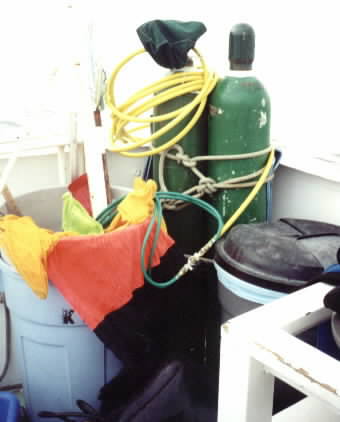
Back on board we classify and measure the critters in each bag. I am getting pretty good at this. A single dive team will replace the contents of the seven bags into the ARM of origin. (Each ARM bears a discrete identification number). Completing that task finishes the KFM diving. Now, activity switches to securing everything for the journey home. Slates get cleaned, the oxygen rig secured, and mesh collection bags stowed.
KFM Still Life. Slates, tape measure reels, and weight belts secure for homeward voyage. Oxygen rig lashed and collection bags stowed. |
|
Since we are in the vicinity, we receive a request to do a dive to prepare one of two of the island’s large ball buoy moorings for removal and repair by securing 35 feet of 1 and 1/4 inch chain to the buoy. A few weeks earlier, the buoy broke lose from its anchor just outside the landing cove and migrated toward Arch Rock before stranding on the reef. Using a rigid hull inflatable, island personnel pulled the buoy off the reef and secured it to the second mooring buoy. To repair the buoy, it would be towed a short distance to the landing cove where the island’s crane could lift the buoy and chain out of the water. However, to prevent damage from the 35-foot chain from dragging the bottom as it entered the channel to the landing dock, we needed to secure the end of the chain to the buoy effectively reducing the chain’s length by half. I volunteered to make this dive since I had worked on these buoys on two separate occasions with the island’s ranger.
PR backs us close to the buoys. The plan calls for Dave to use a lift bag to raise the end of the chain and me to tie it off to the buoy. Told to go to the first buoy, it turned out to be the wrong one, so we swam to the second buoy close by. David dropped down and secured the lift bag to the end of the chain. He added a second bag to provide the extra lift to bring the chain to the surface. In the meantime, I took up a position just under the buoy, keeping one hand over my head and on the buoy to keep the swell from bouncing the thousand-pound steel ball off my head. I quickly tied the chain off to the buoy, deflated the lift bags and returned to the boat with David. The entire operation took less than 15 minutes.
Heading home, the swell prevented us from doing much work on the stern. In some cases, cleaning gear with fresh water as salt water washed over the deck would have been counterproductive, in other cases it would have been dangerous. Still, plenty remained to do in the cabin prior to berthing. As before, everyone pitched in.
The rocking of the boat ceased as we passed the breakwater entrance to Ventura Harbor. Bumpers were deployed and the boat backed into her ship. In a reversal of Monday’s activity, all remaining items on PR were removed for storage. Goodbyes are said, and the team scatters to resume their on-the-beach activities. I am privileged to have met these fine people and to have been part of their endeavor.
Two weeks later, the process would again be played out as the ship left for another KFM cruise. The team would be reconstituted a mix of veteran divers and single trip walk-ons like myself. Options for that cruise would be constrained because of the work we had done. Each cruise collects data that provides a few more data points for monitoring the health of the kelp forests around the islands. No single cruise is crucial, yet each is necessary to get the data we need. Miss a couple of sites and you may break the continuity of observation that has been built over 20 seasons of monitoring. Such a break would render previously collected data less useful, although not useless, and would necessitate the start of a new chain of observation. The work goes on, unnoticed, much as the minute changes in the ecosystem that over time. But because of this work, these changes will be noticed and noted.
Click here to return to Cove Diver's home page.