 |
Deadhorse Diary 2005 |
Tuesday, September 27, 2005
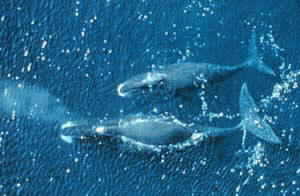
No flying today as the weather report indicates high winds all along the Beaufort Sea coastline from Barrow to Barter Island. Conditions look most promising at Barter Island to the east, but given our experience over the last two days with ocean conditions, we decide not to go. With 10 to 15 foot seas, white caps, and other factors, the likelihood of detecting a whale are almost nil, unless on happened to breach the surface directly underneath the airplane as the observer was looking straight down. Looking at the picture of the bowhead from above, you can see how the white of the lower jaw mimics the white cap.
|
As I write this, the wind howls outside my window. I know that is a cliché. Perhaps rushes past with a low constant rumble. In either event it sounds real cold out there. Due to the grounding, I spent the day working on various projects that I brought along from the office. The wind blew up the dust today, so staying inside was the best option, and any doubt was removed by the "BEAR IN THE AREA" warning posted on the door of the camp.
Friday, September 30. 2005
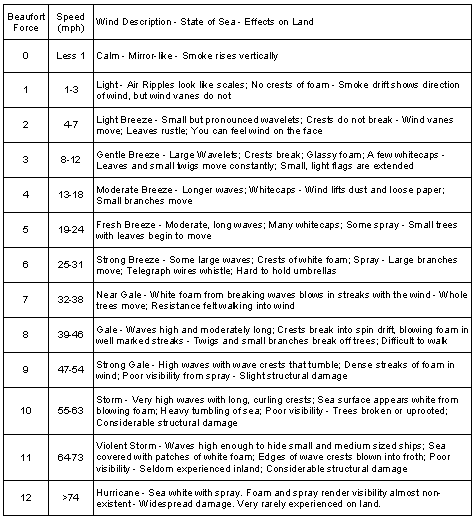
The lack of entries for Wednesday and Thursday signify that we have been down for three days due to high winds, low ceilings, and a host of other weather conditions. Winds were as high as 50 miles per hour at times. With winds like this the sea state, measured as a Beaufort Scale number, prevents the detection of the bowhead whales which may be in the area. Any condition more than a Beaufort 5 or 6 causes swells, foam, a sea of white caps, and high seas. The conditions not only keep us from seeing the whales, but also make a survivable emergency ditching in the Otter all but impossible. Yes, that possibility is a remotely unlikely event, but one that must be considered in planning. We call in every hour via satellite phone to ensure the automatic flight following program is tracking our progress for the same reason.
At the briefing this morning, the weather conditions appeared to be doable to the west towards Barrow. The team leader and the pilots thought it would at least be worth a look.
We took off and headed west. We skirted the coastline, getting offshore as quick as possible for our route to the search area. Once offshore, we found good ceilings (our survey should take place between 1,000 and 1,500 feet), good visibility, and freezing drizzle which was easily handled by the airplane and pilots.
| We initially spotted a couple of beluga whales. We soon began spotting bowhead whales along the transect. The pilots, who have the best forward view, sometimes spot the target before the observer. We feed our observation of number of whales, behavior, and speed to the data recorder via interphone who records the information into a spreadsheet on a laptop computer. A geographic information system provides the location to the spreadsheet automatically. The sea state in the search area quickly deteriorated. | 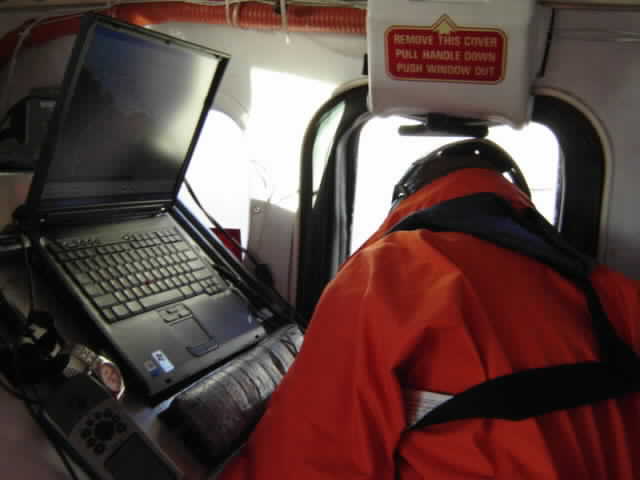 |
At one spot, we recorded a number of whales, but conditions probably prevented us from distinguishing other whales that may have been nearby. Lower ceilings further offshore made it necessary to truncate part of the transect, but we covered as much of the search area as we could. Out total flight time was 4.6 hours.