Sunday, October 2, 2005
We did not fly yesterday
because of conditions. This plague of high wind and low ceilings
continues unabated, compounded by freezing rain and drizzle in
the area. But, the winds seem to be dropping in velocity. Today,
we headed to the airfield around 9:30 a.m. in order to launch the
flight and see what conditions were like offshore. We were hoping
to get out and do a few transects. We got to the ERA hangar just
before the airplane was pulled out to the ramp. The ramp mechanic
raised the overhead door. The noise sounded like the tune-up of a
hopelessly out of tune symphony orchestra, with particular cries
of agony coming from the woodwind section. The airplane was
pulled out of the hangar and we climbed on board.
| We
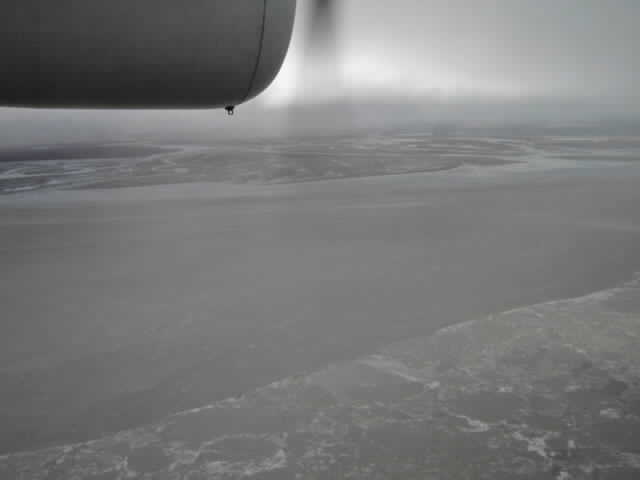
launched without any incident. Cruising toward the coast
it appeared that the ceiling was dropping offshore. Our
progress confirmed these conditions and we decided to
terminate the flight before flying any transects and head
back to the airfield at Deadhorse. This is the third time
we have gone up for a sneak and peek only to find that
conditions were not right for the survey. |
 |
The team continues to meet
every two hours, gathering at 12:30 p.m., 2:30 p.m. and 4:30 p.m.
to check the weather and decide whether it warrants going up. The
result of these gatherings is predictable; nothing looks
particularly good, so we decide not to dispatch. The forecast is
for improving conditions on Monday and Tuesday, possibly into
Wednesday, before the next system moves in with increasing winds
Tuesday, October 4, 2005
We did not fly on Monday due
to low ceilings across the North Slope. The wind died down and
the fog seems to have settled on the entire breadth of the Slope
from Barrow to the Canadian border.
Today, near perfect
conditions were reported at Barrow. We decided to head west.
Conditions at Prudhoe Bay are less than the minimum required for
departure, so we wait at the hangar waiting for the horizontal
visibility to improve. The runway visual range increases above
the minimum about 45 minutes lately and we load the airplane and
go.
We do the entire block 12
area off Barrow. Conditions are near perfect. The sea surface is
the calmest I have seen it on any flight this year and ceilings
are not a problem. Yet it appears as though this block, and
possibly the one adjacent to it, block 3, is the only areas where
conditions are sufficient to allow us to conduct the survey. We
do 6 legs in Block 12, during which we encounter more than 50
beluga whales in one group and 3 bowhead whales. We also see many
whaling vessels congregated offshore and later learn that the
Native Village of Barrow whalers have taken 3 bowhead whales as
part of their subsistent hunt. We avoid flying near them so as
not to disturb their activity.
After the survey in Block
12, we land at Barrow to refuel before doing a survey in block 3
enroute to Deadhorse. Fueling takes nearly two hours. Actually,
fueling takes about 20 minutes, we have to wait for 1 ½ hours
for our turn. It seems that with thewhales that need to be
processed, all but the most essential personnel from the village
are down at the beach helping with that community task. One
person has remained at the airport to refuel aircraft while his
co-workers have joined the others in processing the whales.
 |
We
depart Barrow and head to Block 3. We do four legs of the
survey, but fading light and other conditions force us to
terminate activity in Block 3 and head back to Prudhoe
Bay. We see no critters during our survey of Block 3.
Conditions permitting we will head back there in the
morning. Total time on search today, including the time
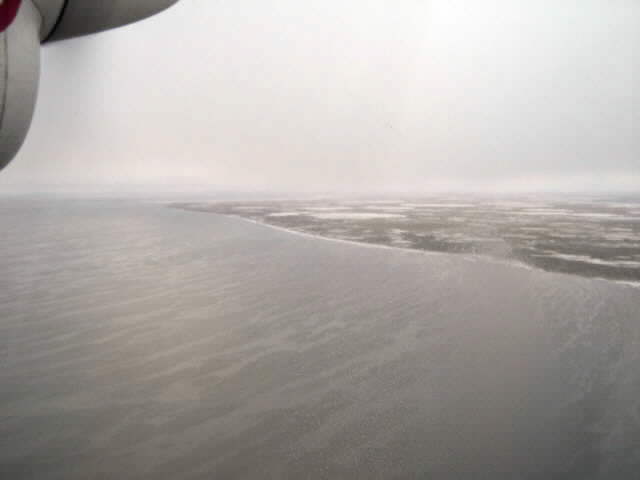
on the ground for refueling, is approximately 8 ½ hours. In the picture at the left,
the slick areas are forming sea ice. We record ice
conditions and coverage as part of our observations.
|
Wednesday, October 5, 2005
Once again, conditions
prevent us from flying today. But as with every day we check in
every two hours to see if conditions have changed enough to let
us fly. Reports across the slope indicate pretty poor conditions,
so we stay grounded. My replacement came in today, so I will head
back to Anchorage tomorrow.
Epilogue
The Autumn migration of the
bowhead whale out of the Beaufort Sea, when we do our aerial
survey, coincides with subsistence hunt of the whales by the
villages along the North Slope. Another hunt occurs in the Spring
during the bowhead whale migration into the Beaufort Sea.
Subsistence hunting in general, and for the bowhead in
particular, is the activity around which the villages are
socially and culturally organized. In these villages, with a
limited cash economy, subsistence harvest of these animals is a
form of social security for the elders of the village. The activity also represents the continuity of the culture from one generation to the next. As indicated above, we
avoided flying near the boats involved in the hunt near Barrow.
We give the hunt activities a wide berth so as to not to interfere
or intrude.
From reading this log, you
can see that during my tour our flight time was limited due to
weather conditions. That is the nature of the climate at the top
of the world. Perhaps there is another explanation. Upon my
return home, I started reading a recently-published book, Entanglements:
The Intertwined Fates of Whales and Fishermen, by Tora
Johnson. While the book explores right whales and activity that poses a threat to their existence in the North
Atlantic, the author opens Chapter 5 with the following
passage that originates from the North Slope of Alaska:
The Great
Spirit...made a special time each spring, when the ice of the
ocean would break apart to form a road where the whales would
swim. In the whale road, the Open Lead, the whales would come to
the surface and wait to be struck by the harpoons of the Inupiaq.
They would continue to do so every year as long as the Inupiaq
showed respect...as long as the Inupiaq took only the few whales
that they needed in order to survive.
But the
Great Spirit decided this also. At that time of year when the
Open Lead formed, when the whales came to the surface to be
hunted, the Great Spirit made it so that a heavy cloud of thick
mist would hang just above the ice, just above the heads of the
whales and the Inupiaq. The thick mist would hang there between
the sea and sky. "Though I give you permission to kill my
most perfect creation," the Great Spirit said, "I do
not wish to watch it."
"The
Gift of the Whale" as told by Michael Caduto and Joseph Bruhac
Return to my
homepage