Baja Journey--Day 1

Friday, December 7, 1990.

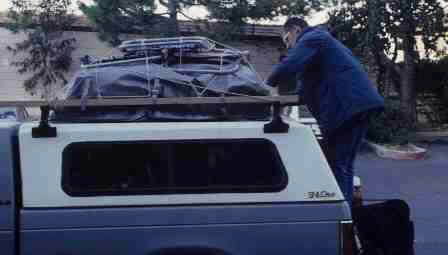
The truck is tightly packed. We have six tanks, dive bags, tents, sleeping bags, coolers, and assorted other flotsam and jetsam in the bag on the fiberglass Snug-top shell’s roof rack and in the bed of the truck. The rack is improvised from my sailboard racks and 2x4s. A vinyl cargo bag containing the less used items rests on the top of the shell within the improvised rack. Eyebolts and cleats in the 2x4s with a length of yellow plastic rope secures everything in place. The bed has just enough room for one person to stretch out, with the other two riding in the bucket seats of the cab. As we head south on Highway 5 toward the border crossing, we see groups of people walking up the median of the freeway. I can’t image what is going on as Andy explains that these people are probably undocumented border crossers. Right now they seem more like traffic hazards than anything else.

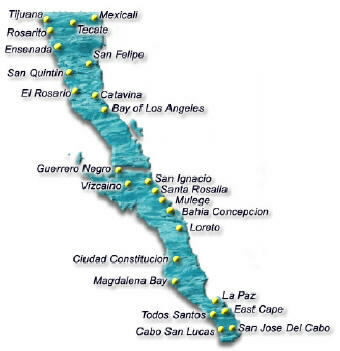
We slow to a stop at the border checkpoint. Smartly uniformed officers ask if we have any firearms. Our reply is "no, we do not" and we are directed to the Immigration counter. Because we are going deep down the peninsula, we have to have tourist cards approved by the officials. From the checkpoint, we catch the divided four-lane toll road, Highway 1D, from Tijuana to Ensenada.

South of Ensenada, the terrain quickly changes from urban to rural. We stop at San Quitin to fill up with unleaded gas, a commodity that is only available at some of the Pemex stations along the route. We are immediately surrounded by child vendors who aggressively jockey to wash our windshield or sell us cassette tapes. I politely turn them down and they ask "do you not like Mexican music?" I attempt to explain that I like all music but that I have more than enough tapes.

The guide books and people I consulted about travel in Baja advise leaded and unleaded gasoline is available in most larger towns and most of the stations associated with resort hotels, such as the La Quinta. My sources caution that smaller towns and isolated stations will have only leaded gasoline, if they have any at all. As such, I resolve to keep the tank always at least half filled. Consulting information given to me by our family friend, Carl Nielsen, who has traveling down the peninsula when the highway was just a dirt road, I map out critical fueling points and several intermediate locations to mitigate against the possibility of running out of gas. We have 2.5 gallon emergency reserve jerry can secured to the roof rack of the truck.
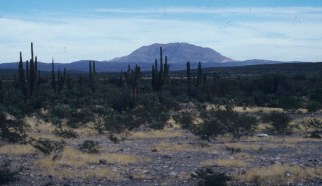
Between San Quetin and Catavina, our stopover point for the night, the terrain changes from coastal ranges to volcanic rock and caldera, bearing a resemblance to the landscape along Route 395 which winds up the eastern Sierra Nevada mountains in California between Mojave and Carson City, Nevada.
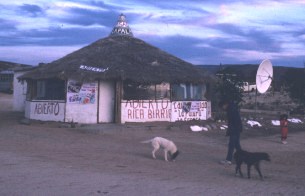
The entire route down Mexico 1 is open range. We see "road kill" cattle by the side of the road. At one point vultures circle over the road marking what turns out to be a road kill coyote. The travel guides discourage driving at night because of the livestock that takes refuge on the highway’s warm asphalt. Catavina is little more than a hamlet, a wide spot in the road, consisting of the campground, abandoned gas station, rancherias, and a luxury hotel. The terrain is largely rock boulder, which are said to contain numerous petroglyphs.
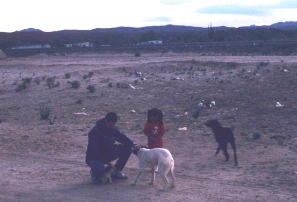
We set up camp. Staking the tent into the granite that underlies the camp is impossible so we find several large rocks to anchor the corner of the dome tent. We wander across the highway to the luncheria for dinner. Brandon immediately makes friends with the owner’s little girl and a small pack of dogs that seem to accompany her. Brandon speaks passable Spanish, which has already come in quite handy. I have a small vocabulary, picked up living in Southern California, but having taken German in high school I am at a disadvantage unless we meet a bus load of tourists from Bavaria.
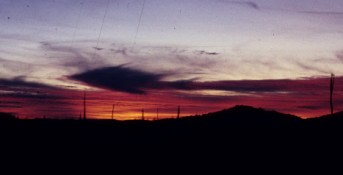
The diner is sparsely decorated, immaculately clean, and largely deserted. We are the only customers. I notice each table has an ubiquitous jar of Nescafe instant coffee, which I come to learn is regarded by many as the national drink of rural Mexico. Being a coffee hound, unable to start a dive trip without a 7-11 20 ouncer, I must look confused because the owner places a carafe of hot water before me and motions for me to help myself to the coffee. I order a carnitas dish, and can’t help wonder if it is related to some of the road kill we saw earlier. The evening sunset, the first of many we will see in Mexico, is fantastic.
During the night, cattle move into camp. I hear a noise outside the tent and shine my light into the night only to discover I am in the midst of a small herd. I mutter a silent prayer that nothing creates a stampede or that none of the boys have come a callin’ looking to revenge the entree at tonight’s dinner. A cold, brisk wind blows across the camp carrying on it the chorus of coyote howls that become my Mexican lullaby.
Return to covediver's home page

Continue to next page

Hosted by www.Geocities.ws

1