Baja Journey--Day 2: The Road to Mulege |
![]() |
Saturday,
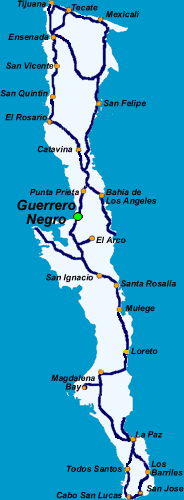
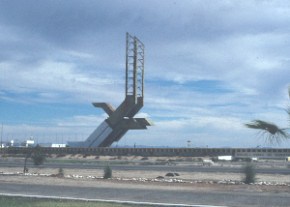
December 8, 1990 We break camp rapidly in order to get to Mulege by early afternoon. We thought briefly about detouring to Bahia de Los Angeles but decide to press on for our original destination. We fuel the truck just outside of Guerro Negro at the La Pinta Hotel. We are at the line of delineation between the states of Baja del Norte and Baja del Sur, as signified by a monument that straddles the highway along the 28th parallel. The monument, a unique architectural feature, seems worn out. It seems emblematic of the promise and reality that is this part of Mexico. Baja until very recently was largely a neglected frontier. Schemes to bring economic development abound, but seem to wither in the glare of the desert sun. |
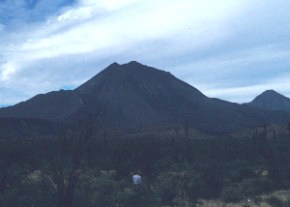
| From here we turn east heading across the mountain spine of the Baja Peninsula. We once again enter volcano country, stopping to stretch our legs and get some photos of three volcanic cones, the Tres Virgenes. Brandon goes off into the bush in search of the indigenous reptiles while we enjoy the view. It truly is breath taking. | ![]() |
| Thus far, the road has been in very good condition. comparable to most secondary highways in the U.S. We are making very good time, cruising at 70 to 80 miles an hour at times. The skeletal remains of wrecks, mostly in the areas marked with the sign Curva Peligrosa or "Dangerous Curve" and the shrines to accident victims that punctuate the shoulder of the highway should serve as a caution to slow down. In some of the smaller villages, speed bumps actually cross the highway and are heralded by signs which state Topes as if to warn "slow down or we will bottom out your suspension." Although I installed heavy duty shock absorbers in preparation for the trip, the weight of the accumulated dive gear and other material makes me approach the asphalt reef of the speed bump with caution less it rips out my bottom. Signs along the highway emphasize that the road is built for economic development, not high speed driving. I agree, but do not find the two objectives mutually exclusive. The faster I get to the dive spot the sooner I will start to spend money which will help their economy grow. |
![]() |
Driving
this highway is a pleasure. It seems to be thin ribbon of
asphalt, two lanes in most places, a little wider in some
spots, a little narrower in others. Blind spots are
numerous but well marked. At one point where the highway
crossed an arroyo, the road had washed out. A crew worked
to replace the missing stretch of pavement while we were
sidetracked onto a detour through the dirt carved by a
nearby tractor. Drivers are exceedingly courteous, waving you by to pass their slower vehicle or signaling with the left directional when it is safe to pass. Often, stakeside trucks or pick ups are loaded with as many passengers as possible. One truck we passes must have had a dozen people in the back and it was standing room only. I began the drive with my lights on during the day as I would most isolated undivided highways in the United States, but quickly relented as every oncoming vehicle flicked their lights at me as if to say, "hey, your lights are on, turn them off, it is broad daylight." Perhaps the Baja vehicle codes prohibit such practice and this was the locals way of keeping me out of trouble with the authorities. |
| At two points along
the way, we come across groups that have set up fund
raising stations, almost like a toll booth, at the side
of the road. One point is within clear sight of an
agricultural inspection station. The sign indicates the
local village is soliciting donations for an ambulance. I
slow to a stop. I figure 3,000 pesos (about $3.00) would
help. The people graciously thank us and we proceed a
short distance down the road to the inspection station.
We are asked if we have any plants, reply "no"
and are waved through without any further consideration.
Was our donation coupled to our expeditious processing.
Guidebooks tell us of the custom in Mexico known as
"moridita" or "the little bite,"
where a small fee is rendered for trivial infractions, a
sort of petty corruption engaged in by minor officials or
a gratuity rendered for special consideration, depending
on your point of view. Mine is the latter. In the whole
time in Mexico, I was not hassled by the local officials
despite sufficient provocation that comes from breaking
the basic speed law. Clearing the mountains we power coast down a long grade from which we catch our first glimpses of the blue waters of the Sea of Cortez--we have arrived. We quickly traverse the mining town of Santa Rosalia and we are again in coastal desert. We come upon a motorhome with a trailer that is listing to port. We stop to ask the couple from Oregon if we can be of any assistance and inspect the damaged trailer. What I first thought to be a flat tire turns out to be a lost rim and tire. Only the axle hub rests on the pavement. They graciously decline our offer of assistance, we say "via con Dios" and we are on our way. |