PICTORIAL HISTORY of VIVISECTION 1804-1848 |
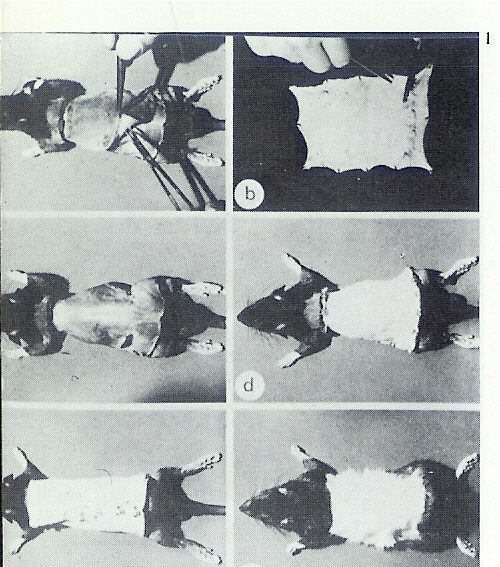
1804: Baronio tried grafting skin from a cow onto a mare - and failed. 1863: Paul Bert tried grafting skin from rats into guinea pigs - and failed. photographs: c1950s. skin grafts in mice (not Barono nor Bert`s experiments) Hindu surgeons, in c800BC, had used human skin grafts to reconstruct the facial injuries of human patients. Gaspare Tagliacozzi, in 1564AD, had used a flap of skin from the arm of a patient to restore the patient`s nose. Garengot, in 1746, regrafted human skin onto the injuries of soldiers. |
 |
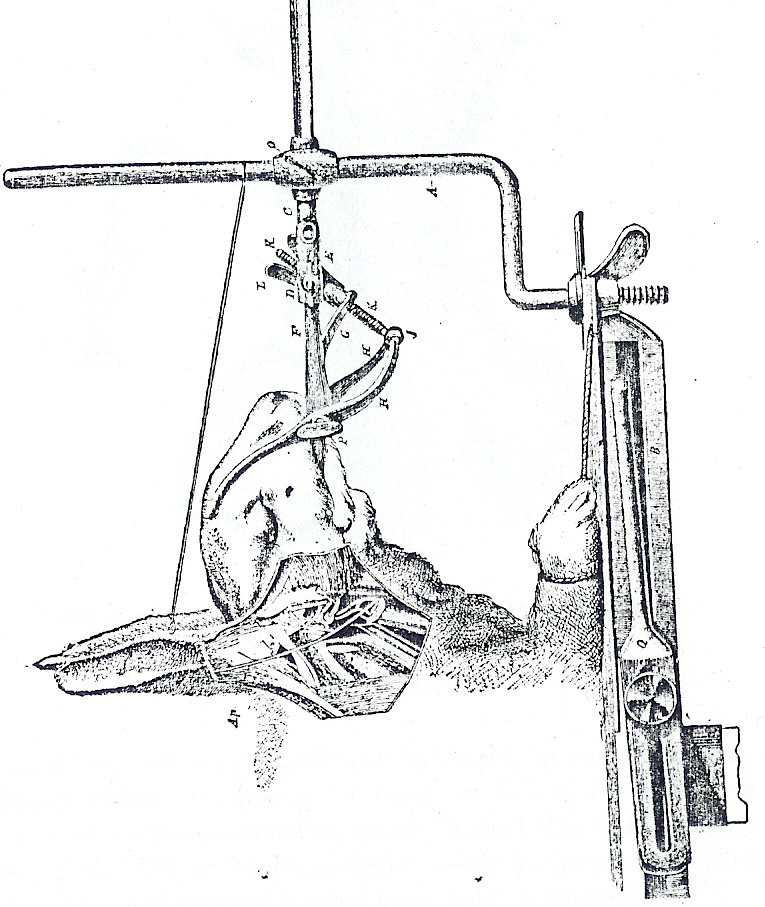
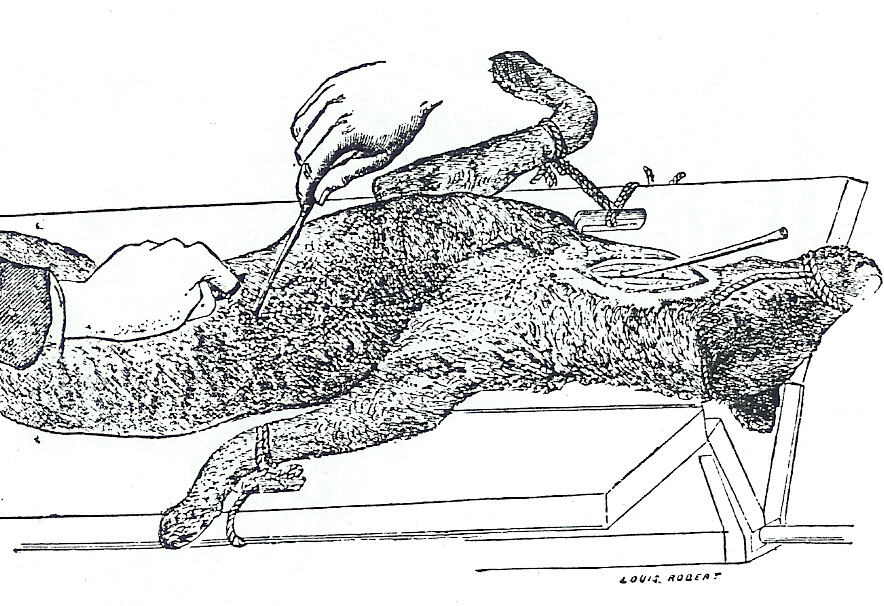
1811: Charles Bell is said to have experimented on animals to demonstrate that anterior spinal nerves are motor nerves, and that posterior nerves are sensory nerves. 1822: Francois Magendie experimented with 4,000 dogs to "prove" that Bell was correct in his distinction between motor and sensory nerves, and then experimented on anoth 4,000 dogs to "prove" that Bell was wrong! Drawing: 1876 Rabbit with its spinal nerves exposed. Susruta, in 600Bc, had, from clinical observations, recognised the difference between motor nerves which connect the brain to the muscular system, and sensory nerves which transmit information from receptor. Bell`s re-discovery of motor and sensory nerves came from his studies of human cadavers - but he was forced to experiment on animals to convince others. Bell wrote: "Experiments have never been the means of discovery; and a survey of what has been attempted in late years in physiology will prove that the opening of living animals has done more to perpetrate error than to confirm the just view taken from the study of anatomy and natural motion". `Medico-Churcigal Review and Journal of Practical medicine` reported, in 1838, that "His [Magendie`s] experiments, not being philosophically instituted or directed have tended to confuse the plainest truths and to establish the most extravagent fancies". |
 |
 |
|
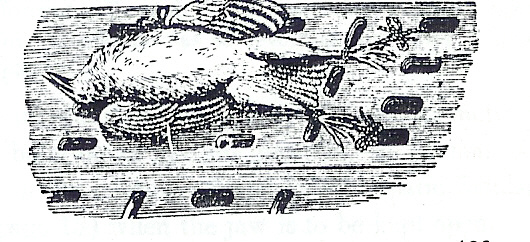
1822: Flourens destroyed the cerebellum of pigeons and concluded that this caused loss of voluntary control but maintained the reflexes. Drawing: 1870s. Pigeon on "vivisection table" (not Flouren`s experiment). From his experiments on pigeons, Flourens denied any possibility of cortical localisation. Paul Broca, in 1861, dissected the body of a woman, who before her death had lost the ability to speak. Broca found a softened portion in the left frontal lobe of the woman`s brain - but his clincial findings were rejected by the medical profession because they were in complete contrast to the (wrong) conclusions from Flouren`s experiments on pigeons. |
 |
|
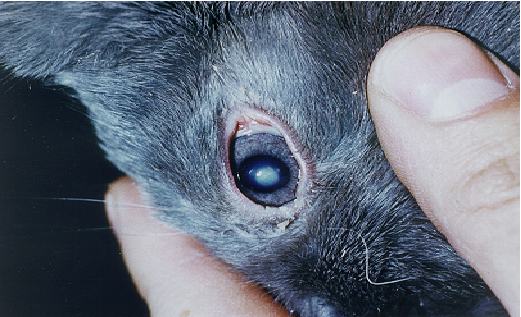
1838: Richard Kissam grafted the cornea of a pig into a human patient. Two weeks later, the cornea started to become opaque and was absorbed. 1841: Marcus tried an animal-to-human cornea graft - and failed. 1843: Steinberg tried animal-to-human cornea grafts - and failed. 1872: Henry Power experimented on cats and rabbits - trying to graft the cornea from one species to another. When Power tried grafting corneas of rabbits into two children, the grafted corneas clouded over and failed to function. Photo: rabbit with damaged cornea (not Power`s experiment) 1877: Arthur von Hippel grafted the cornea disc of a dog into a human - the cornea clouded over. Conrad Zirm, in 1905, carried out a full thickness cornea graft from one human to another - which proved successful. |
|
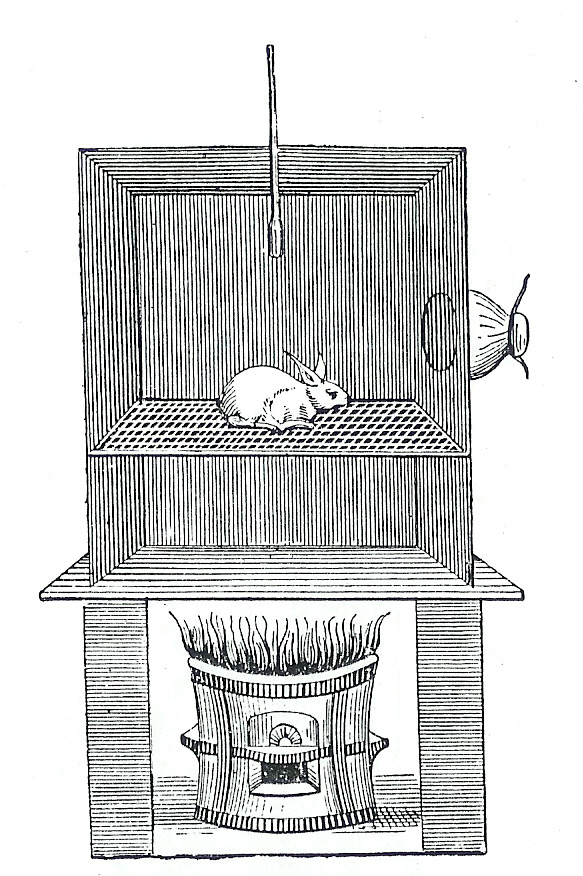
1844: Claude Bernard built a stove in which animals were slowly baked at 90-100 degrees C. Dogs died after 6 mins, pigeons after 10 mins, rabbits after 24 mins. Drawing: 1876. Rabbit in Bernard`s first stove. Bernard admitted, in 1876 "The machine which served our first experiments presented an imperfection which rather complicated the phenomenon". Bernard built a second stove, in which rabbits were heated to 65 degrees C and died after 20 mins. Bernard believed that these experiments would show the cause of fever. Bernard was wrong. High temperature is a consequence, not the cause, of fever in humans. 1850: Bernard cut the sympathetic nerves of animals to influence peripheral blood flow, and punctured the vagus to observe fluid which accumulated in the oesophagus. 1854: Bernard fasted animals and declared there was no sugar in the portal vein, only in the vein of the liver - concluding that the liver was the source of the sugar. Bernard was wrong. Illustration: 1876. Bernard experimenting on nerves and liver of dog. 1850s: Bernard stuck a needle into the cranium of a rabbit and sugar appeared in the urine. he tried repeating the experiment - and failed. He punctured the spine of a dog and declared "Diabetes is a nervous ailment". He was wrong. Thomas Cawley, in 1788, from autopsy studies, had shown the connection between daibetes and the pancreas. |
|
 |
 |
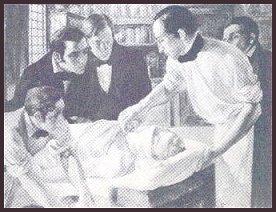
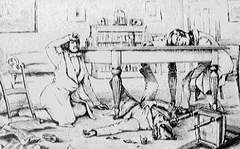
1846: William Morton experimented with ether as an anaesthetic on animals. Crawford Long, in 1842, had used ether clinically when he removed a tumour from a human patient. He went on to use ether in other operations on people - without having conducted any animal experiments. pic: 1842. Crawford Long`s first use of ether. 1848: T H Wakley tried the effects of ether and chloroform on animals - of 33 given ether, 22 recovered and 11 died; of 67 given chloroform, 37 recovered and 30 died. Wakley concluded that neither ether nor chloroform should be used in humans who had heart disease. A celebrated surgeon, with a heart condition, had died, in 1847, after he had been given chloroform. A clinical finding before Wakley`s animal experiments. Chloroform had been discovered in 1847 by Simpson, who tested it on himself and friends. Drawing: 1847. Simpson and friends recovering after trying chloroform. |
 |
 |
|
PICTORIAL HISTORY of VIVISECTION index - click arrow |
 |
PICTORIAL HISTORY of VIVISECTION 1850-1899 - click arrow |
 |
 |
 |