PICTORIAL HISTORY of VIVISECTION 1850-1899 |
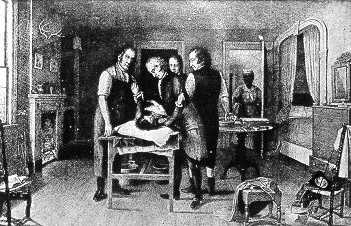
1850s: Spencer Wells experimented on rabbits and guinea pigs and claimed to have found "the best way of closing wounds of the abdomen in ovariotomy". By 1880, Wells had performed 1,000 ovariotomies on women - one third died. Houston, in 1701, performed the first successful ovariotomy on a human patient. McDowell, in 1801, performed a successful ovariotomy. Drawing: 1801. McDowell`s first ovariotomy. Clay, in 1842, included the peritoneum in sutures uniting the abdominal wound in his ovariotomies - stating that the procedure owed nothing to animal experiments. Lawson Tait opposed vivisection on medical grounds. He rejected Wells` method, and by 1886, had performed 139 ovariotomies - with no deaths. |
 |
| 1856: Moritz Schiff removed the thyroid glands of dogs, cats, and guinea pigs - the operation was fatal in these species. Edward Crisp reported, in 1875, "I have been a vivisector for some time. For several years I cut into animals, removing the thyroid glands... as I advanced with age, I saw fit to alter many opinions that I had formed at an earlier period, and I have come to the conclusion that vivisection has not led to the good advocates believe" 1884: Victor Horsley removed the thyroid gland from monkeys, and Schiff repeated his animal experiments. Horsley and Schiff tried treating induced myxoedema by grafting thyroid glands into other animals - and failed. Drawing: 1875. Experimental thyroidectomy on dog. (not Schiff or Horsley experiment) Thomas Curling, in 1850, by autopsy and clinical studies, had shown the connection between the thyroid gland and myxoedema. Kocher, in 1883, performed thyroidectomies on human patients - before Horsley and Schiff`s animal experiments. |
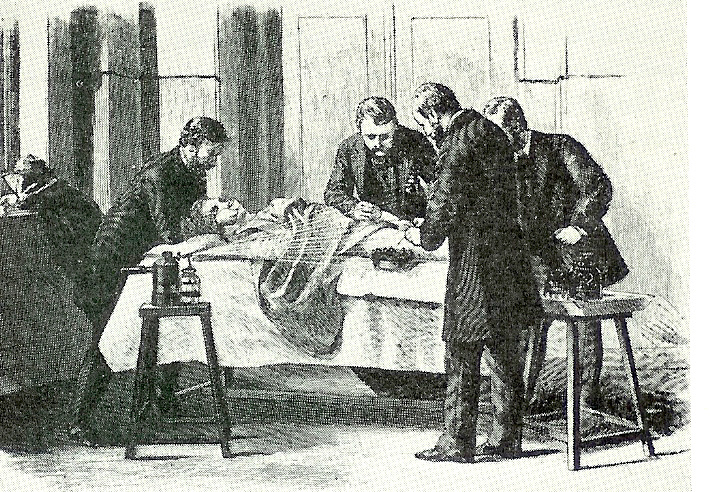
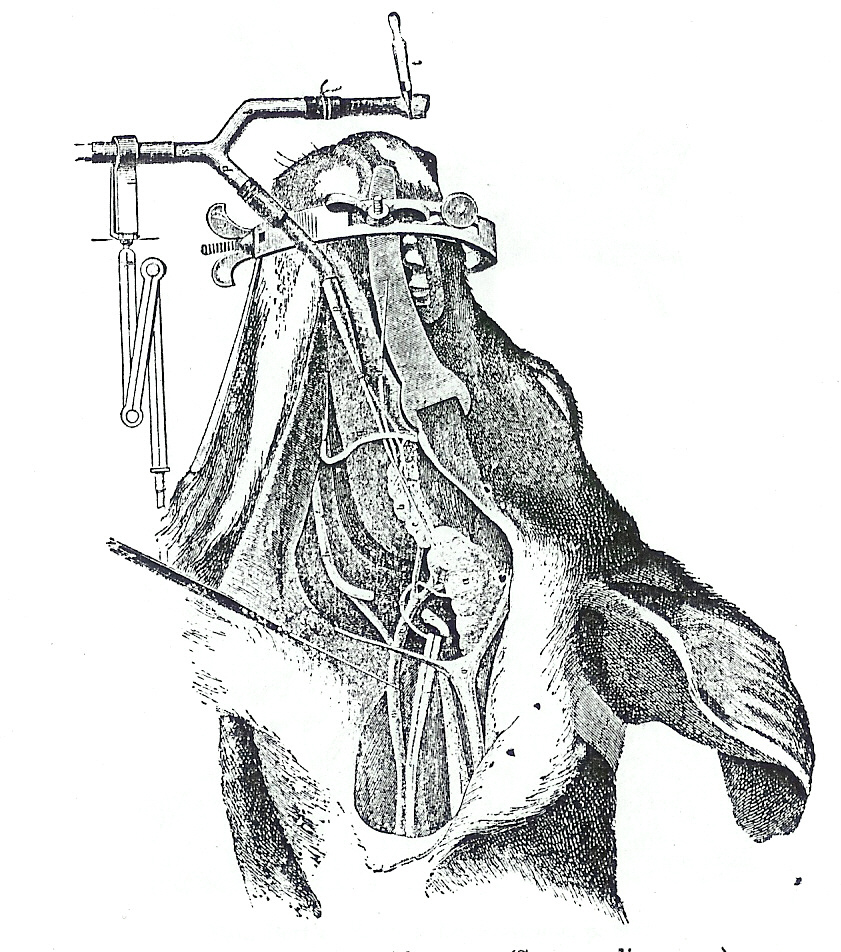
1857: Joseph Lister experimented on inflammatory changes in circulation in the web of the feet of frogs and in the wings of bats - which he claimed led him to study antisepsis. 1867: Lister conducted experiments with various dressings, which he tried clincially. Carbolic acid on crusts of blood resulted in one patient dying and another needing a limb amputated. Lime soaked in undiluted carbolic acid caused death of the tissue of the patients. Putty of carbonate of lime, mixed with a solution of carbolic acid and boiled linseed oil, caused swellings and signs of acute fever in patients. By 1870, all of these methods had been abandoned. 1868: Lister experimented with ligatures of silk thread soaked in carbolic acid. Clinically, it was unsuccessful. 1869: Lister tied the carotid artery of a calf with catgut. A month later, the calf was killed and opened up. Lister found that the catgut had disappeared. When he tried this clinically, he failed. 1872: Lister devised a steam-powered spray - filling the operating theatre with carbolic acid. Carbolic acid soaking the surgeon`s hands and the skin of the patient; acrid chlorine gas was released - affecting the nose, eyes,and throats of the surgical staff. Drawing: 1872. Lister`s carbolic acid spray in use during operation on patient. Lawson Tait, in 1880, turned away from Lister`s antisepsis methods and, instead, used asepsis - absolute cleanliness during his operations. By 1900, most surgeons had turned to asepsis, and by 1918 only very few surgeons held on to the belief in Lister`s antisepsis - most rejecting it and used asepsis. |
|
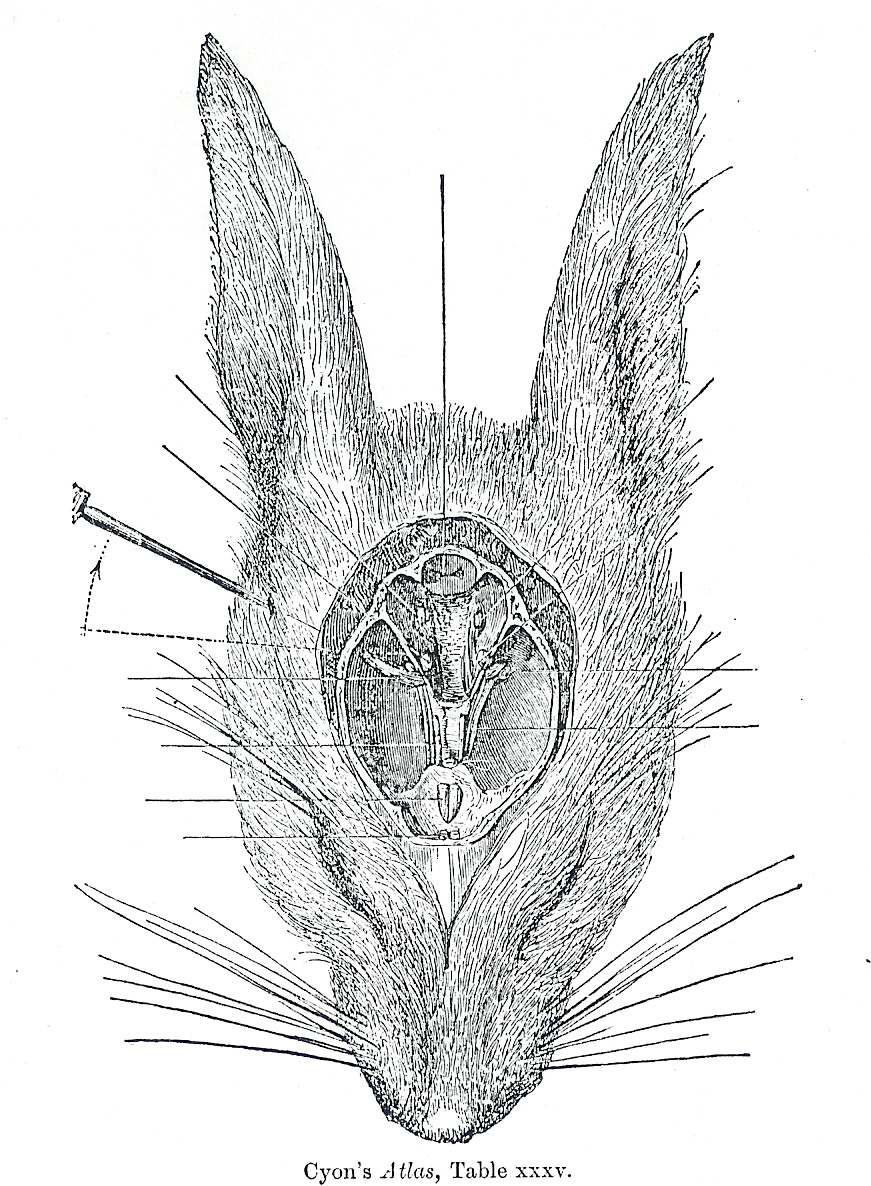
1871: Fritsch and Hitzig removed the top of the skull of live dogs and stimulated various parts of the exposed brains. Prior to their animal experiments, Fritsch had treated soldiers, who had had parts of their brains exposed as a result of injuries during the Prussio-Danish war. Fritsch had noticed that touching certain parts of the exposed brains of the soldiers caused involuntary twitching movements in certain parts of the body on the opposite side. Hitzig had also stimulated exposed patches of human brains with a weak battery and had found that stimulation near the back of the brain caused the eyes to move. 1881: Goltz reported on his experiments, in which he damaged the brains of living dogs and said that motor centres did not exist. Ferrier reported on damaging the brains of monkeys and stated that motor centres did exist. Other experimenters also exposed and damaged the brains of animals - each contradicted the other. Drawing: 1875. Rabbit with brain exposed. |
 |
|
 |
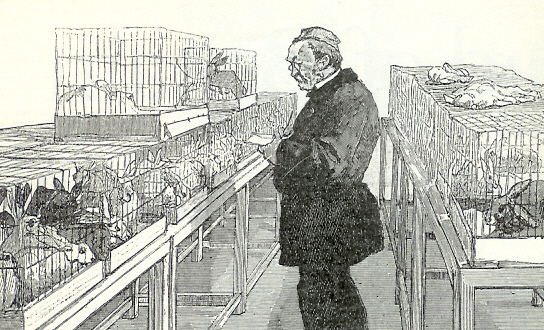
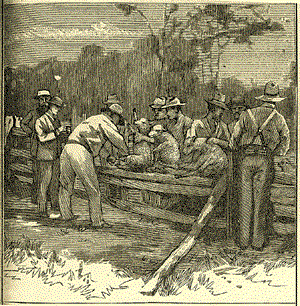
1872: Louis Pasteur claimed to have discovered the "germ theory" by experiments on rabbits. Drawing: 1870s. Pasteur in his lab with caged rabbits. Antoine Bechamp, in 1864, had studied yeast in a test-tube and had established the germ theory 8 years before Pasteur. 1881: Pasteur claimed he had developed a vaccine to protect sheep against anthrax. He took 50 sheep and vaccinated 25. All 50 sheep were then exposed to anthrax. All 25 vaccinated sheep were said to have remained healthy, while 22 unvaccinated sheep died. Drawing: 1881. Pasteur vaccinating sheep against anthrax. The Hungarian Commission, in 1881, reported that Pasteur`s vaccine accelerated anthrax; and the Turin Vet School, in 1882, found that vaccinated and unvaccinated sheep died when inoculated with anthrax bacillus. 1884: Pasteur announced that he had transmitted rabies virus thru monkeys and had then fortified it in rabbits - which would protect dogs from rabies. When Pasteur tried this vaccine in dogs, only 15 out of 22 were "refractory". Pasteur turned to rabbits in the transmission process, and is said to have developed a vaccine which was tested in animals, and then used clinically. In fact, Pasteur tried his rabies vaccine on two human patients with advanced symptoms of rabies before he tried the vaccine on symptomatic animals. With increased clinical use, statistical evidence showed that inclidences of rabies actually increased folowing the introduction of Pasteur`s vaccine. |
 |
|
 |
 |
|
 |
|
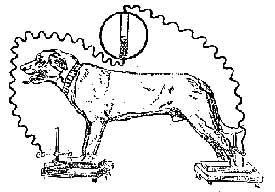
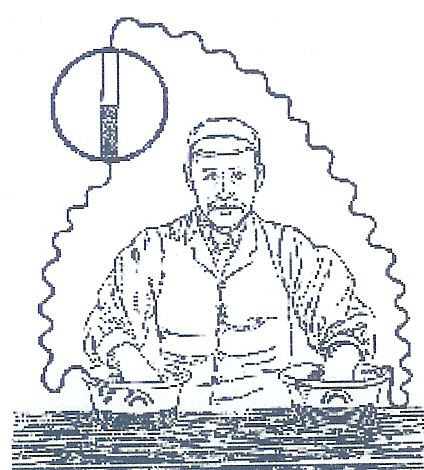
1887: Augustus Waller measured the electrical activity of the heart of dogs without opening the chest by using a capillary electrometer. The instrument allowed a fine column of mercury to be photographed onto a moving plate. Drawing: 1887. Waller`s experiment on dog. Unlike what occurs in humans, in the experiment on the dog the front paws, coupled with an inductor, are silent. The capillary electrometer could detect the tiny current of a beating heart but was too sluggish to follow the heart`s fast electrical variations. Waller wrote an "Introductory address on the electromotive properties of the human heart" in the `British Medical Journal` in 1888. As there are differences between the heart of a dog and that of humans, it was the trial on humans which showed the potential. Drawing: c1888 Waller`s clinical trial |
 |
 |
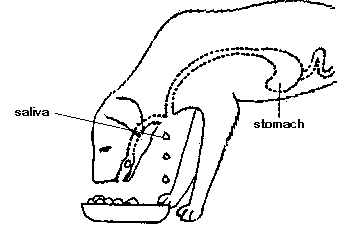
1895: Ivan Pavlov cut the wall of the digestive canal of dogs into small pieces, stitched up the wall, and then collected the diverted digestive juices. In further experiments, Pavlov severed the digestive tract from the mouth to the stomach of dogs fixed a tube in place. When the dog ate, food could not pass into the stomach, but fell thru an opening in the tube. Illustration of Pavlov`s experiment. William Beaumont, in 1833, had studied the gastric actiivty of a human patient - Alexis St Martin - who had sustained a shotgun wound to the stomach, which had left a hole thru which Beaumont could make his clinical observations. |
 |
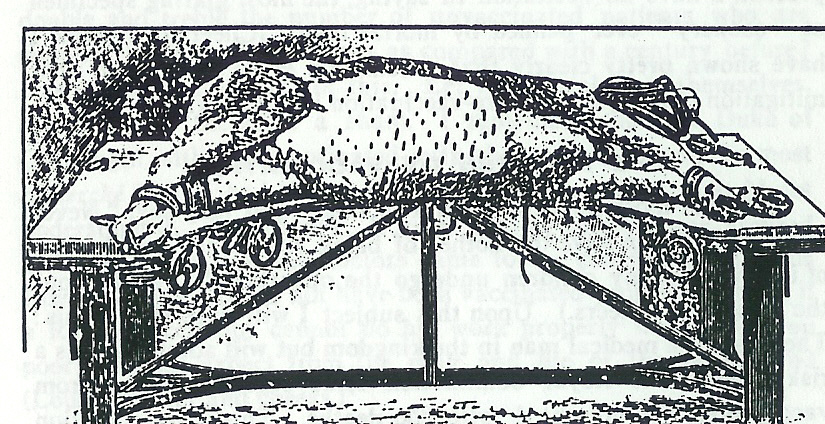
1898: The UK government dictated that all smallpox vaccine was to be produced from calf lymph - which was injected into rabbits to increase virulence. Each batch of vaccine was tested on the skin of rabbits or calves, and later in the eyes of rabbits or guinea pigs. Drawing: c1900. Production of calf lymph by puncturing skin of calf Vaccination did not reduce the death rate from smallpox. In 1881, with 97% of the UK population vaccinated, the death rate was 46 per 100,000. By 1901, with less than 68% of babies vaccinated with calf lymph vaccine, the death rate had fallen to 43 per 100,000; and by 1911, with even less vaccinated, the death rate had fallen to 39 per 100,000. |
 |
|
PICTORIAL HISTORY of VIVISECTION index - click arrow |
 |
PICTORIAL HISTORY of VIVISECTION 1900s - click arrow |
 |
 |
|
|
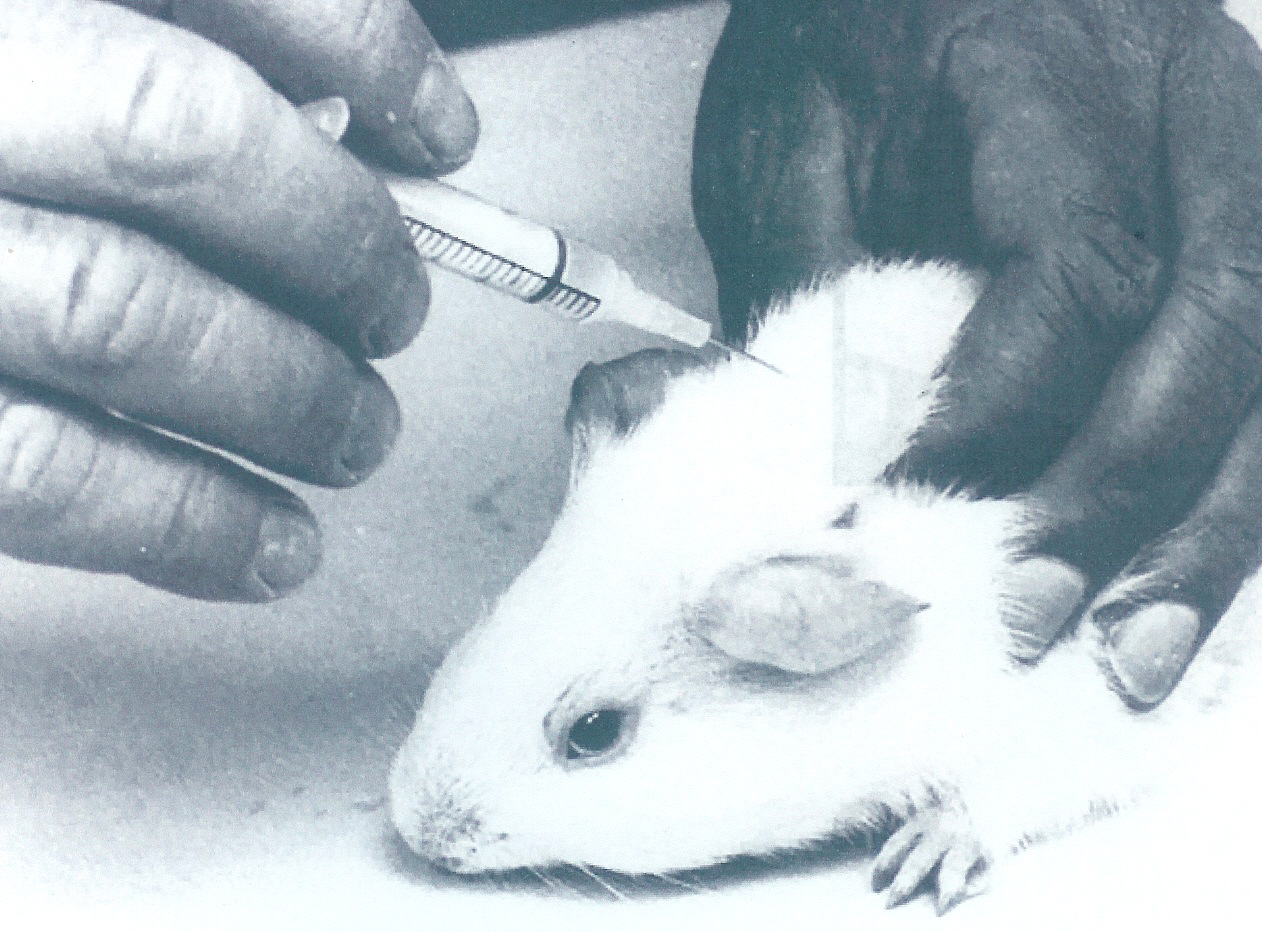
| . 1882: Robert Koch isolated tubercle bacillus which he injected into guinea pigs - claiming this caused tuberculosis in the animals. Dr Doyen, a French specialist in TB, stated in 1912 "The tuberculosis of the guinea pig is not the tuberculosis of man". Photo: 1990s. Inoculation of guinea pig. (not Koch`s experiment) 1899. Koch injected pure culture of tubercle bacillus under the skin of guinea pigs and a year later claimed he had developed a vaccine which protected guinea pigs against TB. Koch`s vaccine - known as tuberculin - entered clinical use in 1890. Evidence showed that it did not protect against TB in humans. Koch was to admit "As regards the effect of the remedy on human beings, it was evident at the very begining of the experiment that, in one very important point, the effect of the remedy on man is entirely different from that on the guinea pig, which is the animal usually experimented upon... Here, again, is fresh and conclusive proof of that most important rule for all experimentalists, an experiment on an animal gives no indication of the result of the same experiment upon a human being". |
 |