PICTORIAL HISTORY of VIVISECTION 18th C |
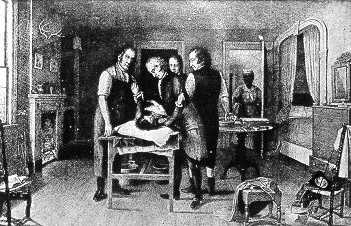
1703: John Shipton is said to have "laid the foundations of abdominal surgery" by his experiments on animals. Robert Houston, in 1701, performed the first successful ovariotomy - without having conducted animal experiments. As Lawson Tait recounted "Failing to see the lessons learnt from this, and led astray by vivisection, no further success was achieved until 1809 by Emphraim McDowell. Drawing: 1809 McDowell operating on a human patient. |
 |
 |
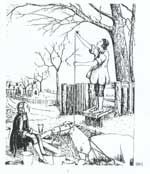
1733: Rev Stephen Hales used a 9ft long tube attached to to the flexible windpipe of a gose to measure the blood pressure in the femoral and carotid artery of a horse. Drawing: 1700s of Hales`s experiment on horse Hales performed a further 8 experiments - on sheep, deer and dogs - and concluded that once blood leaves the heart, arterial pressure becomes less as it travels along smaller peripheral arteries towards the veins. Hales was wrong and his incorrect theory persisted for a century. J Favre, in 1856, made the first accurate measurement of blood pressure in a human, when, during an operation, he catheterised the patient`s femoral artery, bound it to a manometer, and detected pressure in the femoral and brachial arteries. |
 |
|
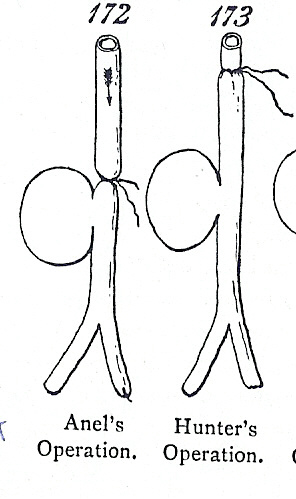
1758: John Hunter tied off the femoral artery of a stag, without removing the distal portion of the limb, to treat an aneursym. Hunter performed the operation on a bricklayer in 1785 - which failed. Anel, in 1710, had operated on an aneursym in a human patient. He placed a ligature on the popiteal artery itself, close down upon the aneurismal sac. Drawing: 19th C. showing position of the ligature in Anel`s and Hunter`s operations. |
 |
|
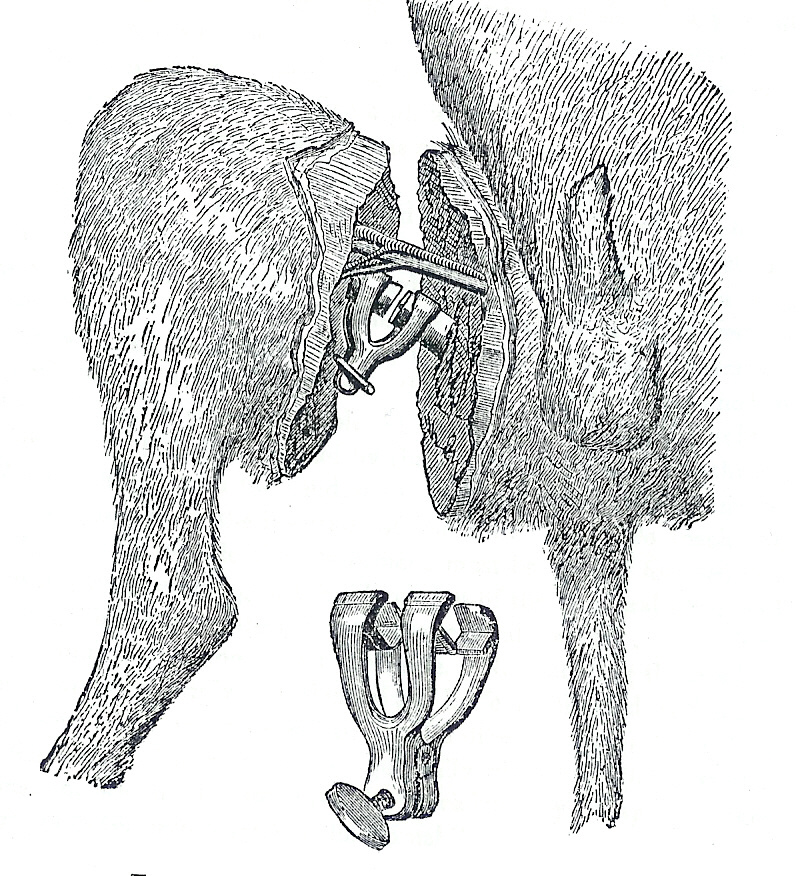
1778: The Secretary General wrote in the preface of `Memoires de l`Academie de Chircurgie` that amputation of the hip joint had only become possible after experiments on animals. Drawing: 19th C. Severed hip of dog. Vohler, in 1690, had practiced surgery for amputaion of the hip joint on a human cadaver. M la Croix, in 1748, successfully carried out the operation on the hip of a human patient - without having performed animal experiments. |
 |
|
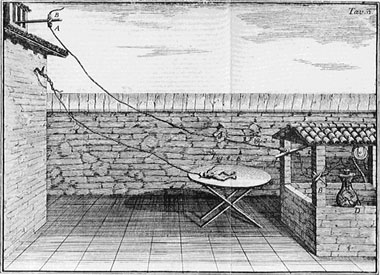
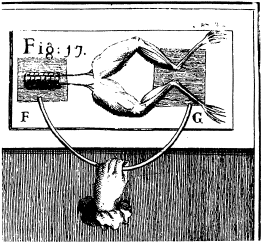
1780: Luigi Galvani touched the exposed femoral nerve of a freshly killed and dissected frog with a metal object near a static electricity machine - which caused the frog`s legs to twitch. Drawing: 1780s. Galvani`s first experiment with frog`s leg. 1786: Galvani hung some frog`s legs on copper hooks from iron railings and noticed that, although there was no static electricity machine nearby, the muscles in the frog`s legs twitched every time they touched the iron railings. Galvani believed that the frog`s legs contained electricity and performed further experiments. Drawing: 1780s. Galvani`s later experiments with frog`s legs. 1790: Alessandro Volta experimented with muscles and found a series of electrical impulses could make the muscles contract. Volta, at first, agreed with Galvani`s theory of inherent electricity in animals. Johann Sultzer, in 1761, had applied a "V" shaped strip of two different metals to his tongue and found that when contact was broken it caused a tatse in his mouth until the contact was re-established. Volta learned of Sultzer`s clinical finding and changed his opinion, and concluded that electricity was generated by contact between two strips of different metals and that Galvani`s experiments had merely indicated that electricity was made by contact between the copper hooks and iron railings. |
 |
 |
|
PICTORIAL HISTORY of VIVISECTION index - click on arrow |
 |
PICTORIAL HISTORY of VIVISECTION 19th C - click on arrow |
 |
 |