PICTORIAL HISTORY of VIVISECTION 17th C |
 |
|
|
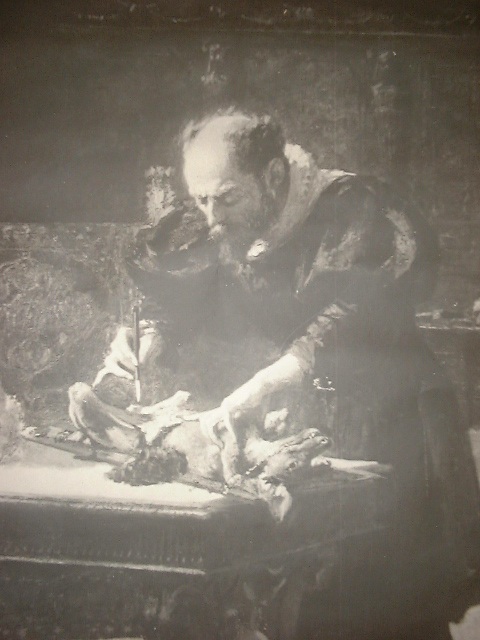
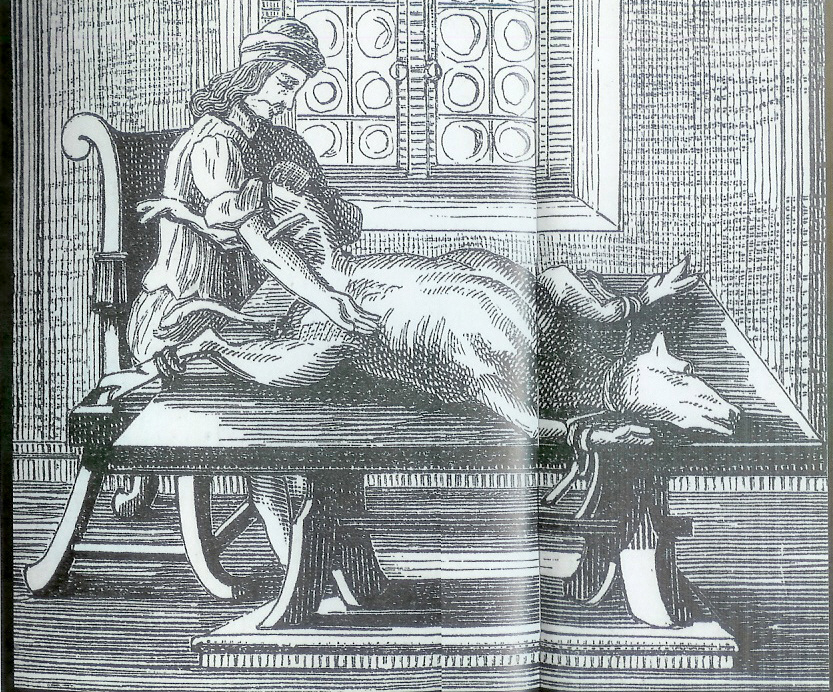
1622: Gasapare Aselli opened up a dog which was digesting food and is said to have discovered the lactreals (lymphatic vessels in the mesmentary). From this experiment, it is claimed that Aselli demonstrated the flow of chyle (the nutrient product of digested food from the intestines to the blood). picture: 1667. Aselli experimenting on a dog. Lacteral vessels were observed in 1628 in an autopsy on an executed prisoner. Aselli conducted further animal experiments and concluded that the lactreals united in the pancreas and then continued to the liver. Aselli was wrong. Bartholini (1616-1680) dissected a human cadaver and disproved Aselli`s wrong theory. |
 |
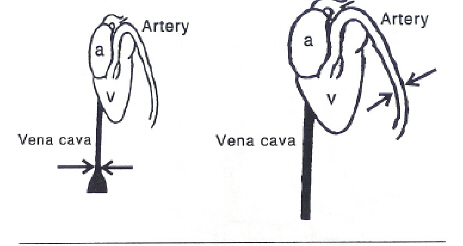
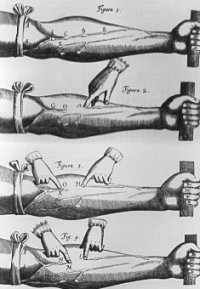
| . 1628: William Harvey mentioned in his `De Mortis Cordis` of having used 49 species in his experiments into blood circulation. Drawings of Harvey`s experiment on blood circulation in a snake. Left hand image shows clamp on vena cava - restricting blood flow to the heart. Right hand image shows clamp on the artery - allowing flow to the heart filling it with blood. Harvey came to several wrong conclusions from his animal experiments. The Ancient Chinese, in c2560BC, knew, from clinical observations that blood flowed in a continuous cycle round the human body. The Hindus, in c600BC, pumped blood thru human cadavers and described blood circulating. Harvey`s three "hypotheses" of blood circulation came from his clinical work and autopsy studies. Illustraion. 1628. Harvey`s demonstration of blood circulation on human. |
 |
 |
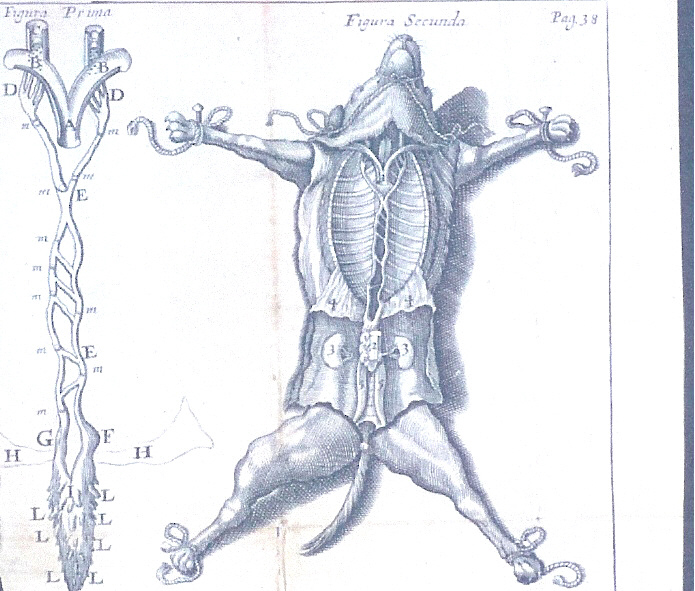
1647: Jean Pecquet experimented on a dog, and is said to have discovered the thoracic duct. Drawing. 1651. Pecquet`s experiment on a dog Massa, in 1532, had traced the ducts proceeding upwards from the renal vessels. Fallopius, in 1561, had mentioned canals filled with a yellowish substance proceeding from the surface of the liver to the pancreas. |
 |
|
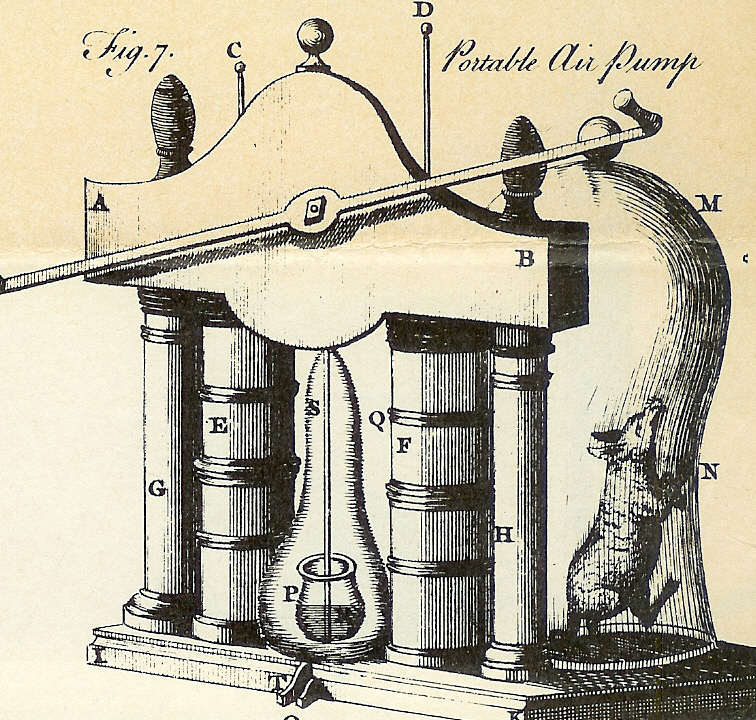
1659: Robert Boyle and Robert Hooke placed a sparrow and a mouse in their air pump and drew out the air. When the air was returned in time, the bird and the mouse recovered. Drawing. 1700s. mouse in modified Boyle airpump. The experiment is said to have led to the understanding of the function of the lungs. 1660: Huygens built his own pump and tried replicating Boyle`s experiment - and failed. Thomas Hobbes noted that Boyle`s airpump was not air-tight. 1662: The Royal Society was presented with Boyle`s original pump and tried using it. The Royal Society encountered the same problems as described by Hobbes. Avicenna (980-1037), by careful clinical observation of human respiration had come close to the modern concept of repirational physiology. Miguel Servatus, in 1545, studied human cadavers and gave a very clear understanding of the respiratory process as preformed by the lungs. |
 |
1665: Richard Lower tried transfusing blood from the jugular vein of a dog to the jugular vein of another dog - but the donor dog died from blood loss. 1667: Edmund King tried transfusing blood from the vein of a calf into the vein of a sheep - but little or no blood flowed from the calf into the sheep. Denys transfused blood from calves into dogs. Denys tried four animal-to-human blood transfusions - two recipients died. Lower and King tried transfusing blood from a sheep into a human - to change woodcut. 1700s. animal-to-human blood the man`s character! transfusion. Andreas Libravius, in 1615, had successfully transfused blood from a young man into an elderly patient. |
 |
|
PICTORIAL HISTORY of VIVISECTION 18th C - click arrow |
 |
PICTORIAL HISTORY of VIVISECTION index - click arrow |
 |
 |