

NEW EBAY LISTING #5579616988
That's right folks -- this innocent, naturally formed stone "charm" was CENSORED by ebay for theThird time now! Apparently, some misguided soul complained to ebay that this relic should've been in the mature audiences category... 3rd UPDATE Note: We complied with everything ebay told us to -- and they jerked our rock off again anyway! So now we are taking a whole new tack, and listing this as a "Mystery Auction." Yep, the Penis Rock has gone underground - in disguise on ebay! **Scroll all the way down for the new picture.** Think it'll last this time???
This auction was featured on
bizarrebids, auctionsightings, watchedauctions, and weirdebay;
had 2,000+ hits with 8 days to go, when ebay
"yanked" it off. This is a unique artifact of Nature,
that we think was getting a lot of interest of a SPIRITUAL nature --NOT sexual! It is an
oddity of nature, yes. A sexual object? No! C'mon people, this
is NOT a sex toy...
Sooo, here again is the original auction... You can decide for yourself what kind of twisted mind sees this gift from an "angel," this god-made phenomenon that has been treasured in my family for generations, as being a pornographic item?? Brrrr! We don't even want to know...
|
|
|
|
%20-%20It's%20Back!The%20ORIGINAL%20Fertility%20Blessing%20Phallic%20Stone_files/s.gif) |
NO FAIL Penis Phallus/Phallic God-Goddess
Blessed Stone Heirloom Fertility Aphrodite/Adonis Natural Stone Icon |
Many years ago, an older couple lived a peaceful, quiet life in their cabin in the woods, when one day, a raggedy old beggar came to their door seeking a meal and lodging for the night. They welcomed him into the wee cabin and warmed him by the fire. After a hearty meal of the wife's stew and a good glass of the husband's "moonshine" the old hobo was shown to a cozy corner in the barn to spend the night.
Very early the next morning, they went together to bring the old fellow a small parcel of food to see him on his way. But he was already gone and all they found was this mysterious stone icon with a curious little note attached to it. The note thanked them for their hospitality and told them to keep this rock safe and their marriage would be blessed with many children. Well, to make a long story short, they did proceed to have many, many children; then grandchildren, and great-grandchildren... This Faith Stone was passed down through generations, which is how I came to possess it.
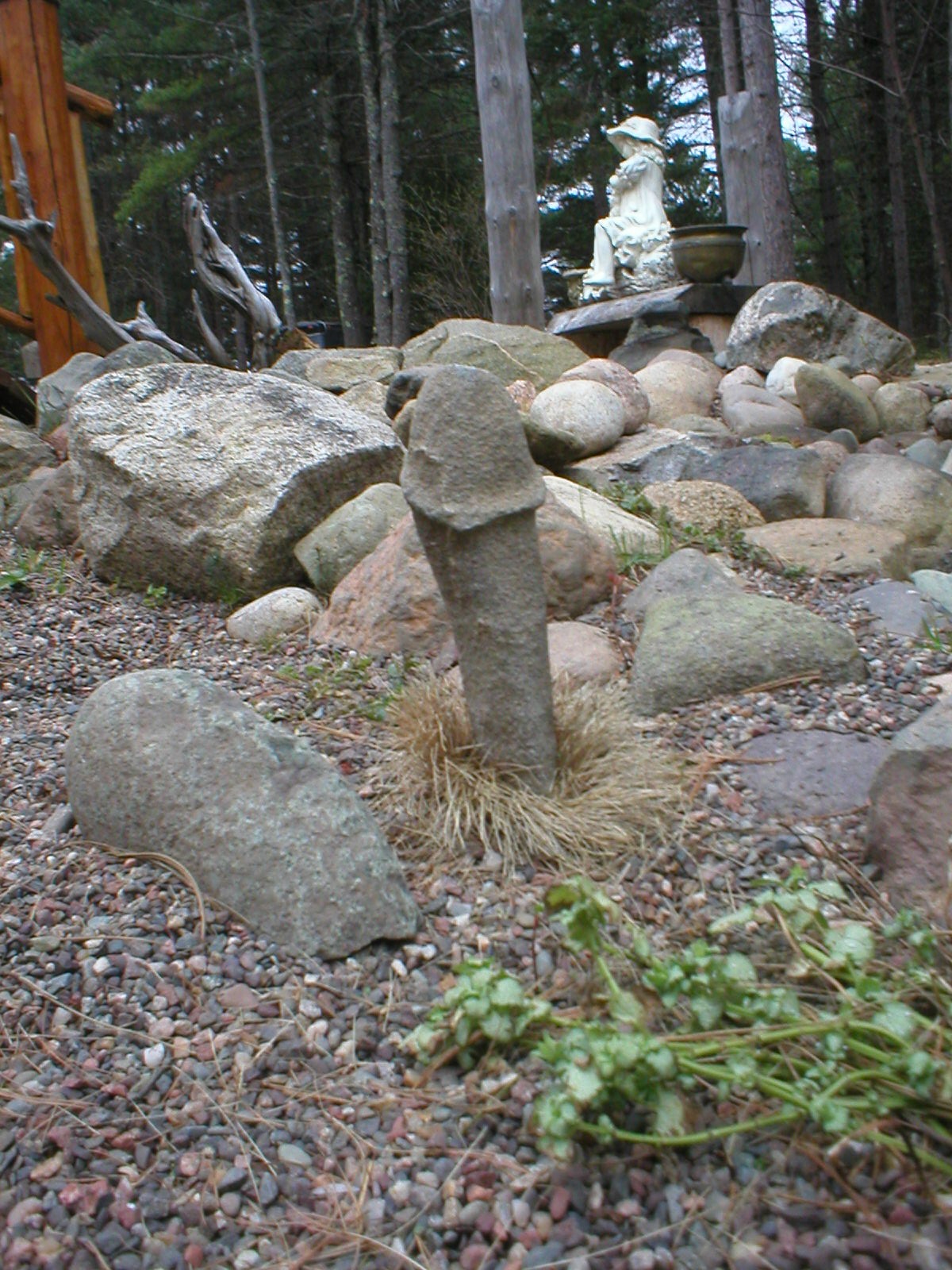
That couple was my own great-grandparents. I myself, have 10 brothers and sisters, countless cousins, 36 nieces and nephews, and 14 great-nieces/nephews. Now that I have 6 children of my own, it is time for me to pass its blessing on to someone else. There is NO ONE left in my huge family who wants to possess this fertility fetish --or who will even touch it anymore! In fact, it is now residing *outside* in my rock pond garden.
This is NOT a joke; it is a serious auction to find this powerful talisman a new home that needs it. It is NOT man-made. Mother Nature herself sculpted this age-old spirit rock, not any human artisan, so it is truly one-of-a- kind. As this has been passed around in our family, it has not been only family members who have been affected. Everyone --male or female-- who has touched it has felt its omnipotent power.
It has also been quite the conversation piece in my house, my parents' house, their parents' house, siblings, cousins, nieces, nephews, friends --all who have posessed this in their homes have gotten many chuckles out of this Blessed stone fetish. We have heard sooo many puns about our family's jewel, such as "You really do have a rock-hard..." etc... But jokes aside - we really have all been truly blessed with many children!
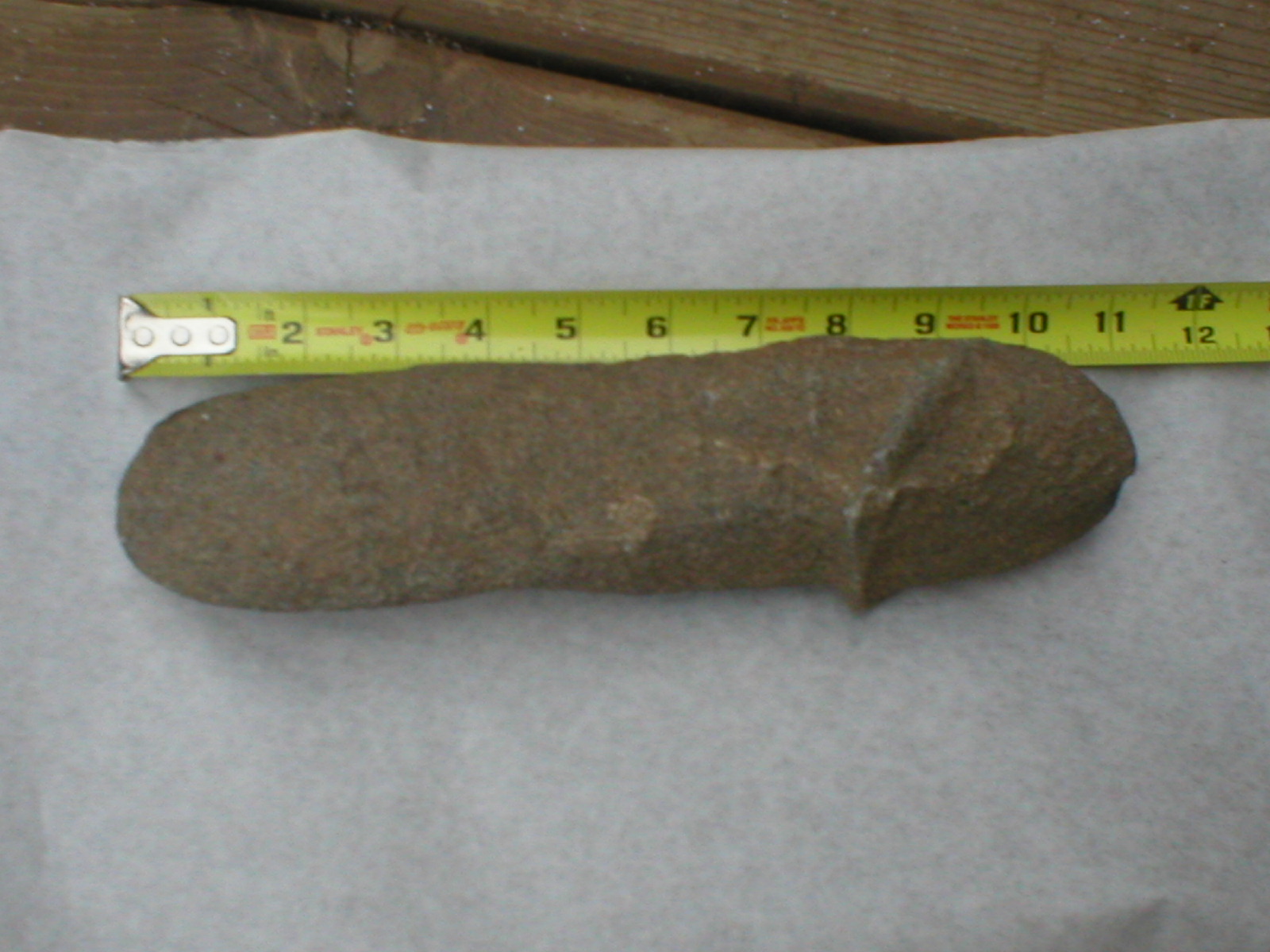
This is an authentic Mother Nature-created phenomenon. In light of the recent trends of auctions of so-called "Religious Memorabilia," such as a half-eaten, petrified "Holy Mother Virgin Mary" grilled cheese sandwich or a common curled dorito chip that someone calls a "Pope's Hat," I would like to reiterate that we believe this is the real deal. This amazing Earth-old icon measures 11 inches long, and 8 inches around the widest part of the "head." You can even see the "veins," on the backside. And though my camera doesn't pick it up, there are very pretty little sparkles in the stone that that glitter in the sunlight.
In every creation myth, we find gods and goddess having different purposes. There is generally a god with a large phallus who is called a fertility god - and at least one creational goddess linked to fertility, pregnancy, and birth. Some say that all of the gods may be one soul playing different roles in the various creational stories that are part of planet Earth's history. The same is true for the goddesses. In many cases their names in various different civilizations/cultures are well-recognized, while others are rather obscure.
Over the years we have been offered many theories as to the origin of this sacred
symbol, which have included some of the following that we
will add below for your amusement:
PLEASE ADD THIS ITEM TO YOUR WATCH PAGE!
Adonis - Phoenecian/Syrian god who was adopted by the Greeks as well. A vegetative resurrecting god.
Ala (Nigeria) One face of the Mother Goddess. She was the ruler of the Underworld, protectress of the harvest, and fertility of both animals and man.
Ama-arhus - Babylonian and Akkadian fertility goddess.
Aphrodite (Greece) Goddess of love, beauty, and sexual passion. She represented fertility through the act of sexual intercourse. - [See Venus]
Arianrhod (Wales) One face of the Mother Goddess. She was associated with fertility, reincarnation, and beauty. Ashur (Assyria) One of the national gods of Assyria. He was the god of both war and fertility, both bringing life and taking it away. Ashur was the husband of Ishtar.
Attis- Phrygian god adopted by the Greeks. He was tied with a fertility cult through his mother. Product of a virgin birth.
Baal (Canaan) Early references state that Baal was married to the fertility goddess Baalat but eventually took on her associations and functions as a fertility god - widely venerated throughout the Fertile Crescent and the Middle East.
Bast (Egypt) Bast was the cat headed goddess. She was associated with both fertility and childbirth.
Bendis (Greece) One of the many goddesses associated with female fertility.
Brigit (Ireland) Brigit was the goddess of home, hearth, feminine aspects, healing, and fertility. She was often seen as an alternate for her mother Dana. This reference reflects the different aspects of the Triple Goddess.
Cybele (Roman) Cybele was the great goddess of fertility in the city of Phrygia
Dagon - vegetation and fertility god
Frigg (Teutonic) Frigg was the Odin's wife (the king of the gods). Frigg protected a man's marriage and made him fertile. Her name was invoked to bring children into a conjugal union.
Freyja (Teutonic) Often confused with Frigg, Freyja was a goddess of sexual activity.
Gefjon (Teutonic) Gefjon was one of Frigg's handmaidens and associated with fertility of both man and the land. Each year, a strip of ground was plowed in her name before the entire field to ensure fertility.
Ghede (Voudoun) The god of both death and fertility. His phallus is said to be carved along a gravedigger's tools.
Haumea (Hawaii) Haumea was identified with her mother Papa (again, a representation of the stages of the Mother Goddess). Haumea was said to be continually reborn, therefore allowing her to continually mate with her offspring.
Inanna - Sumerian goddess of love, fertility and war. Her symbol is the eight-pointed star.
Ishtar - Sumerian and Babylonian goddess of love and fertility. She had a habit of attracting lovers and then killing or maiming them.
Juno Sospita (Roman) One of the many faces of Juno (queen of the gods). Juno Sospita was often called upon by infertile women.
Kokopelli - Native American fertility god - with large phallus - Trickster
Macha (Ireland) Fertility goddess who primarily concerned herself with male virility.
Marduk- The central god in the Babylonian pantheon, patron of the city, which is today located in Iraq. Marduk was god of air, earth, and fertility - supreme leader of the gods after defeating Tiamat - ater known as Bel or Baal.
Mars - Roman fertility god who came to be known as Gradivus, the strider, and the god of war. His symbols were wolf, warpecker, and lance.
Min (Egypt) Often identified with the Greek god Pan, Min was the god of male virility. He is almost always depicted holding a flail in one hand and possessing an erect penis. He is married to the goddess of love and fertility, Quetesh.
Mithras [Mitra]- From Avestan/Old Iranian. A Persian god whose cult flourished through the Roman Empire from about 50 AD. He was on the side of Ahuramazda in the Persian pantheon against Ahriman. Product of a virgin birth.
Mylitta - Babylonian and Assyrian goddess of fertility and childbirth.
Nanshe - Goddess of fertility and water, she was the patron of dreams and prophecy.
Ninurta - God of rain, fertility, thunderstorms, the plow, floods, wells, and the south wind.
Osiris (Egypt) Although he wasn't a direct fertility god, Osiris was a god of reincarnation, a form of fertility. His wife, Isis, reconstructed his dead body after it was dismember by his evil brother Set. Isis reanimated the body long enough to become pregnant.
Pan (Greece) Greek god of nature, Pan is known for his sexual and lustful urges. He represents male virility.
Quetesh (Egypt) Husband of Min, she is the love and fertility goddess.
Shiva (India) God of fertility, medicine, and physical love.
Sophia - Creational Goddess
Sulpa'e - God of fertility, wild animals and the planet Jupiter.
Tammuz [Fammuz] - Sumerian/Akkadian god of fertility who died and was resurrected. Mentioned in Ezekiel 8:14. The Phoenecians lived in what is today Lebanon. Product of a virgin birth.
Tellus Mater (Celtic) Goddess of fertility and marriage.
Venus (Roman) Roman equivalent to Aphrodite. Venus was the goddess of love, beauty, sexuality, and fertility.
Xipe Tot?c (Aztec) "Our Lord of the Flayed One". A phallic fertility god who was seen worshipped by those living on the Pacific coasts.
Belet-Ili - Sumerian goddess of the womb
Hathor (Egypt) Hathor was the protectress of woman and pregnancy. She was sometimes also considered, in some areas, a midwife. Hathor was most often depicted as a cow and she was said to have nourished the mortals with her milk.
Hera (Greece) The Queen of the gods, Hera presided over all things feminine. She was specifically interested in those things dealing with maternity and marriage.
Ixchel (Maya) Ixchel had a disastrous side, as she was the goddess of sending floods and tropical cloud bursts, however, she was generally view as ruling childbirth, lunar cycles, and pregnancy.
Khnum (Egypt) His name means "to create". Khnum was said to be self created, maker of heaven, earth, the underworld, water, all creatures and man. Khnum was said to fashion the bodies of every child born. He was associated with Ra. His first wife was said to be Heket who was eventually usurped by Satis.
Juno Lucina (Roman) Another face of Juno, Juno Lucina had a duel role. She protected pregnant woman as well as at birth, bringing the child into the light.
Pukkeenegak (Eskimo) Feminine goddess who was supposed to give children to the Eskimo women.
St. Catherine of Sweden (Roman Catholic) Patron saint of miscarriage prevention.
St. Gerard Majella (Roman Catholic) Patron saint of pregnancy and expectant mothers.
St. Raymund Nonnatus (Roman Catholic) Patron saint of midwives.
Uma (India) Her primary function was female-ness in all forms, particularly active ones like childbirth. Sri-Laksmi, the Lotus Goddess, should also not be forgotten- although her fertility aspects often get buried in requests for monetary wealth nowadays, her power over fertility and abundance is even older than Uma's, and outstrips her connection with material wealth by a millenia.
Ajysyt (Siberia) Mother Goddess. Her name means "birth giver". She visits every mother among her followers and provides a soul for the newborns.
Artemis (Greece) Although the goddess of chastity, Artemis presides over childbirth because it was said that she caused her mother Leto no pain during delivery.
Bes (Egypt) Bes was primarily a marriage god, but he did preside over the birth of children.
The Hathors (Egypt) "Fairy godmothers" who appeared at birth to bestow blessings to the newborn. They would set the child's destiny. The Hathors consisted of seven to nine young, beautiful women who danced and sang at the birth of a child. The Hathors are said have been created by Hathor herself, as she adopted seven to nine aspects of herself from her role as Mother Goddess.
Heket (Egypt) Wife of Khnum. Heket was associated with Hathor as a birth deity. She was said to be the birth goddess of all creatures.
Ilithyia (Greece) Once viewed as two separate goddesses, Ilithyia was brought together into one. She was the daughter of Hera who freed the child from the mother's womb.
Isis (Egypt) One of the most important female deities, Isis was the protectress of motherhood, healer of the sick, and protectress of women. She also rules magick. Sick with grief concerning the murder of her husband Osiris by his brother Set, Isis reconstructed and reanimated his corpse long enough for it to impregnate her with their only son Horus.
Juno Sospita (Roman) Another responsibility of Juno Sospita was to preside over labor and delivery.
Meskhent (Egypt) Egyptian goddess who presided over the delivery of babies. She was represented as a tile or a brick with a woman's head; the reason being that Egyptian women traditionally gave birth squatting over a brick. She also pronounced judgment over the new child. She was married to Shai who protected the destiny of newborns and children.
Mylitta (Babylon) Mylitta was identified with Aphrodite. She took special interests in the process of childbirth.
Nekhebet (Egypt) A lessor goddess of childbirth.
Nintur (Sumeria) Another name for the goddess Ninhursaga, the Mother Goddess. Her name means "Lady Who Gives Form". She was represented as a woman holding a midwife's pail of water.
Pi-hsia-yuan-chun (China) Known as the "Princess of Streaked Clouds", she protects women, children, and presides over birth.
Renenet (Egypt) Goddess who presided over a baby's suckling. She bestowed both a name and a personality on a newborn infant.
St. Anne (Roman Catholic) Patron saint of women in labor.
St. Margaret (Roman Catholic) Patron saint of women giving birth.
St. Monica (Roman Catholic) Patron saint of mothers.
Serket (Egypt) Serket was the scorpion-headed goddess. She often assisted during childbirth and protected the pregnant Isis from her evil brother-in-law Set.
Taueret (Egypt) Goddess of childbirth, Taueret took the form of a pregnant hippopotamus in hopes that her hideous form would scare away any demons after the newborn infant.
Tlazolteotl (Maya) Tlazolteotl was known as the goddess of unbridled sexuality, eater of filth, and protectress of women in childbirth as a result of that unbridled sexual license.

Click here for the final update in this series.