   
Contact us with questions
and
comments at [email protected].
|
Schneiders
Skink (Eumeces schneideri)
*Note: These skinks are commonly
called Berber skinks in Europe. In the U.S. the name Berber skink refers
to an entirely different skink, Eumeces algeriensis.
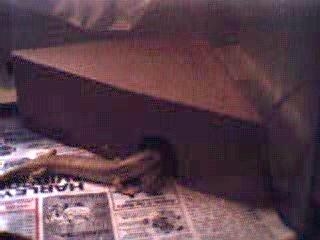
My male and female Schneiders Skinks snuggling on
their temporary substrate.
Length and Longevity:
These Egyptian desert native skinks will grow to be 12-18". About half
of that length is their long skinny tail. If will taken care of they can
live up to twenty years in captivity.
Cage Requirements:
A twenty gallon long vivarium will house a pair of Schneider skinks. They
would, however, take advantage of the extra space if house in a larger
cage, such as a 30 or 40 gallon vivarium. (Two females are fine together,
but males are territorial and will fight if kept together.) Whichever size
you choose needs to have a solid screen lid. Ventilation is important to
these dessert dwelling skink. A solid top would create too much humidity.
Schneider skinks are burrowers by nature and require at least four inches
of sand as substrate. Ordinary play sand works great and is certainly cheaper
than the marketed reptile calcium sands found in pet stores. Your skinks
will happily burrow at night and come to the surface to bask, eat, and
explore during the day. Make sure the sand is dry and is not clumped together
so your skinks can dig around freely.
Although
Schneider skinks burrow in the sand, it's still a good idea to provide
a hide for them. We make our own out of cardboard, and replace them when
they get soiled. Store bought hides also work well and can be cleaned with
soap and water periodically. The best set ups have a hide on both the warm
end and cool end of their tank.
Speaking
of which, Schneider skinks need heat provided to their cage. The idea here
is to heat one half of the cage to provide a temperature gradient across
the cage. Your skink will bask at the warm end when it needs to and move
to the cool end to cool off when it sees fit. This is called thermoregulation
and is the way cold blooded reptiles control their body heat.
I recommend
using an under the tank heat mat under the warm end of the tank. These
are sold at pet stores and on the Internet. (Don't use heat rocks. They
will burn your skinks if they burrow under them!) Schneider skinks also
require a UV basking light to help their bodies produce vitamin D. These
light and lighting fixtures are also available at pet stores. Leave the
lights on for 12-16 hours in the summer and 6-8 hours in the winter. This
provides them with a natural day cycle. Your cool end should be about 75
F, while your warm under should hit up to 100 F. Temperatures at night
can cool to about 68 F.
A shallow
water bowl should be placed at the cool end of the tank. If it is placed
on the warm end, the water will evaporate and create too much humidity.
The skinks will regularly get sand in their water, so it's important to
give them clean water daily.
Feel
free to decorate your skinks cage. Rocks, pieces of bark, and plastic plants
will give them things to explore and play on.. Avoid live plants because
your skinks will most likely destroy them.
Make
sure you don't place the vivarium in direct sun light or a draft. Also
it is not a good idea to place your skinks in a high traffic area. Put
them in a place that they can be enjoyed, but not one that is so busy that
they will be disturbed constantly and get stressed.
Feeding: The main
diet for your skinks should consist of insects, mainly meal worms and crickets.
For an occasional snack offer Schneider skinks high quality canned cat
food, fruits such as bananas, kiwi, strawberries, and pineapple, or vegetables,
such as carrots. Schneiders eat 3-4 times a week. Once a week, be sure
to dust their food with a reptile calcium/vitamin supplement which is available
at pet stores. This will get them the extra calcium and vitamins they need
that their food may lack. To feed, I usually make sure the skinks are on
the surface and I drop a margarine tub lid in the tank filled with their
food. Healthy skinks have no problems feeding readily.
Breeding: As I mentioned
before, these skinks aren't widely captive bred in to U.S. so there is
only limited information on breeding available. As we attempt to breed
our skinks we will help fill in the blanks. Here's what we do know:
Back
to Schneider Skinks
|