   
Contact us with questions
and
comments at [email protected].
|
Leopard
Gecko Care Sheet
Length and Longevity
Adult Leopard Geckos
(Eublepharis macularius) will grow to be about 8 inches and 45-60
grams. Hatchlings are about 3 1/2 inches long and weigh about 3 grams.
Baby Leopard Geckos will reach maturity in about 18 months. Average life
span for these cuties can be over 20 years!
Cage Requirements
One gecko will get
along fine in a 10 gallon aquarium. Two or more Geckos would do better
in a twenty long. (Note: Never house more than one mature male together.
They are territorial and will fight to the death.) Geckos like to have
a place to hide. Pet stores sell hollowed out half logs that look natural
and serve this purpose well. Also consider placing a "humid" hide in the
cage. To make one of these, we fill a shallow dish that's big enough for
the gecko to get in with moist vermiculite and place it under a second
hide. Some keepers use a margarine tub or something similar with an inch
or so of moist vermiculite or sand and a hole cut above the moist substrate.
A "humid" hide helps with shedding and also doubles as an egg disposition
box. Fresh water should be kept in the cage in a shallow water dish. We
also use a little dish to put the geckos' food in so it won't wonder around
the vivarium. Live or plastic plants and grape vines can be added to give
your geckos areas to explore and play on. An under the tank heater and
a light globe are good sources of heat. Temperatures should be kept around
86 degrees F in the daytime and 82 degrees F at night. These temperatures
are essential to keep your geckos healthy and eating. Temperatures also
play a big part in breeding. Eatable reptile sand with calcium makes a
good substrate for adults, but newspaper is recommended for hatchlings.
Eaten sand can cause digestive problems in hatchlings.
Feeding
We feed our Geckos
meal worms, but you can also feed Leopard Geckos crickets, wax worms, super
worms, and pinkie mice. Pinkie mice and super worms are fattening and should
only be feed as an occasional treat or to fatten up your geckos for breeding
season. The prey should be about the length of the gecko's head and not
more than half the width of the head. It's a good idea to add a calcuim/vitamin
supplement to your geckos food at least once a week. We leave a bowl of
meal worms in the cage at all times and let the geckos feed as they like.
Maintenance
Mist your gecko's
cage at least once a day. This will keep the humidity of his cage up so
that he won't have any shedding problems. Scoop away any waste your gecko
has disposed of as soon as you find it. Geckos usually find a certain spot
to use the rest room and continue to only that spot.
Breeding
 Leopard
Geckos can reach sexually maturity within 10 months if they are kept warm
and well fed. Males can be distinguished from females by the hemipenial
bulges on the tail side their cloaca and the pronounced 'v' of pores in
front of the cloaca. Females have a 'v' of pits, but they aren't as pronounced
as the male's pores. As noted above, don't house mature males together.
You can, however, create a breeding colony of one male and as many as ten
females if you have a large enough cage. You can put your geckos through
a cooling period to induce breeding or simply give them a rest period of
two to three months in the winter. To 'cool' your geckos simply turn off
your over head heat and allow temperatures to stay in the mid 70's. You
can leave or heat pad on so if your geckos want to warm, they can. After
a few months maintain their heat at normal temperatures. Males may vibrate
their tails at a female to signal that he is wanting to male. He will chase
her around the cage, and when the female is ready she will let him catch
her. He may hold her head in his mouth, but don't be alarmed, this is normal
behavior. A female gecko can store sperm for up to a year, so one mating
will produce a season of eggs. It may be a good idea to remove the male
after mating to give the female some peace. Leopard
Geckos can reach sexually maturity within 10 months if they are kept warm
and well fed. Males can be distinguished from females by the hemipenial
bulges on the tail side their cloaca and the pronounced 'v' of pores in
front of the cloaca. Females have a 'v' of pits, but they aren't as pronounced
as the male's pores. As noted above, don't house mature males together.
You can, however, create a breeding colony of one male and as many as ten
females if you have a large enough cage. You can put your geckos through
a cooling period to induce breeding or simply give them a rest period of
two to three months in the winter. To 'cool' your geckos simply turn off
your over head heat and allow temperatures to stay in the mid 70's. You
can leave or heat pad on so if your geckos want to warm, they can. After
a few months maintain their heat at normal temperatures. Males may vibrate
their tails at a female to signal that he is wanting to male. He will chase
her around the cage, and when the female is ready she will let him catch
her. He may hold her head in his mouth, but don't be alarmed, this is normal
behavior. A female gecko can store sperm for up to a year, so one mating
will produce a season of eggs. It may be a good idea to remove the male
after mating to give the female some peace.
A gravid female will have
noticable bulges on her sides, and you can see the developing eggs through
her skin. After breeding, females will lay clutches of two eggs every 2-4
weeks if kept well fed, laying up to 16 eggs a season. Supplement her food
with calcium and vitamins every feeding so she doesn't deplete nutritionally.
Studies have linked low calcium levels to in-shell deaths of gecko eggs.
Set up a hide with a dish of moist vermiculite or sand for an egg disposition
box. The female gecko will most likely use this box to bury her eggs when
they are laid. Check for eggs daily and remove them as soon as you find
them. Be careful not to turn the eggs or you could drown the developing
embyro inside.
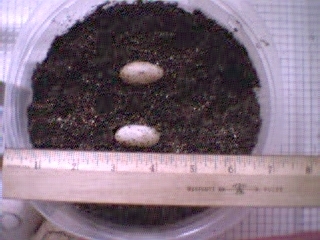 To
incubate the eggs, use a plastic storage container with a lid, such as
a small margarine tub or Glassware (tm). Fill the container with moist
vermiculite. Be careful not to get the substrate too wet or the eggs will
develop mold. Drill a few tiny holes in the sides of the container above
the substrate. These holes can be taped over if the substrate dries out.
Bury the eggs half way in the vermiculite. Place the lid on the container
and put it in an incubator. (We use HavoBator incubators available
at farm supply stores or from reptile supply companies.) A dish of water
can be placed in the container as well to help keep the air in the incubator
humid. The idea is to allow the eggs to absorb the moisture they need from
the air. To
incubate the eggs, use a plastic storage container with a lid, such as
a small margarine tub or Glassware (tm). Fill the container with moist
vermiculite. Be careful not to get the substrate too wet or the eggs will
develop mold. Drill a few tiny holes in the sides of the container above
the substrate. These holes can be taped over if the substrate dries out.
Bury the eggs half way in the vermiculite. Place the lid on the container
and put it in an incubator. (We use HavoBator incubators available
at farm supply stores or from reptile supply companies.) A dish of water
can be placed in the container as well to help keep the air in the incubator
humid. The idea is to allow the eggs to absorb the moisture they need from
the air.
Incubation temperatures determine
the sex of leopard geckos in the first two weeks. For a high ratio of females
incubate at 79 to 83 degrees Fahrenheit. If you wish to have more males,
incubate from 87 to 90 degrees Fahrenheit. After the first two weeks, it
would probably be a good idea, either way, to incubate at around 85 degrees
so the eggs won't get too hot, in the case of incubating for males, and
so the eggs will develop faster, in the case of incubating for females.
Be sure to calubrate your incubator before adding eggs. It can take a few
tries to get it just the right temperature. The eggs should hatch in 5
to 8 weeks.
Check your eggs every day
for problems. If they seem overly swollen or have "stretch marks," you
have them too wet. Put them in a new container with drier substrate right
away. It may be too late. If you notice mold growing on your eggs, carefully
wipe them off with a wet rag and place them in a new container with fresh,
moistened vermiculite. Don't despair, health geckos can hatch from mold
infested eggs. If the eggs are sunken in and dented, your eggs aren't moist
enough. Add water around the edges of the container. The eggs should fill
back out in a matter of hours.
Recommended Reading
The Leopard Gecko
Manual, de Vosjoli, Philippe; Viets, Brian; Tremper, Ron; Klingenberg,
DVM, Roger; 1998; Advanced Vivarium Systems, Inc.
Return
to Leopard Geckos
|