
email The Corner Gardener

|
Updated
July 22, 2002 email The Corner Gardener |
|
|---|---|---|
| The Rainbow Bridge | Recent Articles | Japanese Beetle Facts | ||||
| Author
Unknown Just this side of heaven there is a place more beautiful, more peaceful, and happier than anywhere on earth. This place is called Rainbow Bridge. When a pet dies that has been especially close to someone on earth, the pet always goes to Rainbow Bridge. There are meadows, parkland, leafy woods, clear streams and gently rolling hills for those special friends to lay on, to run on, and to play happily together. Food, water and warmth are plentiful. Those special friends are always warm, are always comfortable. They want for nothing. All those pets that had been ill or had become old and frail in life are restored to full health, youth and vigor; those who were hurt or maimed are made whole and strong once more. They are just as we remember them in our dreams of the glorious past we shared with them. All are happy and content except for one small thing. Each of them misses someone, who was very special to them, someone who they had to leave behind. They spend their days running and playing together until the day comes, as it does to each of them, when one stops and gazes into the distance. His eyes shine with a brightness that even the sun cannot equal. His whole body quivers in anticipation. Suddenly, almost without warning, he turns away from the group and begins to run faster than he has ever run before. He is almost flying across the lush, green grass. You see, you have been spotted by him, and when you and your special friend, who you thought you would never see again, finally meet you cling together in the purest of embraces, and you both know that you will never again be parted. Licks and kisses smother your face, your hands gently caress his head and neck and you look once more into the trusting eyes of the pet, so long gone from your life but who was never ever absent from your heart. Then you cross Rainbow Bridge together.... |
Aside From
Gardening.... by Lisa Hegel It has been a busy spring and summer. Not least of all that has happened was losing my beloved Himalayan cat of almost 13 years, Aja, on May 16, 2002. Rest in peace, my sweet little girl. Her body is now part of the water / shade garden she dearly loved, and her soul is surely at The Rainbow Bridge, where she is now out of pain and happy, playing with (or probably more likely, ruling over!) all of the other cats and dogs who are waiting for their best friends to follow them there. Then, beginning the first week of July, the dreaded hordes of Japanese Beetles returned. It's been an ongoing battle, knocking them off plants as they are feeding into a jar of soapy water. The soap coats their wings so they can't fly, and they can't escape the water, so they drown. Hooray!!! They really are awful bugs, and do a great deal of damage, so I can't muster any sympathy for them. I am actually quite gleeful when I kill several dozens at one time. They will be gone soon, and the more I kill the fewer will lay eggs in the lawn and continue their life cycle - lawn grub to adult beetle to egg, etc. ad nauseam! Here are some facts: Beetle grubs can turn a fine looking lawn into a patchwork quilt of yellow spots. But before you reach for the insecticide bottle, there are a number of organic alternatives that will help you cope with the grubs without poisoning yourself or your family. What are these grubs? The grubs that you see in the lawn are the larvae of Japanese beetles, June beetles, and chafers. These grubs are C-shaped, off-white in color with a dark head. They eat the roots of grass, causing the grass to die and form brown patches. Lawns that are heavily damaged by grubs will have a yellowish tinge and will feel spongy when walked on. The sod itself can be easily lifted, a sure sign that the brown patches were not caused by dog urine. Life cycle Adult beetles emerge, mate, and lay eggs from late June until early August. The eggs hatch in about two weeks and the tiny grubs grow quickly. The yellowing patches of sod usually appear in late August and September, when the grubs are vigorously feeding and the turf is otherwise water-stressed. In October or November, when soil temperatures begin to cool, the grubs stop feeding and move deeper into the soil, where they spend the winter. They return to the root zone and resume feeding early the following spring. What to do: Just a couple grubs per square foot are not a problem to an otherwise healthy lawn. Ten or more per square foot are necessary to justify treatment. Predatory nematodes are available for use in Canada and the US as a biological control for white grub. The use of these nematodes requires that the soil be kept very moist and it is very important that the application instructions for this product be followed closely, as nematodes are living organisms. Treat the entire lawn. Do not attempt to control lawn pests by spot applications. Water the lawn thoroughly after application to wash in the nematodes. When to treat the lawn? The younger the grubs are, the easier they are to control. The best time to apply grub control measures is from mid-July to August and September when the grubs are small and near the soil surface. Although treatments can be made after this time, grubs will be more difficult to kill (because of their larger size). The second best time is March to April when the grubs are once again near the soil surface but a little larger. Encourage natural enemies Certain species of wasps parasitize white grubs. They are sometimes seen hovering over the turf in late summer in search of green June beetle grubs on which to lay their eggs. They are not aggressive and normally will not sting people. The wasp larva feeds externally upon the grub, eventually killing its victim before spinning a fuzzy, brown, jelly bean-size cocoon in the soil. Predators such as ground beetles and ants also take their toll on eggs and young white grubs. Managing your lawn to minimize damage Lawns that are heavily managed and watered regularly may actually attract beetles. They prefer grassy areas where the soil is constantly moist such as lawns, pastures, and meadows in close-cropped grass. Frequent irrigation in June and July may attract egg-laying female beetles to the turf, especially if surrounding areas are dry. In contrast, adequate soil moisture in August and September (when grubs are actively feeding) can help hide root injury. If grub damage starts to appear in late August or September, watering will promote tolerance and recovery. Deep, periodic soaking of the turf is more beneficial than frequent, light watering. Gardeners Surfing Web To Buy Plants The Cincinnati Post, 01/26/02 The Web has become an important horticultural tool, and gardeners are getting as comfortable with it as they are a well-worn trowel or a favorite pair of pruning shears. Better fasten your seatbelt if you type the word "garden" into a search engine. "Which of the nine million possibilities would you like to explore further?" your computer prompts. If it's information on a plant you need, the University of Maryland's Home and Garden Information Center can be a big help. In response to a recent query about leaf spot on a patch of native bugbanes, my husband received back within a few days an expert's opinion on the probable cause of the disease. Though inconclusive, the information was quite thorough, obviously researched. We'll try again on other topics when we're stuck. Cutting-edge gardeners who crave the newest selections of everything may want to have some oxygen handy before visiting the New Plant Page. This list of one brand new cultivar after another provides a green industry forum for introducing new plants. If it's plants you need, the possibilities are almost endless. Two particularly exhilarating Web sites cross that fine line between "serious" and "extreme" gardening. Hang on to your hat, for Heronswood Nursery's site is a plantsman's thrill ride. Encyclopedic in its thoroughness, what differentiates Heronswood's list from a purely informational tome is that each entry - a detailed description often accompanied by a picture - is followed by a price. For a selection of woody plants par excellence, navigate your green thumb over to ForestFarm's Web site. I warn you now, navigating out will be a challenge without a shopping cart full of new trees and shrubs for your landscape. Web addresses that provide a good starting point for online gardeners: University of Maryland Home and Garden Information Center: www.agnr.umd.edu. New Plant Page: www.newplantpage.com. Heronswood Nursery: www.heronswood.com ForestFarm: www .forestfarm.com. Kansas Official Says Voracious Weed Threatens Waterways The Wichita Eagle, Kansas via NewsEdge Corporation : Jan. 25--A hardy, long-blooming perennial flower popular with home gardeners and commercial landscapers is a threat to waterways, marshlands, native plants and wildlife, a specialist with the Kansas Department of Agriculture told a Wichita audience. The plant, purple loosestrife, comes in three commercial species, each of which is marketed as sterile. But the plants will cross-pollinate and produce viable seed, state weed director Bill Scott said this week in a forum at the Sedgwick County Extension Education Center. Those seeds can be scattered from ornamental beds into lakes, rivers and ponds where they grow voraciously, crowding out existing plants that supply food and habitat for wildlife and speeding the silting of shallow water lakes and waterways. Along shorelines, it grows so tall and thick that it blocks access to the water. More than 20 states have declared the plant a noxious weed and implemented programs to eradicate it. It has been described as an infestation that has created problems in 13 Kansas counties, including Sedgwick, Harvey and Kingman. Becky Varbel, who represented DeRee Nursery at the forum, said she doesn't see that the plant is enough of a problem to warrant its ban and the subsequent losses that will mean for the horticulture industry. "This is a really good plant," she said. "It doesn't require much care. It blooms all summer long. It's pretty." Karl Grover, who supervises the Cheyenne Bottoms in Barton County, one of the largest inland marshes in North America, said the problem is well documented in other states. "We don't have loosestrife now, and I don't want it," he said. "From my point of view, it's a lot easier to replace one ornamental landscape plant than to replace all of Kansas' wetlands." So far, the state weed department has prepared a report documenting the loosestrife threat and has proposed a public education program this year and a ban on sales and distribution next year. "Right now we have only about 250 acres of infested area in Kansas," Scott said. "That's something we can get under control. If we wait until we have 250,000 acres, it won't be something we can control." Tim McConnell, Sedgwick County extension horticulture agent, said there are two native species of lythrum -- Lythrum alatum and Lythrum californicum -- that can be cultivated as alternatives to the commercial species now sold. And, he said, there is a list of alternative plants that could be substituted in landscapes. ----- To see more of The Wichita Eagle, or to subscribe to the newspaper, go to http://www.kansas.com January Pages |
Affected Plants: Grubs feed on
grass roots, adults feed on a variety of plants. Damage:
Adults skeletonize leaves and chew flowers. Grubs feed on grass roots
leaving brown patches of lawn. Predator Insects: Milky spore, beneficial nematodes Natural Insecticides: Sabadilla, liquid rotenone or pyrethrum controls adults. Other Methods of Control:
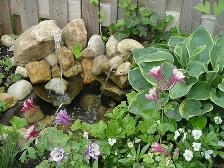 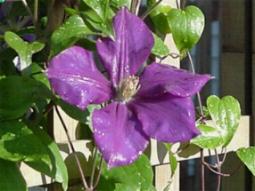
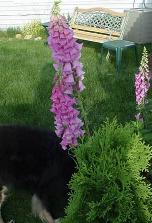 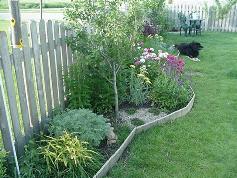 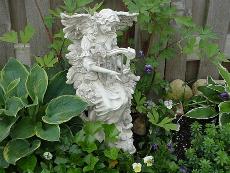 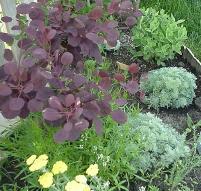 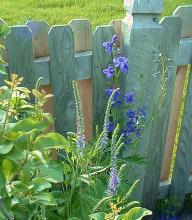 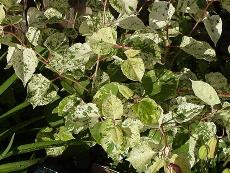  As you probably can see, David and I have been very busy with lots of new plantings and redesigns. I'm especially proud of the red-white-and-blue garden "island bed" in the front yard. Although still in its infancy, next year should see it come into its own. There are a pair of red "Meidiland" landscape roses, planted in memory of my two co-workers who were killed on Flight 11 on Sept. 11, 2001. The rest of the bed is filled with other blue, white and red flowers, grasses and shrubs which should fill in next year.  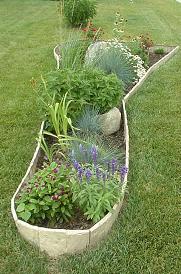 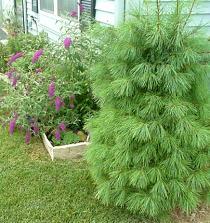 |
||||