 |
 |
 |
 |
 |
 |
 |
 |
 |
 |
 |
|
|
 |
| Most feminists take a holistic approach to politics, believing the saying of Martin Luther King Jr., "A threat to justice anywhere is a threat to justice everywhere". In that belief, some feminists usually support other movements such as the civil rights movement, the gay rights movement and, more recently Fathers' rights. At the same time many black feminists such as bell hooks criticise the movement for being dominated by white women. Feminist claims about the disadvantages women face in Western society are often less relevant to the lives of black women. This idea is the key in postcolonial feminism. Many black feminist women prefer the term womanism for their views. However, feminists are sometimes wary of the transgender movement because it challenges the distinctions between men and women. Transgender and transsexual women are excluded from some "women-only" gatherings and events and are rejected by some feminists who say that no one born male can truly understand the oppression women face. This is criticized as transphobic by transwomen who assert that the discrimination and various struggles (such as that for legal recognitions) that they face due to asserting their gender identity, more than makes up for any they may have "missed out on" growing up, and that discrimination against gender-variant people is another face of heterosexism and patriarchy. See transfeminism and gender studies. |
 |
| Feminism has effected many changes in Western society, including * women's suffrage; * road employment for women at more equitable wages ("equal pay for equal work"); * the right to initiate divorce proceedings and the introduction of "no fault" divorce; * the right of women in allmost all countries to exercise a degree of control over their own bodies and medical decisions, including obtaining contraception and safe abortions; and many others. As Western society has become increasingly accepting of feminist principles, many of these issues, perceived as radical in the 19th century, are now part of mainstream political thought, such as the right of women to vote, own land, and choose their own marital partners, or decide not to marry. Almost no one in Western societies today questions the rights. Some feminists would argue that there is still much to be done on these fronts, while third-wave feminists would disagree and claim that the battle has basically been won. |
| English-speaking feminists are often proponents of using non-sexist language, using "Ms." to refer to both married and unmarried women, for example, or the ironic use of the term "herstory" instead of "history". Feminists are also often proponents of using gender-inclusive language, such as "humanity" instead of "mankind", or "he or she" in place of "he" where the gender is unknown. Feminists in most cases advance their desired use of language either to promote an equal and respectful treatment of women or to affect the tone of political discourse. This can be seen as a move to change language which has been viewed by some feminists as imbued with sexism - providing for example the case in the English language the word for the general pronoun is "he" or "his" (The child should have his paper and pencils), which is the same as the masculine pronoun (The boy and his truck). These feminists purport that language then directly affects perception of reality (compare Sapir-Whorf Hypothesis). However, to take a postcolonial analysis of this point, many languages other than English may not have such a gendered pronoun instance and thus changing language may not be as important to some feminists as others. Yet, English is becoming more and more universal, and the issue of language may be seen to be of growing importance. |
 |
| Feminism has attracted attention due to the social changes it has effected in Western society. While feminism in some forms and to varying degrees is generally accepted, dissenting voices do exist. Some critics (both male and female) find that some feminists are effectively preaching hate against males or claiming male inferiority, citing that if the words "male" and "female" were replaced by "black" and "white" respectively in some feminist writings, the texts could be viewed as racist propaganda. While some feminists generally disagree with the view that men are equally oppressed under patriarchy, other feminists, especially third-wave feminists agree that men are similarly oppressed and that gender equality means oppression of neither gender. Many feel that while feminists claim to believe in equality of the sexes, the ideology of present-day feminism is inherently gynocentric (http://en.wiktionary.org/wiki/Gynocentric). These critics cite both the etymology and symbology of the contemporary feminist movement, and the constant focus of its work on issues that affect women. They feel that followers of this ideology tend to see the world through a certain lens, leading them to be prejudiced. |
 |
 |
 |
 |
 |
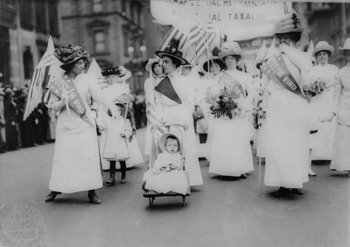 |
| Feminist Suffrage Parade in New York City - 1912 |
| On the other hand, quite a different tendency can be seen in French. Gender, as a grammatical concept, is much more pervasive in French than in English, and as a result, it has been virtually impossible to create inclusive language. Instead, nouns that originally had only a masculine form have had feminine counterparts created for them. "Professeur" ("teacher"), once always masculine regardless of the teacher's sex, now has a parallel feminine form "Professeure". In cases where separate masculine and feminine forms have always existed, it was once standard practice for a group containing both men and women to be referred to using the masculine plural, but nowadays, forms such as "Toutes les Canadiennes et tous les Canadiens" ("all Canadians", or literally "all the female Canadians and all the male Canadians") are becoming more common. |
|
| These critics say that the feminists start with the assumption that women are widely oppressed in contemporary America, and never stray from that assumption � leading to observations that are clouded by confirmation bias. This group of critics would like to see a new non gender-biased term replace �feminism,� such as �gender egalitarianism." This term would then replace �feminism� when used in reference to the belief, close to universal now in contemporary Western culture, in basic equal rights and opportunities for both sexes. Some argue that because of feminism, males are beginning to be oppressed. Those who make this claim often note that males die from suicide 4 times more frequently than females attempting suicide in the USA; rates climbed dramatically during the 1980s and early 1990s; 72% of all suicides are white males; slightly over half of all suicides are adult men, aged 25-65; critics conclude that the USA is becoming a country where males especially white males are severely oppressed. The global statistics are similar. According to sociologists, there are various reasons for these suicide rate increases, and they do not indicate a greater level of male oppression. |
| Some studies of the 20 year increase in male suicide rates (ending in 1998, when the rate began to decrease) have found only a correlation between it and: local economic health and employment rates, suicide methods preferred by men, male isolation if divorced, women seeking treatment for depression in far greater numbers than do men, and (especially) aging populations. It should be noted that during the same approximate period (1952 to 1995) the rates for teen and elder suicide nearly tripled Many people object to the feminist movement as trying to destroy traditional gender roles. They say that men and women have many natural differences and that everyone benefits from recognizing those differences. For example, children are thought to benefit from having a masculine father and a feminine mother; in this view, divorce, single parenthood, or non-traditional gender roles are all seen as harming children more than do conflict in the home, dual but poor role models, or new definitions of masculinity, femininity, or family. The traditional nuclear family is now an exceptional background in the US, and has been the subject of many critiques characterizing it as a racist or culturally ignorant or nostalgic idealized model. Criticism has been made that social change and legal reform have gone too far and now negatively |
| affect men and families with children. For example, it has been suggested that custody hearings in divorces are biased towards the mother, and several organizations have formed to fight for fathers' rights. Some men also express worry that a belief in the glass ceiling for women has led to women being promoted more than men for the purpose of public relations than for their merit. This could be compared to affirmative action; thus, feminists who favour such a method of reform usually present arguments similar to those used for defending affirmative action (i.e. that such a system is required to offset the results of previous discrimination). Although efforts to curb sexual harassment against women in the workplace are normally applauded, there are those who note that the situation is such that the concern directed towards women in resolving disputes of sexual harassment is indirect discrimination, in that less concern is given to men when they are the subject of the claims, or when they are claiming a case of sexual harassment. Since the 1990s, proving sexual harassment in the United States (by either men or women) has been made much more difficult by Supreme Court decisions. |
| Postcolonial feminists criticise Western forms of feminism, notably radical feminism and its most basic assumption, universalization of female experience. These feminists argue that the assumption of a global experience as a woman is based on a white middle-class experience in which gender oppression is primary, and cannot apply to women for whom gender oppression may come second to racial or class oppression. Today, young women most commonly associate "feminism" with radical and gender feminism, and this has put off a lot of these women from being active in feminism, spurring a move away from second-wave labels. However, the basic values of feminism (gender equality of rights and opportunities) have become so integrated into Western culture as to be accepted over-whelmingly as valid, and non-conformity to those values characterized as unacceptable, by the same men and women who reject the label "feminist". |
|
 |