 |
 |
 |
 |
 |
 |
 |
 |
 |
 |
 |
|
|
 |
| The following is a sampling of statistics related to the relative status of women worldwide. � Worldwide, women work more than men, when both paid employment and unpaid household tasks are accounted for, according to the United Nations Human Development Report 2004: Section 28, Gender, Work Burden, and Time Allocation In rural areas of the developing countries surveyed, women perform an average of 20% more work than men, or an additional 98 minutes per day. In the OECD countries surveyed, on average women performed 5% more work than men, or 18 minutes per day. � Women own only 1 percent of the world's wealth, and earn 10 percent of the world's income, despite making up 51 percent of the population. � Women are underrepresented in all of the world's legislative bodies (see Women in National Parliaments, November 2004 (http://www.ipu.org/wmn-e/world.htm)). In 1985, Finland had the largest percentage of women in national legislature at approximately 32 percent (P. Norris, Women's Legislative Participation in Western Europe, West European Politics). |
 |
| Currently, Sweden has the highest number of women at 45 percent. The United States has just 14 percent. The world average is just 9 percent. (Wales, while not an independent country has 50% of its members being women.) � In some parts of the third world, women are considered as effectively property, and have no legal rights in practice. Millions of women are expected to undergo female circumcision. In some areas, rape is used as a sentence for a crime, even crimes not committed by the women themselves. (See, for example, the case of Mukhtaran Bibi.) Female share of seats in elected national chambers in November 2004 (percent): |
 |
 |
 |
| Sweden 45.3 Norway 36.4 Finland 37.5 Denmark 38.0 Netherlands 35.0 Germany 32.8 New Zealand 28.3 Austria 27.5 I celand 30.2 China 20.2 UK(Commons) 17.8 United States 15.0 Japan 7.1 |
| Most feminists believe discrimination against women still exists in North American and European nations, as well as worldwide. But there are many ideas within the movement regarding the severity of current problems, what the problems are, and how to confront them. Extremes on the one hand include some radical feminists such as Mary Daly who argues that the world would be better off with dramatically fewer men. There are also dissidents, such as Christina Hoff Sommers or Camille Paglia, who identify themselves as feminist but who accuse the movement of anti-male prejudices. On the other hand, many feminists question the use of the term feminist to groups or people who fail to recognize a fundamental equality between the sexes. Some feminists, like Katha Pollitt (see her book Reasonable Creatures) or Nadine Strossen (President of the ACLU and author of Defending Pornography [a treatise on freedom of speech]), consider feminism to be, solely, the view that "women are people." Views that separate the sexes rather than unite them are considered by these people to be sexist rather than feminist. There are also debates between difference feminists such as Carol Gilligan on the one hand, who believe that there are important differences between the sexes (which may or may not be inherent, but which cannot be ignored), and those who believe that there are no essential differences between the sexes, and that the roles observed in society are due to conditioning. Modern scientists sometimes disagree on whether inborn differences exist between men and women (other than physical differences such as anatomy, chromosomes, and hormones). |
 |
| List of notable feminists http://en.wikipedia.org/wiki/List_of_notable_feminists |
| Source: Wikipedia, the free encyclopedia. "http://en.wikipedia.org/feminism" |
 |
|
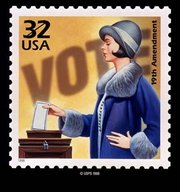 |
| American women earned the right to vote with the passage of the 19th amendment to the U.S. Constitution |
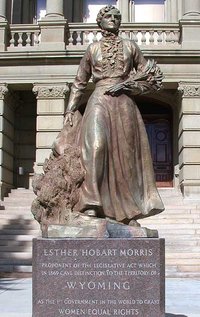 |
| Statue of Esther Hobart Morris in front of the Wyoming State Capitol |