. .
�Small island developing states have all the problems and challenges of the coastal zone concentrated in a limited land area�vulnerable to global warming�� 17.126
�Adopt measures� to mitigate impacts and reduce the threats posed to marine and coastal resources." 17.128b
�Study the special environmental and developmental characteristics of small islands�� 17.129a
��existing databases should be expanded and geographic information systems developed and adapted to suit the special characteristics of small islands.� 17.130
�Centres for the development and diffusion of scientific information and advice on technical means�with reference to management of the coastal zone, exclusive economic zone�� 17.134
��large number of unique species of flora and fauna, giving them a high share of global biodiversity�) 17.125
Agenda 21, Chapter 17, Section G
Sustainable Development of Small Islands
For many years, small islands have been seen as a tropical paradise and are becoming more popular as holiday destinations. The lure of small islands in particular, is their unique cultures and the seemingly unspoilt environments. As recognised throughout Agenda 21 small islands, especially the Pacific islands, are home to a huge array of plant and animal life, both terrestrial and marine. There are at least 40 Small Island Developing States (SIDS) recognised by the United Nations (UN). Although they have no universally recognised definition, they have similar problems to the developing world, however their small size and remoteness has lead to these problems being intensified. For the benefit of this critique of Agenda 21, Small Island Developing States may be considered as geographically small, low lying islands whose economies are in a state of transition. Many SIDS collaborate under the Alliance of Small Island States AOSIS, which along with acting as their collective voice within the UN, works towards promoting the benefits of Small Island States to the international community.
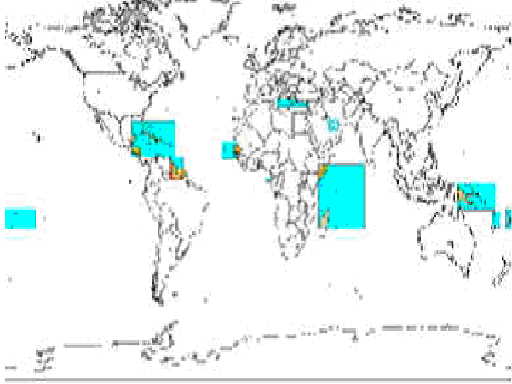
Map showing the global distribution of SIDS from http://www.fao.org For individual island information see the FAO website above.
Map showing the global distribution of SIDS from http://www.fao.org For individual island information see the FAO website above.
This section highlights some of the major issues with small island states as well as a number of strategies for dealing with them. Small island states have a uniqueness providing them with an unmatchable opportunity to use their cultural knowledge and heritage to develop their economies sustainably.
So what are the major issues concerning Small Island Development highlighted by Agenda 21?
 SIDS are dependent on their marine and coastal resources this, combined with their small size, results in the majority of the population living coastally. In Indonesia 110 million people out of 180 million live in coastal areas. Their small size has concentrated the pressure on their coastal resources, especially with the onset of tourism. In particular, waste management is a problem as there is limited space for landfill and incineration is too expensive. The estimated cost of clean up of stockpiles of waste for 14 pacific small island states is estimated at US$38 million.
Their small size leaves them vulnerable to the impacts of climate change especially the loss of vital natural resources and economies. The already occurring impacts have been as high as 20-30% of domestic GDP.
SIDS are geographically isolated, providing them with unique cultural heritages and hugely diverse ecosystems. This in itself may be a tourism magnet. In the Seychelles, 70% of their economy is tourism derived and 30% of the labour force is employed in tourism. This proved a particular problem during the Gulf War when tourism collapsed. As a result, the government is now developing alternative activities, such as fishing and farming for bananas and tea, etc. The collapse of tourism would spell disaster for many other SIDS.
The small size of SIDS has meant that development options are limited, as is their developmental capacity, especially of the Caribbean SIDS. The islands are located in a major shipping area. The Panama Canal increases the risk of pollution from oil tankers and there is regular movement of nuclear and other hazardous materials across the Caribbean. The planning capacity of the Caribbean SIDS is placed under great strain, in order to incorporate disaster evaluation methods. Along with their relatively small size, SIDS ecosystems are fragile and vulnerable giving the environment a fairly low capacity to cope with waste discharge from any developments. Their small size means that land use is a commodity and needs to be well managed to ensure chance of sustainable developmental options. Hawai�i, although not a Small Island Developing State is a good example of poorly conceived development options, which have caused substantial environmental damage and hindered sustainable development options.
The grazing of cattle after the arrival of Europeans started the ball rolling in terms of erosion. Since then, monoculture has prevailed. In 1835 sugar crops were cultivated and since the 1900�s pineapples have predominated. These crop types exceed the carrying capacity of the environment, although when the crops are planted erosion is minimal, it is between plantings that the erosion problems worsen. Pearl Harbour on O�ahu, and Kane �ohe Bay receive the majority of the eroded soil. It has been estimated that the damage to the fragile marine ecosystems are severe, for example one ton of eroded soil from Kunia entering Pearl Harbour causes more turbidity that the same amount entering Laguna Bay in California. Another threat to the environmental well being is through climate change. Soil releases huge amounts of carbon dioxide; therefore as the soil is being eroded it can no longer store carbon. This is then released into the atmosphere or into the oceans.
Section G aims to help these islands steer away from unsustainable practices such as poor waste management already prevalent in areas with a heavy tourist population. The preservation of the environment is key. Scientific understanding of the expected impacts of climate change and island biodiversity, coupled with international finding to develop new technologies that coincide with indigenous knowledge and cultures.
What initiatives are proposed?
With the help of the international community, SIDS should:
Undertake comprehensive studies into the full impacts of climate change, and the protection of valuable marine resources, in order to plan for the expected impacts.
Identify and adopt management strategies in conjunction with cultural knowledge and the above changes in mind, to allow for continued sustainable development.
Improve access to technologies and data information among the States.
