Agenda 21, Chapter 17, Section G
Sustainable Development of Small Islands
Rachael Bentley
Background
In the last few years global climate change has become of international importance as one of the worlds long-term challenges. In 1988 the Intergovernmental Panel on Climate Change (IPCC), with the backing of the European Union, confirmed that the likelihood of global change would increase if greenhouse gas (GHG) emissions continued to increase. After this the IPCC recommended that immediate planning was needed, especially with regard to coastal states needing to adapt to the expected impacts. This was first recommended in 1990 and then again in 1992 in the IPCC Global Climate Change and the Rising Challenge of the Sea Report of the Coastal Zone Management Sub-group; May 1992; that stated that action was needed now if adverse impacts were to be avoided.
Their recommendations stated that small island developing countries undertake measures that will reduce their vulnerability by effective management of their coastal zone. This was echoed in Agenda 21, 17.128 (b)
Existing impacts of climate change
In both the South East Asian SIDS and the Caribbean SIDS there have been economic and environmental impacts of climate change. Drought in Fiji in 1988 wiped out two thirds of their sugar crop, with the overall impact being 3% of the GNP. In Tonga the squash crop, which produces half of the exports by value, was cut by 50%.
So in response to the IPCC recommendations, and the basis for action outlined in Agenda 21 what has been done?
 In the pacific the South Pacific Disaster Reduction Programme (SPDRP).
In the Caribbean; The Caribbean: Planning for Adaptation to Global Climate Change (CPACC). For the basis of this case study it is the CPACC that will be discussed.
The Caribbean Response
As in many countries, the coastal area has come under increasing stress, the Caribbean member states, CARICOM have been influential in ensuring cooperation and trade between the islands and also internationally. Although economically beneficial it has not been without its downsides. The coastal resources have come under increasing stress and it is widely considered that climate change will worsen the already prominent problems:
1. Intensification of human population and activities,
2. Increase in tourism,
3. Inadequate waste disposal,
4. Inadequate development schemes.
The Caribbean islands consist of Antigua and Barbuda, Bahamas, Belize, Cuba, Dominica, Dominican Republic, Grenada, Haiti, Jamaica, St. Lucia, St. Kitts and Nevis, St. Vincent).
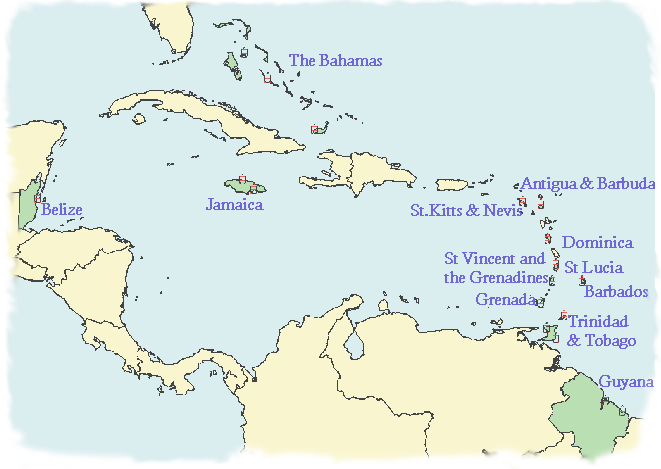
Map from http://www.cpacc.org FAO, 2000)
Origin of the Caribbean response.
CPACC originated in conjunction with the 1994 Global Conference on the Sustainable development of Small Island Developing States in Barbados. The Caribbean small island states submitted the proposal to the Global Environment Fund (GEF). The project gained GEF approval in 1995 and was endorsed by the ministers involved. Each member country has been designated with a Project National Focal Point (NFP), for example Jamaica.
Overall project aim: To assist Caribbean SIDS to cope with the adverse effects of global climate change, especially sea level rise. To do this the project proposes to:
Strengthen regional capacity for monitoring and analysing climate and sea level dynamics and trends and to determine the immediate and possible impacts.
Develop integrated management and planning in terms of cost effectiveness for response and adaptation to the impacts of climate change on coastal and marine areas.
Identify particularly vulnerable areas
Enhance regional and national institutional arrangement for human resource development.
Identify options and instruments to develop long-term plans.
The project will assist the national governments, utilising the University of West Indies Centre for Environment and development (UWICED).
UWICED will follow the Agenda 21 management related activities, 17.130, 17.131, 17.134 and 17.136, reference to Agenda 21 data and information, international and regional cooperation and coordination, scientific and technical means and capacity building respectively. The project will be regional in its set-up and will rely on cooperation between the 11 participating countries.
The total cost of the project is expected to be US $6.3 million. Of this adaptation planning costs for the short-term are expected at US$3.5 million. US $2.2 million will have to be generated by the four regional components and US $1.3 million by the four national pilot components.
The above is all policy, but what has been actually done?
A Sea Level/Climate Change monitoring network.
With the help of the US National Ocean Service of the National Oceanographic and Atmospheric Administration (NOAA), 18 tidal gauges have been installed as part of the Global Sea Level Observing System (GLOSS). NOAA is the major body overseeing the operation, with the Caribbean meteorological Institute (CMI) being the regional agency. A long-term fund for this has been set up of US $ 50, 000 and will also be supplemented with user fees.
Databases
The databases include SIDSNET along with Regional Archive centres linked with National Implementation Coordinating Units (NICUs) and Regional Project Implementation Units (RPIU). All participating countries will have training units and technical support.
Inventory of Coastal Resources and Uses
Collect valuable data needed for projects and to establish biodiversity.
Data collected will be physical, and that of the natural environment
All countries will have Geographic Information System (GIS)
Regional training courses.
Policy framework for integrated coastal zone management
Land use guidelines
Disaster contingency planning
Draft framework to be presented for CPACC representatives
Training to adapt framework for a specific countries needs
Pilot programmes include
1. Coral reef monitoring for climate change,
2. Coastal vulnerability and risk assessment,
3. Economic evaluation of coastal and marine resources,
4. Economic and regulatory policies,
5. National communication in response to UNFCCC.
Recommendations
The Caribbean small island developing states have made substantial progress compared to some of the other regions. However, there are still areas that need addressing. Waste management, especially sewage treatment, is still lacking in effectiveness in many SIDS and this needs to be rectified in order to reduce the level of organic matter being discharged into the marine environment. Other emerging issues also have to be considered, these include:
Effective contingency planning to accommodate the expected impacts of sea-level rise is required, such as the construction of hurricane resistant buildings.
Land use, the lack of available land for development is one of the issues that may threaten biodiversity and the health of coastal fringe ecosystems. It is feared that many small island states will begin land reclamation for tourism development. This in itself may result primarily in habitat destruction but may also affect sediment cycles in the long term, which would have further reaching consequences.
In conclusion, many small island developing states are in need of considerable aid in developing and implementing the many policies needed to accommodate the expected risks they face.
Sophie Holmes
Section 17.131 of Agenda 21 advises signatories to �develop and strengthen inter-island, regional and inter-regional cooperation and information exchange� with regards to SIDS (Small Island Developing States). Chapter 17 also emphasises the need for more scientific and technical support for SIDS. Since 1992 progress has been made regarding Agenda 21 as a whole. For Section G Chapter 17, the Barbados Programme of Action (SIDSnet incorporates the ideas from the original text (outlined above) and the issues raised in the BPA. The aim of SIDSnet is to provide a service to SIDS that will enable them to achieve the initiatives proposed in Agenda 21, ultimately sustainable development.
The Small Island Developing States network was set up as a direct result of the Barbados Programme of Action. Two bodies were responsible; the United Nations Development Programme�s (UNDP) subsidiary group Sustainable Development Networking Programme (SDNP) and the Special Agency for Technical Cooperation between Developing Countries (TCDC). SIDSnet has been funded by both its founding agencies and initially Germany, Italy, Japan and Norway. All 42 island states registered with AOSIS (Alliance of Small Island States) are members.
SIDSnet functions include:
Information exchange
All good management plans require sound knowledge both scientific and traditional, therefore as regional bodies initiate ideas to tackle sustainable development, information needs to be shared among islands and decision-makers alike. Basic information is also available for each small island developing state.
Hosting and mirroring websites
Although UNDP is investing money into SIDSnet, not all islands have access to fast Internet connections. Therefore, islands and organisations can reap the benefits of a website even though there is not the facility on their Island. Benefactors of this initiative include Caribbean Conservation Association and UNDP Trinidad.
Email facilities
SIDSnet has initiated the minimum of email facilities to all participating SIDS. Most recently Tuvalu in the Pacific is now online as a result of SIDSnet initiative.
Website
One key tool that highlights the plight of SIDS worldwide is the SIDSnet website. In 1999 more than 100 countries were logging on regularly, thought to be mainly from academia. Information on BPA objectives and projects is predominant. Other information regarding activities, workshops and conferences are listed under topics; biodiversity, climate change, coastal and marine, energy and SIDS, tourism, trade and SIDS and other issues. There is also information about global weather, which acts as a service for tourists as well as the usual visitors.
Implementing regional initiatives SIDSnet has been instrumental in implementing the following projects:
Pacific Island Internet Project promotes use of the Internet use for development in the smallest island nations.
Asia Pacific D Information Project (APDIP) helps local governments develop effective information and Internet strategies.
Internet Initiative for Africa aims to implement Internet strategy and infrastructure in numerous African countries including SIDS Sao Tome & Principe and Comoros.
Success stories
As well as information, SIDSnet also covers successful projects that have been initiated as a result of Agenda 21. Case studies are listed under island regions.
Training
The Government of Japan has funded SIDSnet Internet workshops. Basic Internet skills (retrieving information and using SIDSnet) were taught in over 21 different SIDS to facilitate optimal use of the initiative. More are planned for the future.
Although SIDSnet has seen successful projects initiated, the problems concerning SIDS cannot all be completed via email and on the Internet. Communications are improving but face-to-face consultations still seem more productive and binding. People can discuss with ease in person as opposed to online, particularly when connections are not the most reliable. SIDSnet is successful in achieving technical goals but without personal cooperation within and among regions no substantial progress will be made.
Future Considerations of SIDSnet
Funding
As with other SIDS initiatives funding is depleting with time. It essential to gain more funding to ensure all SIDS have access to the Internet and the opportunities that SIDSnet represents. Initial donors have decreased their funding substantially. SIDSnet has the potential to be a powerful tool in achieving sustainable development but investment is the key to its success.
Publicity
More public awareness is needed about SIDSnet. This will encourage new investment if carried out correctly and raise the awareness of SIDSnet as a service to island dwellers and as a data pool to researchers and decision-makers.
Technical Development
SIDSnet aim to ensure that islands, regional bodies and enterprises have the tools for collecting, analysing and publishing information. As developments are made SIDSnet want to offer the new technologies as a means of ensuring its success.
SIDSnet is a useful tool in achieving the goals set by Agenda 21. For more information about SIDSnet, its functions and information available see the website.