Agenda 21, Chapter 17, Section A
Integrated Management and Sustainable development of Coastal and Marine Areas, Including Exclusive Economic Zones
Robert Staniland
Integrated Coastal Management (ICM) has now existed as a tool for sustainable development and conservation for around 36 years. In this time many significant improvements have been made to our ICM practices, cumulating in the new directions proposed in Agenda 21 (see section A overview). As we progress into the 21st century what is the current status of ICM around the world? Are all coastal nations adopting ICM programmes and what problems have arisen?
The Status of ICM 2000-2001.
Coastal Zone Canada has recently held their 4th international conference �Coastal Stewardship: Lessons Learnt and Paths Ahead�. The conference presented a document entitled �Baseline 2000�. Although not specifically related to Agenda 21, the document raises some very salient issues faced by ICM decision makers and summarises, numerically, the involvement of coastal nations and semi-sovereign states (including those which border international lakes and land locked seas) in ICM efforts in the year 2000. A copy of the document in pdf format can be obtained from the website listed above.
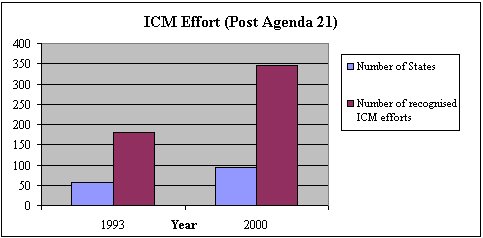
Implicit in the recommendations and directives of this section of Agenda 21 is the need for all member states to participate in setting up integrated coastal zone management schemes as distinct forms of sustainability planning and management. Although, as outlined in the overview, it has been incredibly difficult to create effective ICM schemes that can be universally adopted, there have been definite advances in the number of nations participating in ICM efforts. The last ten years, since Agenda 21, has seen the biggest period of growth in the field of ICM (there has been almost a doubling of ICM efforts in the last seven years) and it is now internationally recognised as the most effective method to realise the goals of conservation and sustainable development of coastal resources (see box 1, which shows the number of states at national and sub-national level, which have instigated ICM efforts).
Box 1: The Change in ICM Effort Since Agenda 21
The following table shows the number of ICM efforts made by coastal nations up to the year 2000 and their composition, in terms of the levels at which the ICM effort has taken place e.g. those occurring at national or sub-national level, or being carried out by island nations. (Adapted from Coastal Zone Canada data).
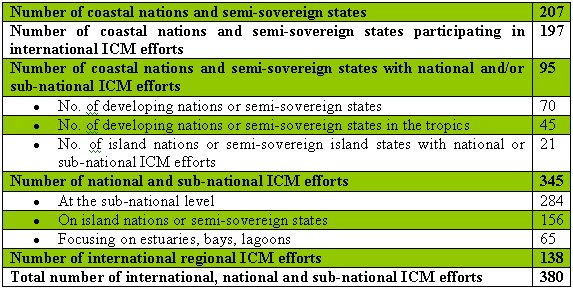
As the above data set shows, integrated coastal zone management efforts have been widely adopted by almost all the coastal nations in the world at some time over the last few decades (for case studies of individual countries see the NOAA web site). This also includes around 25 initiatives for the planning and management of international open seas, international landlocked seas and gulfs and international lakes. However, as mentioned, there have also been a variety of issues that have arisen which have proven problematic to effective ICM effort.
Box 2: Problems for ICM in the Year 2000
 National and sub-national ICM efforts require a high level of commitment by the relevant authority, be it a government, NGO or interested party, with a well-prepared budget and full stakeholder participation, which is often very difficult to achieve, but without
  which no effective program can take place.
International programs have less commitment due to the consensual nature of their agreements, with weak enforcement and inadequate budgets. Therefore many international ICM programs cannot resolve their motivating issues.
There is very little information available as to whether or not ICM activities are meeting their stated objectives. Although permits have been issued, local land-use plans approved and marine protected areas or special areas of conservation have been designated, this does not provide conclusive proof that the issues that motivated the management program are being resolved.
Is ICM Appropriate for All Countries?
Agenda 21 has lead to the development of ICM programs in all signatory states in some form and there is little doubt that with fine-tuning and the universal adoption of strengthened Agenda 21 directives, then ICM is the best option for defence of the coastal resource. However, it is not feasible in all countries. A set of environmental, political and socio-economic conditions needs to be in place before ICM can be used efficiently. For many nations and regional governments, these conditions are not in place.
Many coastal nations do not have the socio-economic links to coastal resources required to instigate ICM (e.g. tourism, fisheries, recreational potential, wetlands and coral systems).
The political situation in some developing countries (e.g. civil war, abuse of power etc) means that the capacity to implement ICM is weak.
Democratic governance and national desire to cooperate with other coastal states in preparation of ICM guidelines is essential but not possible in all circumstances, making ICM difficult, if not impossible to establish in these countries.
At the beginning of the millennium for which Agenda 21 was designed, there is plenty of evidence that ICM is a good and advanced approach for coastal conservation and sustainable development.
Its practitioners are increasingly agreeing upon the principles, concepts and definitions of ICM and global programs are being adapted for a �best practice� approach.
Performance assessments for ICM programs are becoming established and will further aid the strengthening of ICM initiatives by acting as an evaluation process which is open to criticism and available to anyone who wants to see it.
Many of the major goals of ICM are being met; pollution is decreasing (e.g. in the UK pollution caused by agricultural effluent fell 29% between 1991 � 1998), the frequency of toxic spills has lowered and the world�s hazard prone areas are having the necessary development restrictions placed upon them
However, ICM reporting systems remain inadequate and the extent of a management programs success is difficult to quantify. This issue needs to be resolved if we are to progress further (Future directions for ICM and Agenda 21 can be seen in the future section) in our ICM efforts, meet the objectives of Agenda 21 and begin to have an effective impact on our environmental problems.
Joanne Smith
What is Local Agenda 21?
A concept that was first formulated by the International Council for Local Environmental Initiatives (ICLEI) 1991, Local Agenda 21 was one of the primary outcomes of UNCLOS Agenda 21:
�...By 1996 most local authorities in each country should have undertaken a consultative process with their populations and achieved a consensus on a �Local Agenda 21� for the community...� Agenda 21, section 28.28
With emphasis on sustainable development and the integral role of stakeholders, there are several key features of the initiative:
Multi-sectoral co-ordination for the continual development of action plans.
Comprising of local stakeholders, a policy body should be formed to consult with
Non-Governmental Organisations (NGO), businesses, community groups etc, in order
to prioritise and prepare action plans.
Assessment of local needs in terms of social, economic and environmental concerns.
Target setting in order to achieve the goals of the plans.
Monitoring and reporting the progress of the plans.
http://www.iclei.org/la21/la21rep.htm
The whole process is never ending as the stakeholders undertake continuous revision of the plans. It is therefore a new concept in sustainable development. The connection between Local Agenda 21 and Chapter 17, Section A of UNCLOS Agenda 21, is therefore apparent. It may further be emphasised in the example of County Durham�s �Turning the Tide� regeneration project.
Case study � County Durham
Early geological history indicates the County Durham area to have been covered in forests and swamps, which have subsequently created extensive coal deposits. Mining first began in the 1840s and rapidly became the mainstay of employment and importance, with over 26,000 people employed in the Easington area alone. At the industry�s peak, four pits directly tipped on 12km of the 17km coastline. This equated to approximately 2.5 million tons of spill per year or a total of over 40 million tons by the time of the last pit closure in 1993 (based on Local Council figures). Not only did direct pollution occur in terms of immediate dumping, but the colliery spill was also washed out by tides, only to cause a pollution problem elsewhere along the coastline. The Magnesian Limestone Plateau of the county also creates environmental conditions that are rare, and it is therefore a vital habitat for wildlife. However, the associated grassland has largely been lost through natural processes of coastal erosion and extensive mining activities and as thus, has increased pressure upon inhabiting wildlife. The potential for mine-water contamination of groundwater resources is also of major concern, especially in terms of old shallow mine workings.
In a separate initiative, this threat is currently being addressed through close collaboration between the Environment Agency and the Coal Authority, to develop the Durham Mine-water Pumps.
Social effects were also apparent. After initial mass unemployment due to pit closures, the local communities began to decline further, due to the neglected image it had gained. A lack of interest from new industry to invest in the area occurred, along with low incentives for tourists to visit and for locals to take an interest. A once thriving economy had collapsed.
�Turning the Tide� Initiative The emphasis of the initiative is on regeneration. Beginning in 1996, the complete restoration plan consists of a number of projects based around four main categories:
Beach Improvement
Removal of debris, litter and derelict structures in order to achieve greater aesthetic values. Natural changes within the environment are also monitored.
Nature conservation and landscape enhancement
Reclamation and extension of the limestone grassland, with many former mining and farming sites being converted to wildlife reserve.
Removal of colliery spoil
Two spoil heaps at Easington and Horden to be removed before a greater pollution hazard is created through ocean circulation and weather patterns.
Coastal recreation and access
After improvement of the coastline, improved facilities for both locals and tourists to be developed. This is to include extensive creation of improved footpaths, cycle paths and greater accessibility to beach areas.
Examples of projects undertaken in line with the above objectives can be seen below. (A full outline and further information on these and other projects undertaken, may be found at http://www.turning-the-tide.org.uk/)
| Location | Project Name | Project Description |
| Blackhall | Cluster A - Blackhall Rocks | Improvements to Blackhall Rocks car park, picnic area and footpaths, including provision of a universal access route to the coastal viewpoint and seating area. |
| Crimdon | Crimdon Seafront Demolitions | Demolition of disused and dangerous buildings. |
| Cycletracks/ Whole Coastline | Beach Monitoring - Algae and Invertebrates Survey | Carry out an algae and invertebrate survey within the intertidal zone. |
| Cycletracks/ Whole Coastline | Beach Cleaning | Carry out a twice yearly programme of rubbish and debris clearance from the beach. |
| Cycletracks/ Whole Coastline | Beach Monitoring - Physical Changes | Carry out a programme to monitor the effects of coastal erosion on beaches. |
| Cycletracks/ Whole Coastline | Habitat Creation - Soil Survey, Etc. | Carry out a soil survey, chemical analysis, drainage report and management plan for reversion to magnesian limestone grassland |
Information from website http://www.turning-the-tide.org.uk/
Project costs, 1996-2001
The five year plan was estimated at being in the order of �10 million, �4.5 million of which was donated by the National Lottery�s Millennium Commission. The rest had to be raised by local businesses and individuals. This may be seen as being one of the keys to its success. The close involvement of stakeholders is also integral to the planning, management decision making and implementation processes. Involvement of the community at all levels, have given greater incentives to achieve the goals set, and have returned a sense of pride to the people. Voluntary events for fundraising, design development and artwork, community action fund projects and the development of public awareness activities, are just some examples of the work that has been done in order to bring regeneration to the county.
The outcomes of �Turning the Tide?�
The initial regeneration project was due for completion in March 2001 and it is therefore too early to give exact figures on improvement. However, bathing water standards continue to rise across the north-east and business investment is increasing, especially in terms of the manufacturing and service industries. Public transport initiatives, new central developments and greater facilities in town centres, have also allowed for better health of areas in terms of the environment and economy. Overall standards have therefore seen a dramatic improvement, along with the improved morale of local individuals. The Environment Agency has stated that vast improvements have been made regarding the lowering of industrial emissions from power stations, metal, chemical and mineral works. However, minewater is still of specific concern, along with a general alarm over continued industrial pollution from other sources. Such hazards include that of asbestos, chemical gas clouds and raw sewerage.
Initial investigations indicate that the �Turning the Tide� project has largely been successful with the primary goals of the plan achieved. The current failures and concerns do need to be addressed however, but this may be achieved through the continuing development of plans and changing priorities that the Local Agenda 21 structure allows.