|
Risky Business
As the shock of new Malaysian art music subsides,
a Kluang native's Starry Night's Ripples is set to take
on four composers from around the globe
- Options2, The Edge, Nov 2004
download the pdf version: Pg
1 | Pg 2
 If
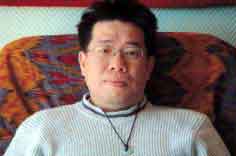
you have time for just one concert this year, keep Nov
27 free when our very own Chong Kee Yong presents his
winning work, The Starry Night's Ripples, at
the Malaysian Philharmonic Orchestra's International
Composers' Award (MPOICA). The Kluang farmboy who has
earned the very apt nickname "the Professional Prize
Winner" in Belgium will be vying for a tenure as MPO's
composer-in-residence and a prize money of US$30,000.
And if you're interested in music at all, then you have
no excuse but to catch Chong at the workshops beginning
Nov 23 and the final concert. If
you have time for just one concert this year, keep Nov
27 free when our very own Chong Kee Yong presents his
winning work, The Starry Night's Ripples, at
the Malaysian Philharmonic Orchestra's International
Composers' Award (MPOICA). The Kluang farmboy who has
earned the very apt nickname "the Professional Prize
Winner" in Belgium will be vying for a tenure as MPO's
composer-in-residence and a prize money of US$30,000.
And if you're interested in music at all, then you have
no excuse but to catch Chong at the workshops beginning
Nov 23 and the final concert.
The Starry Night's Ripples premiered at the
MPO Forum this March, and it gave Chong the edge over
fierce competition from equally masterful works by three
other Malaysians, Adeline Wong, Johan Othman and Ahmad
Muriz. Chong's dramatic clash of elements, as earth-shaking
as the very creation of the stars itself, earned the
Belgian resident a place in the MPOICA on a three-two
vote.
Johan's Topeng 1 was as classy and compelling, if not as colourfully
vibrant as his Phase 1 entry Ittar, and Ahmad's Benih Harapan
showed plenty of promise, but I venture that Wong's magnificently constructed
Steel Sky was the one that came close. Both Wong and Othman are certainly
composers to watch - Wong herself is writing a cello concerto that will bring
Malaysia's name to the Australian Composers Orchestral Forum 04 (ACOF), and
we will not be alone in hoping she will win.
In fact, this reviewer would go so far as to say that
all six participants of this first round of Forums deserve
their day in the sun, and their talent ought to be continually
nurtured. With a world-class orchestra and a world-class
venue, there is surely room here for more than one composer.
But there had to be one winner, "with a very small 'w,'"
as Forum director Kevin Field repeatedly stressed at
the end of Phase 2, and there was never a doubt that
Chong would be the one.
"He was the one composer who successfully integrated
the total Forum experience into his work. He adopted
suggestions without sacrificing his goal, continually
showed a strong understanding of the medium and suggested
to the panel that he could stand alongside international
composers in the MPOICA...," says Field.
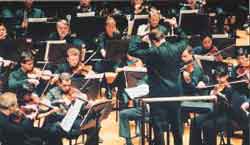
Chong's work demands almost specialist technique from the players, but the MPO did a superb job of making it sound easy. Field admits that easy was far from the case, "the closely related issues of ensemble, blend and balance, to name but three. It will all come together that much easier in the MPOICA through familiarity. This is why for audiences and orchestras alike, second performances are more important than any original commission and premiere. We all need to grow into a 'new style' and this takes time."
Listening to the four works, one cannot help but notice this "new style" that had influenced all the composers. Unlike Phase 1, which was a happy clash of different musical personalities, it seemed as if everyone was trying very hard to be a Chong in Phase 2. "That's your opinion, I disagree," says Field.
"I think writing for the second round orchestra of such proportions was a bridge too far for some, and this will be addressed in the next Forum. [Here] they were free to write for any ensemble within the orchestra, but they all decided to open Pandora's Box! Having said that, what each composer impressed on me was their single-mindedness - they very much believed in themselves and their work and this is an essential fact when dealing with 105 members of an orchestra. It is important for the conductor to believe in them too if the performance is to be worthwhile."
Undoubtedly, the passion and commitment of Field and the orchestra were first-rate;
far more persuasive, in fact, than a regular MPO concert
I recently attended. My hours at the rehearsals of Phase
1 were certainly more memorable than most concert
performances I have ever attended here or elsewhere,
and this is no exaggeration. I can't recall a single
bar of Mendelssohn's Elijah nor a fragment of Joyce
Koh's Tai, but I can still remember the trumpet motif
in Starry Night's Ripples. And I didn't even
like Chong's music at the start.
The audience at Phase 2 was equally appreciative: "A very 20th century programme well performed... I never knew there were so many great composers in Malaysia," says one. There were some constructive critics, who said the Forum would be "immensely more enjoyable if the composers had told a human story rather than a representation of natural phenomena... some of the works do not have sense of direction... a bit too avant-garde, the sense of tension is rather unpleasant... we are ideally in search of new sounds, not just to emulate but [aim for] an identity [that is] non-pretentious and mature in understanding... something to call our own".
What does Field have to say on some key learning points so far? "Orchestration... intelligent thematic 'development' no matter how individual the style or idea. One question common to all was, 'What was your first idea or germ from which the remainder took root?' I was always surprised to discover that in most cases the original 'cell' was submerged by orchestration or lost in the overall structure, leading us all to bark up the wrong tree."
The Forum itself is learning from this experience. Field is considering keeping all candidates on board for the complete twoyear run of the Forum and offering a larger ensemble for the first round, a smaller orchestra for the second. To make it more interesting, candidates might perhaps be asked to orchestrate an existing piano prelude like Debussy's. "These are not set in concrete, just ideas for now. You'll have to wait until May of 2005 for the 'new improved version'!" says Field.
What should a composer take note of when writing for such a competition? "They can write their wildest dreams - [Forum panellist] Fraser Trainer's quote, not mine!" says Field. "Few composers would write with a specific competition in mind - I would worry if they did. A winning work... successfully communicates the composer's dream to the audience. The Forum allows the individual to grow, free from the burden of total competition. Only later in the second round does it get a bit juicy in that regard!" One of the panellists, composer Gerard Brophy, adds: "[In the current rounds] we were looking for composers whose work demonstrated some level of excitement and innovation... the second round [emphasised] issues of musical expression - for example 'musical confidence', the clarity and effectiveness of musical utterance. I must emphasise that these criteria transcend any stylistic considerations and, above all, we did not encourage innovation for innovation's sake, which as we are all aware can result in stilted, awkward and ultimately inexpressive music."
Brophy recommends that future aspirants focus on "[issues of] clarity of musical notation, clarity of musical expression and formal/architectural considerations. In order to achieve these goals, I encourage the applicants to completely immerse themselves in a comprehensive study of the chamber and orchestral repertoire. It is only through this activity, combined with considered reflection, that a composer can liberate completely their musical imaginations andthus indeed fully express their musical personality."
It's clear we're off to a good start, and long-term plans for a regular Forum
and Field's advocacy of new music in general augur well for a Malaysian art
music scene that is self-sustaining, and which may even lead the way regionally.
Does the conductor who brought so many new pieces to life have any idea of what
shape this music scene would eventually take? Are we headed the Contemporain
way, or would Post-Minimalism and cross-cultural assimilation take the lead?
I mean, where IS new music today?
"This is a huge question!" admits Field. "We are talking about new music of the western art tradition and therein lies the problem - tradition! Performances of new music tend to be satellite activities to larger festivals or hot-housed in ghettos of dedicated new music ensembles and institutions by virtue of the greater public fear and resistance to all things new. The formula 'new = risk of box office income' rules. To date, we have performed over 80 works from living composers over the last six seasons - for a non-specialist, new music ensemble this is quite a feat; it's a path down which many quality orchestras are travelling. New music performances in Europe, for example, are thriving and being driven by firstrate works from first-rate composers, from IRCAM [Institut de Recherche et Coordination Acoustique/Musique] to the BBC Proms. Only through regular integration of the new with the old will audiences become more aware and less 'afraid' - and box office managers more daring!"
Prior to the Forum, the MPO had already dipped its toes into the territory with commissions from Chong, Sunetra Fernando and Tazul Tajuddin. With more Forums and more new works, we may well see the day when Malaysian music forms a permanent part of each season's programme. "We all have a part to play," says Field. My experience with MPO audiences proves that they are just as inclined to accept the new as they would a symphony of Brahms. I think it also has to do with indigenous classical Indian, Malay and Chinese music, all of which are as fresh and contemporary in sound and colour as a work by George Benjamin, for example. It would in part explain the success of the MPO new music series� back to your second question about where new music is now - probably at the same place now as it was for Berlioz then."
A moment of d�j� vu, as I recall an interview with the Queensland Philharmonic a decade ago when the music director remarked that in Mozart's time, orchestras and audiences were looking forward to the next new piece that was being written. The QPO ran regular competitions for its local composers, and I had in that article advocated that we do the same for Malaysians.
Field has done a remarkable job in making this vision a reality, but more work needs to be done. The Forum will need to reach out and gradually involve more sectors of the community and engage more partners in order to provide more opportunities for local art music to grow and flourish. Still, the MPO has made significant inroads. It has earned its stripes in helping pull us out of the dark ages of art music.
Field offers an insight to this dark past: "During the planning of the Forum, I spoke with a number of potential composers... One phone call ended with the person slamming down the receiver, after telling me of an incident that took place when the MPO was first formed where they were all at a formal gathering of VIPs, only to be advised one to one by a key official that no individual composer in Malaysia was capable of writing for an orchestra of this standard. "On hearing this, I was as shocked and angry as that composer. The experience of the call sharpened my focus on the development of the Forum." Field adds that this official has long since left the organisation, but while he has worked hard to dispel the myth with such an admirable line-up of Malaysian compositions that we have thus far been treated, such an ignorant remark leaves lasting scars. "It just goes to show what a negative impact such a venture can have," says Field. "All the more reason to keep at getting it right."
- By C H Loh
Related articles:
- Brand New Beat -
Amidst the riot police and tear gas, CH witnesses
the birth of Malaysian art music repertoire (Options2,
The Edge, Jan 04)
- Sowing The Seeds
- CH speaks to Kevin Field and contemplates the great
art music adventure (Options, The Edge, March 03)
|