|
| |
Special Things
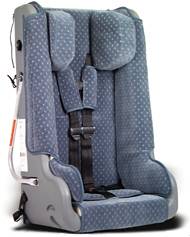
SnugSeat
On December 23rd 2000 the whole family was traveling to visit
relatives. We were struck from behind by a drunk driver. Needless to say, that
great big chunk of plastic called a Gorilla carseat (by Snug Seat), that was
more often than not a right royal pain, came through tremendously. Connor didn't
have a mark on him. The seat and associated 5-point harness did exactly, if not
more than it was designed to do. If anyone had any doubts, put them to rest. My
beautiful son, Connor owes much to the people at SnugSeat.
Thank you.
Fathers' Day 2000
Dick Sobsey
June, 2000
Almost 50 years ago, I used to watch Roy Rogers and Dale Evans on TV. When I
was six, Roy and Dale were the kind of heroes that I needed. I was still
learning about the world, and their show made it easy to tell the good guys from
the bad ones. What I didn't know back then was that Roy and Dale were also
parents of a severely handicapped child. Their Daughter Robin had Down syndrome
with lots of complications. She only lived a couple of years, but Roy and Dale
loved her and did everything they could to keep her alive as long as they could.
Dale was one of the first parents to speak out about being the mother of a child
with a severe developmental disability, in a time when most parents hid such
children. Roy joined her in telling people that Robin had been a wonderful
blessing for their family. They were heroes in more ways than one back then, and
just like on their show, it was easy to tell who the good guy's were.
Now, Father's Day in the year 2000 is here. I'm looking at an old photo of
Roy Rogers holding his precious daughter, Robin Elizabeth. The caption reads
"Our baby Robin helped show us the true meaning of love and faith." It
makes me think about what it means to be a father in the year 2000. As a father
who lost a severely handicapped daughter many years ago and who does the best he
can to preserve and protect the life of another one today, I think I recognize
the love in his eyes. In my mind, I can still hear Roy and Dale singing
"Happy Trails to You" at the end of each show. It was sweet and a
little sad when I heard it back then, and now I recognize its deeper meaning for
them.
Today, life is a lot more complicated. We have new heroes. In a few days,
Robert Latimer's murder conviction comes before the Supreme Court of Canada.
Repeatedly we are told that he was a hero for killing his own child, for sparing
her from a life of misery. People tell me that he must have been compassionate,
rational, and brave. Media experts tell me that he must have loved his daughter
a lot to do what he did. I guess it's a new millennium and we have different
kinds of heroes now.
There is certainly no shortage of them. Michael Gentry will be sentenced for
involuntary manslaughter of his 15-year-old severely handicapped daughter in Los
Angeles on July 6th. Perhaps this too was an act of love. Oto Orlik stabbed his
14-year-old severely handicapped daughter more than 30 times before she died in
Wisconsin in 1998. How many fathers could be that rational or compassionate?
Eight-year-old Justin Blair, who was blind and had cerebral palsy was beaten to
death with a hammer by his father in New Hampshire. I can not imagine the
kind of courage that would require. There are 110 fathers, step-fathers, foster
fathers, and adoptive fathers who are implicated in the homicides of their
developmentally disabled children in our current homicide database at the
University of Alberta. These heroes shot, scalded, stabbed, poisoned,
electrocuted, starved, beat, drowned, hanged, smothered, beat and gassed their
disabled children to death. One father who was enraged because the
hospital would not give his child the care that he felt was required, threw the
child out of a twelfth story window.
Only a few cases get much attention from the media. Often the sentences are
light. In 1984, Louise Brown's father killed her and then claimed that his car
had been stolen with her in it. The judge sentenced him to only five years for
killing his daughter who had Down syndrome because he thought that her father
might have been traumatized by having a disabled child. After all, he was no
threat to society and a model citizen, just another heroic father overcome with
grief, who spared his disabled daughter and his beloved family a life of
unimaginable suffering. The English courts were less forgiving when he came back
before them in 1997. They sentenced him to life for killing his brother by
stabbing him 63 times.
Now, I confess that I am not the best father in the world. There are times
when I could be a better father to my son who has a severe disability and times
when I could be a better father to my daughter who doesn't. I will never be the
hero who takes decisive and drastic action. I know dozens of other fathers of
kids with disabilities who are also less than perfect. They will never be heroes
of the new millennium. They will just face life one day at a time, usually a
little sleep deprived, feeling their way unexplored territory. Many of them have
much tougher challenges than I do. Lots of them handle things with more grace.
Some of them are better natured.
Some of them are great writers or artists or musicians. Most are just
ordinary people, but in the middle of the night, trying to soothe a sleepless
child, they are all pretty much the same. Some complain that life demands a
little too much from them, and others don't, but deep inside, they love their
children and they love being fathers to them. Most of them consider themselves
lucky. They have grown as human beings and learned new things about themselves
because of their special relationship with a child who needs a lot from them.
Some of them are single fathers. Most have wives that give as much or more to
their families and who share the triumphs and setbacks. Some have other children
who feel deprived because their parents give so much to the child with a
disability, but most of these brothers an sisters are comforted to know that
their parents would do just as much for them if they needed it.
These men are not the heroes of the new millennium, far from it. They are
only fathers. Their names will not become household words. They will not receive
thousands of letters of support for their courage. They will not be discussed by
lawyers and bioethicists. They will never become poster boys of for the
right-to-die movement. They will just keep doing the best that they can for as
long as they can do it.
Neil Young is the father of a son with severe cerebral palsy. He's written
songs about his son. He bought a controlling share in Lionel Trains in order to
get them to make adaptive controls for their trains. He and his wife Peggy
worked actively worked to develop services for children with disabilities.
Kenzaburo Oe is the father of a son born with a severe disability more than 30
years ago. He has written extensively about his relationship with his son and
won the Nobel Prize for literature for his efforts. Others, who are not so
famous, work long days and come home to take care of a severely handicapped
child. These actions are not the kind of fatherly heroism that gets national
attention. They are not heroes. They are simply fathers.
Roy Rogers died a few years ago. To me, he is still a hero, in the old
fashioned sense, but hero means something very different, now. For Fathers Day
for the year 2000, I want to salute all the fathers of kids with special needs
and to all fathers everywhere who find away to give there kids a little more of
themselves when it's needed. Here's to all those dad's who will always be less
than perfect and never be heroes but keep on doing the best they can.
Happy
Father's Day.
7 June 2000
Dick Sobsey is a Professor of Educational Psychology and Director of the JP Das
Developmental Disabilities Centre at the University of Alberta. He is the father
of a nine-year-old son who has a severe global developmental disability.
Please feel free to share this father's day message with anyone who may be
interested.
Dick Sobsey, Director
JP Das Developmental Disabilities Centre
University of Alberta
6-123 Education North
Edmonton, Alberta T6G 2G5 Canada
phone: (780) 492-3755
fax: (780) 492-1318
[email protected]
The following is a report published in the American
Journal of Medical Genetics describing research done on X-Linked Infantile
Spasms. It is rather dry reading, but for a health practioner contains a host of
very good information.
Extract:
Clin Genet 1999 Mar;55(3):173-81
Confirmation of linkage in X-linked infantile spasms (West syndrome) and refinement of the disease locus to Xp21.3-Xp22.1.
Bruyere H, Lewis S, Wood S, MacLeod PJ, Langlois S
Department of Medical Genetics, Children's and Women's Health Center of British Columbia and the University of British Columbia, Vancouver, Canada.
The syndrome of infantile spasms, hypsarrhythmia, and mental retardation (West Syndrome) is a classical form of epilepsy, occurring in early infancy, which is
etiologically heterogeneous. In rare families, West syndrome is an X-linked recessive condition, mapped to Xp11.4-Xpter (MIM 308350). We have identified a
multi-generation family from Western Canada with this rare syndrome of infantile spasms, seen exclusively in male offspring from asymptomatic mothers,
thereby confirming segregation as an X-linked recessive trait. Using highly polymorphic microsatellite CA-repeat probes evenly distributed over the entire
X chromosome, linkage to markers DXS7110, DXS989, DXS1202, and DXS7106 was confirmed, with a maximum LOD score of 3.97 at a theta of 0.0. The
identification of key recombinants refined the disease-containing interval
between markers DXS1226 and the adrenal hypoplasia locus (AHC). This now maps the X-linked infantile spasms gene locus to chromosome Xp21.3-Xp22.1 and
refines the interval containing the candidate gene to 7.0 cM. Furthermore, this interval overlaps several loci previously linked with either syndromic or
non-syndromic X-linked mental retardation (XLMR), including one recognized locus implicated in neuroaxonal processing (radixin, RDXP2). Collectively,
these studies lend strong support for the presence of one or more genes intrinsic to brain development and function, occurring within the critical interval defined between Xp21.3-Xp22.1.
Entire Report:(710 Kb)

You will need Acrobat Reader to view this document, you can
get it here:

|


