 |
|
| MIDDLE PASSAGE |
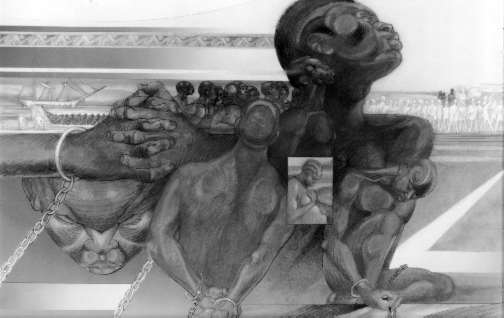
| The Middle Passage was a transport of slaves New World. Europeans used the Middle Passage to trade rum, cloth, guns, and other goods for slaves. Many slave captains, such as John Newton, became known for transporting slaves to the Americas and the islands of' the Caribbean. In order for slaves to get to these vessels, they were taken from their villages by European slave captains. They were forced to marched shackled and chained together to board the slave ships. Due to the fact that all slaves could not aboard the ships at once, many of the slaves were kept in dungeons until the ship returned. Once aboard the ship, they had to endure very harsh and very cruel punishment that lasted for several weeks, months, or sometimes several years. Aboard the ship, the slaves were treated like animals, and they were branded with piping hot irons and restrained with shackles. There were about 300 to 400 slaves in one living quarter with very little ventilation. Many of the slaves lived on deck, which consisted of about 5 feet of headroom without any standing room. The space in the living quarters was so diminished that many of the slaves had to lie in a spoon position on their backs with their heads between the other slaves' legs. This meant that they were forced to lie in feces, urine, and blood throughout the voyage. In some instances, they were chained together dead or alive until the bodies were pronounced dead and thrown overboard. According to John Newton, �Every morning, perhaps, more instances than one are found of the living and the dead fastened together.� In these small quarters, many diseases began to spread such as small pox, fevers, fluxes, measles, yellow fever, malaria, and other fatal viruses. According to an 11 year old boy, Olaudah Equiano, �the closeness of the place, and the heat of the climate, added to the number in the ship, which was so crowded that each had sacredly room to turn himself, almost suffocating us. This caused copious perspiration, so that air soon became unfit for respiration, from a variety of loathsome smiles and brought on a sickness among slaves, of which many died.� |
 |
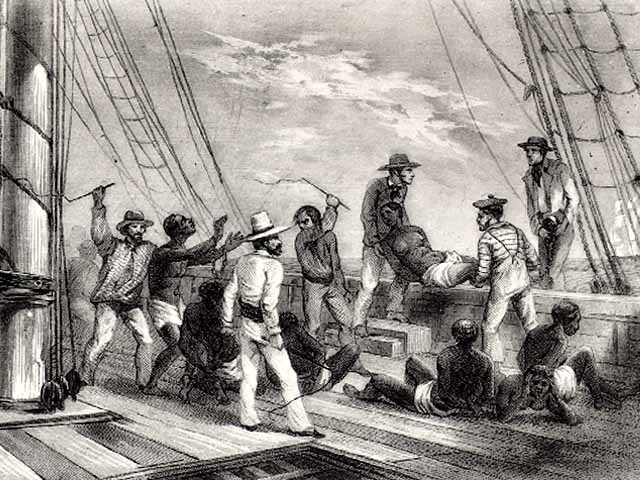
| In good weather slaves were allowed on the deck and men had to be brought to the top in shackles and chains, which were cuffed to the bulwarks. While still shackled together, they were forced to jump up and down until their ankles began to bleed and were raw and aching. The women and children were allowed to roam free with the supervision of the captain. The captain allowed them to dance and be merry, but if they refused to dance they were beaten furiously with a whip. The men were separated from the women and children on the ship. Furthermore, aboard the deck, the women were forced to participate in a custom called �bed warming�. In this custom, they were beaten, then sexually abused and assaulted by the captain and the crew members. The men were often chained in pairs at the wrist or ankle; which brought about homosexuality among the men on board. At many times, the captains of the ships would throw slaves overboard, whom had diseases so it would not affect all of their cargo. They were fed two meals a day, which consisted of spoiled food, beans that had been boiled to a pulp mixed with palm oil, boiled rice, and millet, cornmeal with salt beef, flour, water, red pepper, and stewed yams. They were also given a half pint of water. They used whips and muzzles to make the slaves obey their commands. Another torturous event on the slave ships was when the captains would place coal or fire on their lips to force them to eat when they refused. They would also torture them with hot melted lead on slaves who went on hungry strikes. Another way of getting the slaves to obey when they did not eat was to pry their mouths open with a speculum oris (a device that pries the mouth open with a thumb screw, and causes gagging and vomiting). The slaves endured many hardships aboard the slave ships. Many of them tried to escape these harsh conditions by cutting their wrists, jumping over board, killing their babies, and starving themselves. These horrible acts caused rebellions or mutinies aboard the slave ships. Negroes would make weapons out of their chains and shackles so that they could attempt to kill their captain and his crew members. One successful mutiny occurred on Amistad. It consisted of a group Africans led by the Congolese chief, Joseph Cinque, who was bound for Cuba. The slaves revolted in 1839 during a voyage across the Atlantic Ocean. They succeeded in killing the captain and the majority of his crew members. Despite all of the hardships and cruel treatment that the slaves endured during the Middle Passage, many of them survived. There were only 30% of the slaves who did not survive the harsh and cruel treatment. Most died due to the foul air, suicide, diseases, starvation, and the unsanitary conditions they endured on the ships. Those who made it over had a strong will to survive and self-determination. Due to the punishment that slaves had to endure throughout the years, the conditions became worst in the New World. After all the brutality from the white men, we as African Americans have come a very long way. |
 |
 |