|
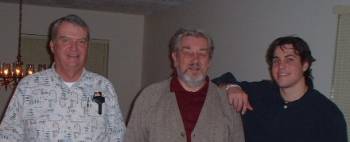
Bill, John and Martin Sobolewski, December 25, 2001
John [Bill's PhD student] is big into communications systems and IP cores. Our retirement jobs! |
Senior techies
Csd, of course, likes to do a reasonable amount of hardware and software design, software and book writing, web design and implementation and other projects.
80C52 Forth and BASICs are nothing but fun. Pci/cardbus wdm drivers are a bit more work. But, nonetheless, within moderation, fun too.
Senior citizens in their 60's and 70's are the teeny boppers of Florida. There are some really old citizens down there. Monday May 13, 2002 10:50
| Retiring boomers may jolt economy
Some economists see a major slowdown ahead. By MICHAEL E. KANELL ATLANTA — The coming retirements of the baby boom generation are like a huge, global wave that will disrupt economies, swamp government budgets and leave gaping holes in the labor force, some researchers warn. The full effect is a ways off — the oldest boomers turn 62 in 2008 — but once the wave starts to break, they say, it will take decades to pass. "This is a change that is going to affect the global economy in a profound way,” said Paul Hewitt, director of the Global Aging Initiative at the Center for Strategic and International Studies. The center has just released a book-length study that warns of labor shortages in the developed world, soaring taxes and floods of money shifting into less-developed. — but growing — countries. If the study is right, it is a recipe for economic and political upheaval. “You ain’t seen nothin’ yet,” Hewitt said. “It is going to dramatically slow down our growth.” Yet some people think that supposed tsunami headed our way will only turn out to be a ripple. “There is a perception that there’s this huge wave that’s going to crash over retirement and change the face of the United States as we know it,” said Sarah Zapolsky, research analyst for the senior advocacy group AARP. “But it’s almost too soon to project the whole impact this is going to have.’ Who is right? And just as importantly, who should care? Boomers — the 76 million-strong generation born from 1946 to 1965 — must wonder if the country can afford to take care of them in their dotage. Generation X — born in the 25 years after the boomers — may see dramatically higher taxes. Those born in the 1990s and after will probably see their needs compete with those of retired boomers. But it’s not just the boomer bulge. As modern medicine lengthens life expectancy and birth rates fall. societies are aging. For many decades — as far as can reliably be projected — the number of people retiring each year will far outpace the number entering the work force. The shift could reshape ..... In any economy, those who do not work the elderly, children, those who are too disabled to work, those who art jobless for any reason — are supported by those who do work The more people working, the easier the burden But as the ranks of the retired swell, the balance will tip dangerously in nearly all industrialized nations, according to CSIS. When it does, a lot could change. A wave of new dependents — whether children or retirees — creates a gap between revenue and benefit costs. The obvious way to make up the difference is to raise taxes. The payroll tax, now about 16 percent, could rise within two decades to nearly double that, said Gerald Dwver, vice president for research and economics at the Federal Reserve Bank of Atlanta. Add other taxes and the burden could be unprecedented for Americans “You could be a 2l-year-old and looking at a marginal tax rate of 50 percent — and the Social Security part of that starts with the first dollar," Dwyer said. The result could be a vicious cycle, said Thomas R. Saving, director of the Private Enterprise Research center at Texas A&M University and a member of the president’s panel on Social Security. Higher taxes depress workers’ incentive, which could mean lower output, which means lower government revenue — which brings a call for higher taxes to pay benefits. A budget surplus might have offered some cushion but the government has plunged back into deficit spending. The White House predicts a return to an overall surplus in a few year but only if the Social Security Trust Fund is counted. The numbers are a matter of debate. Some economists say a manageable tax increase would take care of the problem. The skeptics note that America in the 1960s had a far higher ratio of dependents to workers than boomer retirement will produce in the 21st century. Boomers were kids then, and there was also a host of retirees at that time. Skeptics also argue that the economy could grow enough to make huge tax levies unnecessary. Most critically, in- creased productivity provides the economy with ever-greater output per employee. An expanding economy lifts the standard of living for everyone, they say. Can it improve fast enough? The Cassandras say no. History says it can, argues Richard Du Boff, professor emeritus of economics at Bryn Mawr College in Bryn Mawr, Pa “If productivity increases there will probably be some room for both a higher standard of living and higher taxes to pay for benefits. Over the past 100 years, that has been the case,” he says. Of course, another way to avoid raising taxes is to trim benefits. Entitlements to the elderly already consume about 35 percent of a federal budget, Saving said. He projects that if benefits keep pace with inflation, those entitlements by midcentury will consume 80 percent of the federal budget. “In 60 years, Medicare. Medicaid and Social Security would totally exhaust the federal budget,’ Saving said. “And clearly, that is not going to happen. Either they will control a much greater share of the budget than they do now, or these programs are going to be smaller.” That contest between paying more and providing less can end up a political tussle. Older voters have often had a disproportionate impact on government — because they are reliable voters. “This is a very serious problem coming that is going to be a challenge to our economy, said Kevin Hassett, economist for the American Enterprise Institute. “Look at the political dynamics: Old people have time to vote, and they are vested in the system. And at the same time, you’ll have the most powerful bunch of retired people ever.” That political dynamic makes it crucial to forge a resolution as soon as possible — if only out of fairness to people who have expectations about what they will get when they retire, Dwyer said. Changes in the population reshape the economy. An aging population buys differently. As the most powerful demographic group moves into retirement, prices will probably go up for things boomers want down for what they disdain. Some economists warn that retirees will cash in stocks to pay for both needs and recreation and depress stock price for decades. Others discount the idea. Because people don’t know when they will die, they tend not to use up all of their assets Many people want to leave something to heirs, too, Hassett said. “In the United States, retired people are actually net savers, he said. “The notion that baby boomers are going to retire and start eating their wealth not consistent with behavior.” Since the end of the Industrial Revolution, unemployment has been a scourge — sending workers into bread lines or to barricades. Until the birth of the modern welfare state. Through the decades, the developed world has trimmed workweeks. That holds down unemployment by spreading the work more thinly. It was assumed that the labor market would always be a case of too many people chasing too few jobs. Joblessness might be lower in booms and higher in recessions, but it was a given. But that is going to change, at least in the developed world. “In the future there won’t be unemployment,” Hewitt said “In the future, there will be a labor shortage. One possible result of the boomer wave splashing ashore is the end of a set age as the common dividing line between work and retirement. Through most of the 20th century, the age of retirement crept downward. But as the number of retirees outpaces new workers, each retiree soon will represent a potential unfilled spot. One obvious route for softening labor shortages is to keep people working. Incentives for retiring may disappear, replaced by reasons to stay in the work force — perhaps longer vacations, higher pay. Another way around shortages is to import workers. The United States has been accepting roughly 1 million immigrants a year, an influx that can offset much of the shortfall in the birthrate. But Europe and Japan will soon be eager to have those same immigrants, said Saving of Texas A&M. “Europe and Japan will be sorely short of labor. What is going to happen over the next generation is that we will be competing for immigrants. We will have to pay more to get immigrants.” But the problem is more complex — and dangerous. Shrinking populations mean shrinking markets for businesses, ebbing profits and dwindling labor pools. Investment in companies and research could shift to where the growth is: places like India and China. For investors, that shift is a good hedge against falling profits. Of course, it is a gamble. too. The impact of an unprecedented shift of resources is impossible to gauge, Hewitt said. Sarasota Herald-Tribune Sunday March 24, 2002 |
Windows wdm drivers received notification when an application which uses a peripheral device terminates. At this time the driver should send a message to a peripheral device to put itself into a low power mode. Providing, of course, that the peripheral core has the ability to place itself into a low power mode.
When a windows app loads, the driver associated with the app receives notification. It then sends a wake-up to the peripheral device, then waits until the peripheral send notification that it is awake.
The 80C52 microcontrollers are almost ideal for low power operations. Reason is given at the end of Fixmer's green article.
Real world practical handling of getting into and out of low power modes are explained by Jerzy Chrzaszcz.
The watchdog circuit seen at 1 in 2 may have problems Chrzaszcz may have solved!
Sometimes the video coming from the 80C51 got unsynchronized after a watchdog reset. But this was a sufficiently low-priority problem it was not pursued at discovery time.
If you don't take the time to do it right at first means you have time to do it again. - Sandia labs saying
It took Sobolewski to attempt to pronounce Chrzaszcz to bill!
|
Bill, John and Martin Sobolewski, December 25, 2001
John [Bill's PhD student] is big into communications systems and IP cores. Our retirement jobs! |
At Sandia labs we used the 80C51 low power modes for electronic tags. There are some really-neat battery-powered 80C52 apps where the micro sleeps most of the time. External sensors wake it up. Tuesday February 12, 2002 07:08