Explaination
- Topology is the way each node is physically connected to the network, common topologies include:
Bus
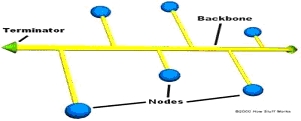
Each node is �Daisy-Chained� (one after the other) along the same �Backbone�, similar to Christmas lights. At either end of the bus network there is a �Terminator� (Resistor) prevents the signal from bouncing back. The Bus topology makes the addition of new devices straightforward, either by attachment to the exsisting cable or to cable which can be added to eithre end.
This type of Topolgy uses a Broadcast channel, so that all attached stations can hear every transmission; this adds to network traffic and increases the likelyhood of Collisions (See CSMA/CD). The maximum length of a single Bus segment is 500 metres and upto 100 stations can be attached to it.
Advantages
- If a node malfunctions, it simply stops communicating: it doesn't prevent the rest of the network from working.
- The attachment of devices is straightforward and the cable can be extended.
Disadvantages
- If part of the 'Backbone' cable developes a fault, the whole network (assuming it consists of a single segment) fails.
Ring/Token Ring
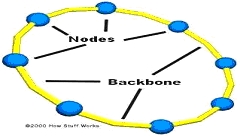
Like the Bus network above the nodes are also daisy-chained, this network is a complete circuit.
When a Packet is sent by a node it will pass to the next node on the network, which will take any data addressed to it and adds any data it wishes to send. This continues round the network, each node passing its privilege to speak (Token) onto the next.
Only nodes with the token can send or receive data.
Advantages
- There is no dependence on the central host computer as the data transmission around the network is supported by all the device in the ring.
- High transmission rates are possible.
- Routing between devices is relatively simple because the messages normally travel in one direction only around the ring.
Disadvantages
- The system depends on the reliability of the whole ring and the repeaters, although it can be designed to bypass any failed node.
- It may be difficult to extend the length of the ring because the physical installation of any new cable must ensure that the ring topology is preserved.
Star
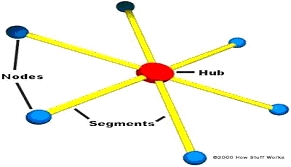
Each node is connected via a central device called a Hub (or switch), so every node is indirectly connected to every other through the central device.
In this Topology, all messgaes pass through a Host (probably a mainfrme or minicomputer) computer, which interconnects the different devices on the network. The host computer has a message switching function allowing messages to be transmitted point-to-point.
Advantages
- Centralised control of message switching allows for a high degree of security control.
- Each spoke in the star is independent of the rest and a fault in a link or device in one spoke, can be identified by the computer at the Hub.
- The data transmission speeds can vary from one spoke to another.
- It is suitable for WAN's where organisations rely on a central computer for the bulk of the processing tasks.
Disadvantages
- The network is vunerable to Hub failures which affect all users.
- For a WAN, the control of communications in the network requires expensive technology at the hub and complex operating/comunnications software.
Star Bus/Tree network
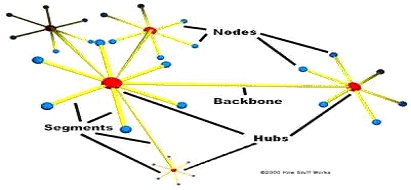
Probably the most common of networks, many star networks are connected via the Hubs along a �Network Backbone�, usually a cable that allows a faster rate of data transfer.
This is a mixed topology designed to provide high speed bus backbone via which multiple, slower, star networks can communicate with one another.
Useing switching technologies each device/node on a network can communicate directly to another device/node on any of the connected networks.
Advantages
- Flexible, easy to add or remove the smaller networks (sub hubs).
- The attachment of devices is straightforward and the cable can be extended.
- Redundancy can be built into your design, giving your data two routes to take through your network.
Disadvantages
- The network is vunerable to Hub failures which affect all users on the section that is administered to by that Hub (or sub hub)
|
|



