Explaination
- A unique address associated with an Ethernet card.
MAC addresses can be hard-coded into circuitry or stored in read-only memory (ROM), and they can be configured using vendor-supplied software. The uniqueness of MAC addresses is ensured by the Institute of Electrical and Electronics Engineers (IEEE), which assigns networking device vendors specific blocks of MAC addresses for the devices they produce. The first 3 bytes (24 bits) represent the manufacturer of the card, and the last 3 bytes (24 bits) identify the particular card from that manufacturer. Each group of 3 bytes can be represented by 6 hexadecimal digits, forming a 12-digit hexadecimal number representing the entire MAC address. Examples of manufacturer 6-digit numbers include the following:
00000C (Cisco)
00001D (Cabletron)
0004AC (IBM [PCMCIA Ethernet adapter])
0020AF (3Com)
00C0A8 (GVC)
080007 (Apple)
080009 (Hewlett-Packard)
NOTE
Some NICs come with a software utility that you can use to change the MAC address of the card. Changing the address is not a good idea! If you accidentally configure two network cards on your network to have the same MAC address, address conflict problems will result and the computers will not be able to communicate on the network. However, some NICs, such as Token Ring cards, actually require you to assign a unique MAC address to them before they will work.
TIP
To determine the MAC address of your computer’s NIC, use the following commands:
The MAC address is transmitted as part of the header of all data packets sent from any computer on a network. The address for your own workstation can be seen by typing 'IPCONFIG /all' at the DOS command prompt (look under the PHYSICAL ADDRESS heading).
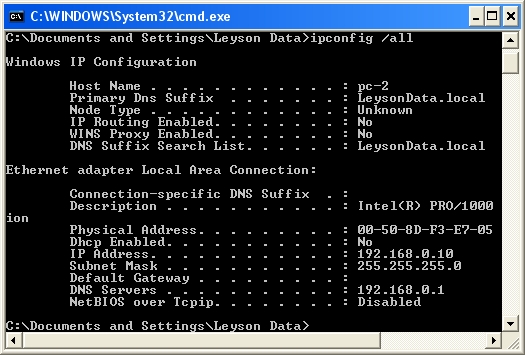
As you can see it consists of 12 hexidecimal characters the first three pairs are unique to the manufacturer of the ethernet card, and the next three pairs are unique to your card.
Each frame on an IP-based local area network (LAN) contains a source MAC address and destination MAC address in its header. These addresses are added to the frame by the media access control (MAC) layer of the protocol stack. Every device and port that connects to an Ethernet LAN requires a MAC address. These MAC addresses are used by devices such as bridges and Layer 2 switches for building routing tables to direct traffic through the network. Bridges gather MAC addresses by examining the source MAC address of every frame of network traffic they receive. They then use these source addresses for building their internal routing tables, which they use to forward frames only to the segment that has the station with that particular destination MAC address. This process reduces network congestion by avoiding the need for bridges to forward broadcasts.
on your own MIME (Multipurpose Internet Mail Extensions) An Internet standard that lets computer files be attached to email. Files sent by MIME arrive as exact copies of the original so that you can send processing files, graphics images, spreadsheets and software applications to other users, provided the recipient has a MIME-capable email application--most today are MIME-capable. modem An electronic device that lets computers communicate using regular phone lines. The name is derived from "modulator-demodulator" because of its function in processing data over analog phone lines.
|
|



