The second LONG ISLAND(CVE-1) was
laid down 7 July 1939, as MORMACMAIL,under Maritime Commission
contract, by the Sun Shipbuilding & Drydock Co., Chester,Pa.; lauched
11 January 1940: sponsored by Miss Dian B. Holt: acquired by the Navy
6 March 1941; and commissioned 2 June 1941 as LONG ISLAND (AVG-1)
Commander Donald B. Duncan in command.
In the tense months before Pearl Harbor, the new escort aircraft
carrier operated out of Norfolk, conducting experiments to prove the
feasibility of aircraft operations from converted cargo ships. The data
gathered by LONG ISLAND greatly improved the combat readiness of later
"baby flattops." Just after the Japanese attack, LONG ISLAND escorted a
convoy to Newfoundland and qualified carrier pilots at Norfolk before
departing for the west coast 10 May 1942. Reaching San Francisco 5 June,
the ship immediately joined Admiral Pye's four battleships and provided
air cover while at sea to reinforce Admiral Nimitz' force after their
brilliant victory in the Battle of Midway. She left the formation 17 July
and returned to the west coast to resume carrier pilot training.
LONG ISLAND departed San Diego 8 July 1942 and arrived Pearl Harbor the
17th. After training she ran south to Palmyra Island, the ship loaded two
squadrons of Marine Corp aircraft and got underway for the South Pacific 2
August. Five days later, the marines, while landing on Guadalcanal,
encountered stiff opposition and needed more air support than could be
provided by handful of carriers available during the early months of the
war. Touching Fiji Islands 13 August, LONG ISLAND then steamed to a point
200 miles southeast of Guadalcanal and lauched her aircraft. These planes,
the first to reach Henderson Field, were instrumental in the liberation of
Guadalcanal and went on to compile a distinguised war record. Her mission
was accomplished in an outstanding fashion. Reclassified ACV-1 on 20
August, LONG ISLAND sailed for Efate, New Hebrides, and arrived 23
August.
LONG ISLAND decommissioned 26 March 1946 at Puget Sound Naval
Shipyard. Struck from the Navy List 12 April 1946, Oreg.,24 April 1947 for
scrapping. This was not to be. The old warrior still had some life left
for on 12 March coversion to merchant service. Upon completion of
conversion in 1949, she was named NELLY and served as an immigrand
carrier between Europe and Canada. In 1953, she converted into a
schoolship. Later that year, she was renamed SEVEN SEAS and with a
cargo of students, begain sailing all over the world in pursuit of
knowledge. After 13 years of service in this role, she was replaced as a
schoolship for the university, and was sold to the University of Rotterdam
for use as a floating dormitory. Into 1969, she is still in service in
this role, berthed near the university grounds. LONG ISLAND
received one battle star for World War II service.
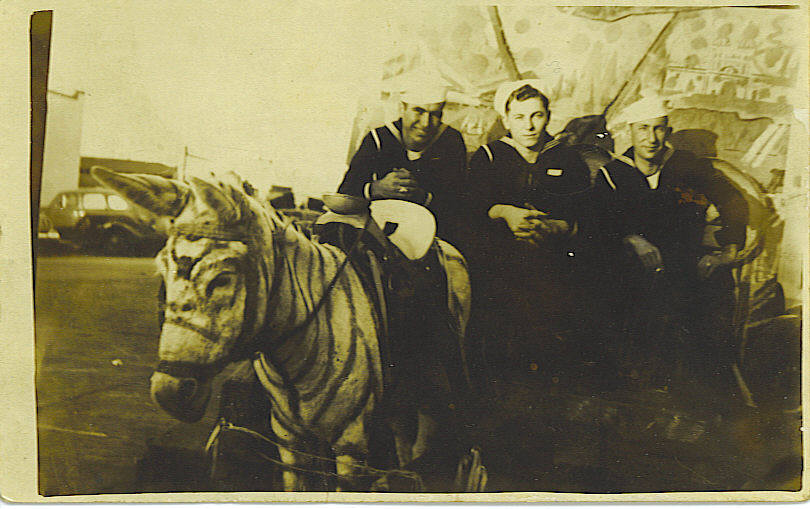
Three shipmates of Long Island