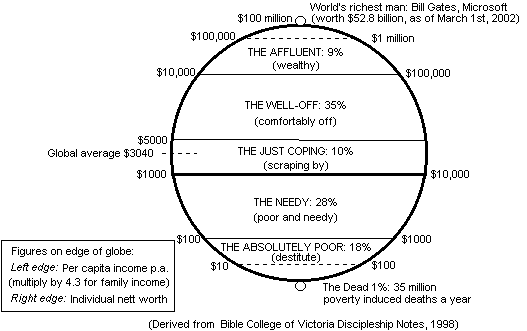
Living midst an economic reality
Perhaps the greatest issue lying before us is that of economics. In fact, some claim that it is the greatest issue of discipleship for us as Christians, especially when we consider the following figures:
Developed countries, with 26% of the world population, use 80% of the Earth's resources
(Source: World Commission of Environment and Development Report, based on 1980-82 averages).
Given that the Gospels record Jesus as so often talking about money and riches, we do well to seriously investigate the issue.
It is amazing to note how often Jesus commented negatively on how we as humans treat money and wealth, saying that it is very hard for the rich to enter the kingdom of God (Mk 10:23), saying that you cannot serve God and money (Matt 6:24), and saying that God's judgement will come upon those who have been rich in this age but who have not been generous to the poor (Lk 16:19-31).
Jesus made clear that the reason for his stern pronouncements was that the way you treated money revealed the nature of your relationship with and understanding of God, our heavenly Father, who created the whole world in the first place and who cares for all our needs (cf Matt 6:19-34). The more you hoard and covet, the more you reveal a lack of trust in God. And judgement will come upon you because the more you hoard and covet, the more you fail to see the need of your neighbour - another human being of equal worth to yourself.
It stands to reason, therefore, that the less you know of and trust in God, the less the economic system you practise will conform to God's standard. How, then does the economic system as practised in the West stack up? Consider at the outset the very definition of economics in our Western textbooks: "Each economic system in its own way tries to solve the central problem of allocating scarce resources among alternative ends. The ends are goods and services the economy can produce. Resources are scarce because people's wants are not easily satisfied, if not insatiable." (Microeconomic Analysis, Allan J. Braff, John Wiley & Sons, 1969), or, "Economics is basically concerned with the most efficient use of scarce resources (factors of production such as land, labor, capital) in producing various types of goods and services to satisfy numerous different and competing demands." (The University Desk Encyclopedia, Elsevier, 1977).
Notice that the two basic factors common to these definitions - scarce resources & people's wants - are directly related, because resources are perceived as becoming more scarce as people's wants increase. But since one of the leading qualities of Christians should be contentment (cf 1 Tim 6:6-10), it stands to reason that 'Kingdom economics' will take on a different form to that which is taught in our universities. Added to that the knowledge that in God our resources are never scarce, since our God is a generous and abundant God who is able to create something out of nothing, we do well to rethink all that we may have been taught to date about economics from a secular point of view!
Let us therefore go back to some first principles upon which to base our economic thinking.
In the beginning God created the heavens and the earth, and He told people to fill the earth and subdue it, and to have dominion over the fish of the sea, the birds of the air, and over every living creature that moves on the ground (cf Genesis 1). God also did not create the earth to be empty but formed it to be inhabited (Isaiah 45:18). He also made us in His image, which means amongst many other things that we are creative, just like God Himself.
From this simple framework, we may establish a few important points:
1. By definition, the more people there are, the more the 'standard of living' should increase, because we are creative beings endowed with numerous and various giftings and talents.
2. By definition, unless God continually replenishes the 'content of the Earth', the Earth's resources will ultimately deplenish. But this is not our problem, it is God's! [And it in actual fact is not a problem, because God has already ordained a new heaven and a new earth. What is more, given the whole overall plan of God (see Zeta) I can sense that it was always His intention to create a new place for us to live after the period of this age was complete and the earth had become full of people!]
Therefore, it is not in the first instance for us as humans to worry about sustaining the earth and its resources! That is thinking coming from a mindset in which there is no God and this world is all there is for us for 'eternity' (or until the sun explodes, etc).
God's first and most important priority for us is to conduct all our relationships, even and especially our economic ones, humanly. We are not machines. Each one of us is a person made in the image of God and is to be treated with dignity and respect, and we are to have open eyes and ears to the needs of our neighbour.
Five keywords thus arise, around which we as Christians should conduct our affairs: contentment, creativity, love, responsibility, subsumed under the banner of doing all for the glory of God, equalling true 'beauty'. These can be the hallmark of a Christian's economic activities.
We can thus formulate some basic principles governing our daily work:
1. We should be able to enjoy what we do.
2. The place where we work should be aesthetic from our perspective. It should be a place fit for the person's spirit to soar.
3. The total environment in which work is conducted should be healthy - mental, spiritual, physical, emotional - such that it is conducive to giving us life. Consider the case of an inter-continental sailor on a container ship: is it really good for a married man to be away from his wife for so long? Why can't ships that aren't fitted out for family accommodation be converted into such for the sake of the complete health of all?
4. The purpose and fruit of our work cannot be separated from that of meeting the needs of others. There is no place for hoarding, whether in 'private barns', gold bullion, stock markets etc. One person's abundance is to supply another person's lack (cf 2 Cor 8:13-15).
5. When it comes to what work to do, first principles in any society must always be the production or provision of sufficient food, drink, and clothing, closely followed by shelter. Once these needs are met, and we ensure that these primary producers are always getting enough in return for their labour, and that they are satisfied, can we joyfully diversify our work interests and use our talents and labour to bless people in other spheres of living (eg professional musicians). But note that we never have to worry ourselves about the provision of these needs. Jesus said that as we seek first the Kingdom of God all these things will be given to us (Matt 6:25-34) - not dropped in our lap, but that as we go about looking to fulfill our responsibilities the right doors will open for us (note that the birds don't worry but still have to fly out of the nest in search of food).
6. We each have a responsibility to work for as long as we are fit and able to (cf 2 Thess 3:6-14), where work is defined as my productive labour for the glory of God (and hence of benefit to others). And this is to be done within a reasonable 'work-rest-play cycle', originally defined by God as 6/1 (86/14). [Today, the 80/20 rule seems a good guide: Commit 80% of your time and resources, leave 10% spare for emergencies/surprises, and leave 10% for God. In hourly terms, after allowing 68 hrs for sleep per week, we would have 10hrs for God, 10 hrs for 'unforseen details', 40 hrs for work, 40 hrs for family/hobby etc, and the 10 hrs for God could be split up as 1hr per day and 4 hrs on Sunday for example.]
7. Where possible we should seek to employ others who are currently unemployed, asking them to join with us in the task before us, so that they, too, may have the benefit of participating in a task for the glory of God and expressing their talents and gifts.
The application of the above points lead to factors for great social gain.
For example, if no-one actually wanted to do a job, then it shouldn't be done! Not all consumer wants are good and wholesome, and money must not be the arbiting factor of whether or not the service is provided (consider the case of prostitution).
Furthermore, a person's consumer wants should not dictate the working conditions of those required to produce that good. If they do, then the consumer is actually the creator of slavery, and the Bible teaches that slave-trading is contrary to the gospel (cf 1 Tim 1:9-11) and that we should, if possible, try to get out of slavery work-conditions (cf 1 Cor 7:20-22).
We may also extend the above to goods and services which, although people both gladly produce and consume, offend God in His own right (eg the making of idol statues, cf Eph 19:23ff), but by definition, if it offends God it cannot be good for us, for we are made in His image. In this case, persecution may have to be endured by the one advocating the change, because the people in that industry have now lost their source of livelihood and expression of talent, but he should always be prepared to clearly explain the folly of the practice and encourage those producers to seek God and hear His new direction for their lives - he can be sure that God wants them to have life to the full too!
So what about our current economic system? We are living in a free market capitalist society that seems to have a different agenda than the one just presented. So whilst trying to implement and live according the Biblical worldview just outlined, a Christian should also know how to live in a God-honouring way within this current system. This will mean addressing issues at each of the four 'sites' of this economy:
1. The site of consumption. We need to challenge the 'fetish of the image' so prevalent in our society. Most of the consumer questions today are related to image, and we must be careful of that trap ourselves. Our identity is in God first, not the Nike tick, for example.
2. The site of marketing. We are confronted today with an impersonal place-less market. We need to be persons in our transactions, not just 'machines' who dispense with and receive cash.
3. The site of manufacture. We must address treating people as just exploitable human resources and as just 'providers of labour'.
4. The site of extraction. The earth, whilst given to us by God to subdue, is not first and foremost to be seen as an untapped and exploitable resource. In the fulfilling of our human potential for the glory of God, we are to treat the earth with regency and respect, but not stoop to attitudes of reverence (as though the earth was more important than us) or romance (as though we are equal with the earth).
We also need to come to a biblical view of money itself. If we give money an independent life of its own and act as if it existed in and of itself, we become its slaves and devotees. Furthermore, if we think about it deeply, money actually represents the property of another person. Perhaps one of the best teachings on money can be found in Luke 16:1-15, where we come across a manager, or steward, who is held up as an example to us by reducing the debts which people owed his employer to a level which matched the original lending price, cutting off the interest factor. In this way the steward looks for his future security not in a new accumulation of capital, but in the making of friends. In this way, money is disconnected from the search for money, from the pursuit of more, and it becomes a non-threatening means of improving human relations. Mammon is de-sanctified.
Finally, I think it is pertinent to have a look at perhaps the most mis-interpreted passage in the Bible regarding money: The parable of the talents in the section Matthew 25:14-46. It has been so common to allegorise from the story that Christians are to make as much money as they can for the Kingdom, that we miss the actual meaning. There is a direct connection narratively between the talents parable and the following 'sheep and goats' account. They belong together, and what Jesus is doing is contrasting how two different types of rulers make their final judgements - rulers in the Kingdom of Mammon and Kingdom of God. In this world of venture capitalism, where people "harvest where they have not sown and gather where they have not scattered seed" (Matt 25:24), where those with money make more money and those without it actually get less (Matt 25:29), if you don't play the game and don't even put your capital in the bank to earn interest, because you realise that by doing so you actually oppress the poor, you are an enemy of the system and you need to be cast out! But in the Kingdom of God, judgement as to whether you are cast out or not is exactly on the point of how you treat the hungry, thirsty, naked, sick, etc (Matt 25: 35ff). Jesus is highlighting the completely different values-set upon which He will make His judgements. Jesus is also thus distancing Himself totally from the principle of investing money to make more money.
Living midst a political reality
Politics is basically the science and art of government, and its aim should be to help people living collectively in a society to live in harmony or 'shalom'. The Bible tells us that the only government system that can ever truly fulfill this aim is that which the Messiah will inaugurate, and the form His civil society will take is that of 'the Kingdom of God'.
Now we should praise God that this Messiah has already come - Jesus Christ of Nazareth! - and he already has been exalted to the position of King of kings and Lord and lords. However, His kingdom is yet to manifest itself in all its fullness - that will only happen once Jesus Christ returns from heaven, which in itself will only happen once enough people have become his 'subjects' through the conversion process outlined earlier in this document.
This therefore means that we who already are followers of Jesus, who already are His subjects, are part of 'two kingdoms' whilst we still live on this earth in this age. We are citizens of earthly kingdoms (cf Acts 22:25) and also citizens of the Kingdom of God (cf Phil 3:20), but our greater allegiance is to the King of kings who is the ruler of all.
Let us now address how we should relate to the present government systems in this age.
The Bible tells us that we are to submit to the governing authorities, for they have been instituted by God, with one of their chief functions being an agent of God's wrath to bring punishment on the wrongdoer (cf Romans 13:1-7). They therefore are supposed to be operating at the third level of the covenant pyramid outlined earlier, implementing God's law with justice and righteousness, with the express purpose of ultimately being a tool of God in bringing that person to repentance. They are to be providing an environment in which it is possible for grace, the 'capstone level' of the covenant pyramid, to be exercised. This was one of the chief purposes of the Mosaic law - to be a 'diagnostic tool' in the highlighting of sin (cf Romans 5:20-21), so that it could be dealt with and gotten rid of appropriately.
Therefore we as Christians are to be actively praying for, and, when directed by the Holy Spirit, working for kings and all those in authority that their systems and decrees may be as such to allow us as Christians to continue to live godly lives to the fullest extent, having unhindered access to being able to spread the news of God's grace, so that as many as possible can come to a knowledge of the truth and thus be saved (cf 1 Timothy 2:1-4). And the more people become followers of Jesus, the less the people in government have to exercise judgement and the more they can focus on the art of justly and righteously administering and organising the collective concerns of people living in society with the end of shalom. The fact, however, that we know that everything will not be perfect until Jesus Himself returns should not deter us from working and living toward these ends, because they are totally aligned with the values of the Kingdom and our own new natures in Christ.
Now if the government is in itself a wrongdoer, that need not negatively concern us as Christians, because the Bible says that God Himself establishes kingdoms and tears them down as He wills - they are under His control, and whatever they are doing, whether good or bad, God is using and directing for the achievement of His great purpose: maximal salvation of human souls. Therefore, if a governing authority asks us to do something which is against our conscience, we must obey God rather than men, but still submit to the governing authority's decisions against us. The Bible is filled with such examples. There is no need, nor precedent for, radical violent upheaval against the governing authorities by us as Christians. Our prayers and our obedient submission as we seek to do God's will will accomplish the greater purposes of God.
And if we have to encounter and submit to persecution instigated by the authorities, we also have 'spiritual armour' to help us in that day of evil, knowing that these governing authorities are in that moment currently under the influence and direction of higher evil principalities and powers in the spiritual realm (cf Ephesians 6:10-18). And we are not alone in our stance against these powers, for God has ordained angels to fight for us in the spiritual realm (cf Hebrews 1:14).
Finally, perhaps the final question to address is whether or not a born-again Christian can really be, or should be, a part of government. To this we may say that God distributes gifts to His people as He wills, and it certainly seems that people with the gift of administration (cf 1 Corinthians 12:28) who act justly and righteously would be of great benefit to society! Furthermore, we read how in the Old Testament God raised up and appointed Joseph to be second in charge of Egypt, especially endowing him with wisdom to help the whole region survive seven years of famine, but all within the greater purpose of revealing His glory to the whole world (cf Genesis 41ff).
But what about being a part of a defence force, or police force - can a Christian who is living in the realm of grace, who has the inner desire to love his enemy, actually prosecute vengeance on his enemy on God's behalf? God's first and ultimate desire is to see all people come to repentance, because He does not want any to perish. A part of that process includes being a tool of God to communicate the standards and righteous decrees of God to those who presently are not living in accordance with them (cf 1 Tim 1:8-11), and they can be communicated in love and grace. Furthermore, just like God Himself, we are to be long-suffering in the face of denial and refusal of grace, and always ready to show mercy. But God does get angry if grace is continually denied, and He does exercise judgement for the greater good. Therefore we, as Christians, may legitimately exercise the same, under His direction.
Living midst a religious reality
We are living in a world in which a high proportion of the world's population is aware of the existence of other religions apart from their own. Furthermore, the people who adamantly hold to their religious beliefs and expect others to follow suit are labelled as a militant minority. There is a common view that all religions are basically paths to the same destination, and that the most important thing is that we love each other and be happy (as long as we don't lose our own personal creature comforts).
Welcome to the pluralistic secular world in which we live! It is a world in which a great divide has been created - the "public world" of "facts", and the private world of values and beliefs.
And we as Christians are supposed to proclaim that Jesus Christ is the way, the truth, and the life, and that no-one gets to the Father except through Him! For us to be living in accord with this proposition, let alone begin proclaiming it, defend it, and ask others to join with us, must surely seem like a foolish thing to do. And yet, it is actually the most sensible thing to do, because truth is by definition exclusive.
Let me explain. Someone who says that all religions are basically the same has understood none of them. In reality, every system is implicitly exclusivistic. Buddhism was born out of a repudiation of two cardinal doctrines of Hinduism. Sikhism rejected both Buddhism & Hinduism. Baha'ism excludes the exclusivists. Islam is exclusivistic theologically and linguistically. Atheism rejects all theistic viewpoints.
The question basically boils down to which exclusive system is the right one, and as addressed in Alpha, only the system taught in the Bible, as centring on Jesus Christ, is true to reality. (For an extended treatment, see "Can Man Live Without God" by Ravi Zacharias, Word, 1994).
This is not to say, however, that the other systems mentioned don't contain elements of the truth! A thousand times no! In fact, it must logically be the case from a Christian perspective, since we are all one people, with the same natures, living on the same planet created by the one God, thus examining the same data when formulating our own systems on life. And since every human, when they start reflecting on life, naturally is seeking for happiness, peace, love, etc, it stands to reason that unbiased objective investigation will converge to the same truths, no matter from what direction you start! But the point is that people are biased, and that there is also a devil who is trying to mislead people from the Truth. That's why we as humans need revelation directly from God Himself, which we have in its clearest form in the life of Jesus Himself (cf Hebrews 1:1-4).
Furthermore, it is a false presumption to believe that God has been silent toward other cultures beyond the Jews (in OT times) and Christians since then. Just as God spoke to Abram the idol worshipper, and to Cyrus, and to Balaam, and to Melchizedek, it stands to reason that because God is not willing for anyone to perish, He is giving every person the opportunity to faithfully obey what He asks of them. It is when a person has faith in what the true God asks of them that they are counted righteous, and the blood of Christ (whether they know of Christ or not) washes them of their sin and gives them access to the Father. So Jesus Christ truly is the only way to the Father, but knowledge of Him is (was) not absolutely necessary for salvation. Faith in what God reveals to you is necessary. (But if Jesus is preached to a person and they refuse Him, then we can know that they do not have the faith of Abraham! Jesus said: "All that the Father has given me will come to me" and that those who do not acknowledge Him have not truly acknowledged God either). (Please note that what I am saying here in no way undercuts the imperative for Christians preaching the gospel, for this preaching is one of God's means of speaking to people. Furthermore, the evidence of the New Testament is that now it IS that God wishes all people to know of Jesus, and those who are seeking God will have Jesus revealed to them! - Consider for example Cornelius, The Ethiopian eunuch, and Saul (Paul): to each of these God fearing people Jesus revealed Himself either personally, or via an angel and a person, or the Spirit telling someone to go and preach Jesus to the person! The evidence is that NOW, in New Testament times, "there is no other name under heaven by which we must be saved!" (Acts 4:12)).
So when we as Christians come to live out the truth in our lives, we are definitely not doing it the midst a 'truth-vacuum' in society! Far from it. When we come to talk and interact with other people, we are definitely not 'writing on blank blackboards'! One of our chief tasks is to first help others make sense of what is already written on the blackboard of their life!
Beyond that, we are also required to 'limit our freedoms' if they would be misunderstood by someone else and thus hinder them from responding to the gospel (cf 1 Corinthians 8-10). This means that whilst before God I may eat pork, if a Muslim I intend to talk with would be offended by it and through my eating there would be less of an opportunity for him to hear the gospel, then I should not eat pork before him. For the sake of the gospel we need to limit ourselves and try not to 'turn-off' anyone - whether Christians or non-Christians (1 Cor 10:32).
With this in mind, we are able to begin to look at the Christian reality in which we find ourselves, and also address how God would want us to practice our faith so that an onlooking world can get less of a wrong impression of what Jesus had in mind when He said 'follow Me'.
The Christian reality
An onlooking world often sees a diverse, disintegrated, 'club-mentality' Christian church, with all the thousands of denominations and 'church titles', and often with very antiquated, though quaint, practices.
To my mind this paints a rather bleak picture, especially in light of Jesus' prayer that the world may believe that God sent Jesus through the unity of believers (John 17:21).
We need to begin to repaint the picture, getting back to basics, holding onto essentials, and learning how to walk in love when it comes to differences of opinion.
I suggest that we begin with two foundations:
1. Jesus Christ is the head of the Church.
2. The Church comprises only those who are born again by the Spirit of God.
Whilst it is true that God appoints leaders for every local congregation, and whilst it would be wrong for a local assembly to not allow enquirers to join with them for worship, I believe we need to emphasise again these supernatural elements of the Church. They cannot be denied from Scripture, and they are the only true basis for spiritual unity. I cannot emphasise enough what Paul said in Romans 8:9b "And if anyone does not have the Spirit of Christ, he does not belong to Christ", the evidence of which is either the ability to speak in tongues &/or ability to rejoice greatly in God and praise Him, both being accompanied with the ability to call God 'Father'. And this is nothing to be scared of - it is God's promise for all who call upon Him (Acts 2:38,39).
And let me say that we must not be ashamed of the 'supernatural'. We as Christians must not be 'shamed to silence' by the so-called proofs of 'modern science'. Whilst we don't need scientific evidence to prove our faith - the presence of the Holy Spirit is plenty! - there is vast material now available to give 'reasons to believe', from archaeological to historical to theoretical. We must remember that the scientific method cannot be totally objective, as many people believe. All scientific investigation occurs within a worldview as to how to interpret the data discovered, and even as to which data to retain and which to discard or ignore. For many scientists this is an evolutionary worldview with no place for God. Holding to this view is just as 'religious' as a Christian holding to the Bible, even more so, because it consciously ignores the testimony of eyewitnesses from the past as recorded in historical documents such as the Bible. But as we noted in Alpha, the evolutionary worldview is NOT true to reality! Therefore many of the pronouncements of the modern scientific movement are foundationally flawed, because they do not take into account all the evidence. Therefore a Christian has no reason to be ashamed of proclaiming 'Jesus is Lord'. In fact, it is the only truth that makes sense of life!! (For great up to date material concerning scientific evidence for the truth of the Bible, contact the organisations 'Answers in Genesis' and 'Reasons to Believe').
Secondly, let us continue to acknowledge the two specific rites which publicly identify a Christian:
1. Water baptism - signifying death to the old way of living and the desire to live a new life filled with the Holy Spirit.
2. The Communion meal (bread and cup) - signifying the ongoing relationship we have with Jesus Christ, our need of Him for daily living, and proclaiming His death until He comes again.
Note that however these rites are practised, and whatever specific content is associated with their meaning, they are very political acts. They both proclaim our allegiance to Jesus Christ as king, and not to the "Caesars" of this world.
Thirdly, let us practise the command Jesus gave us so that we shall be marked as Christians:
"A new command I give you: Love one another. As I have loved you, so you must love one another. By this all men will know that you are my disciples, if you love one another." (John 13:34,35)
This means that:
a) As the Samaritan loved the wounded man, we as Christians are called upon to love all men as neighbours, loving them as ourselves.
b) Love all true Christian brothers in a way that the world may observe. This means showing love to our brothers in the midst of our differences - great or small - loving our brothers when it costs us something, loving them even under times of tremendous emotional tension, loving them in a way the world can see.
(see also "The Mark of the Christian" by Francis Schaeffer)
I suggest that all the other Christian disciplines (such as prayer, praise, worship, fasting, regular Bible reading, fellowship with other Christians, solitude) only have their place in the context of seeking to embody the above.
I believe we also need to redefine in our heads what we mean when we say "I am going to church on Sunday". What we are actually doing is going to worship God together with the rest of our Christian community. The Church is a living entity, a group of people, and not an institution, not a building. Have you noticed how impersonal that first sentence really is?! Imagine if we all instead started to say "I am going to worship God on Sunday"? Whilst this might start to reduce the meaning of worship to just a Sunday activity (whereas technically the whole of our lives should be lived in a spirit of worship to God), it is actually quite a more meaningful and penetrating statement!
Thus when we say things like "I'm part of Regent Baptist Church", or "I'm part of Richmond Assembly of God", we can start to unpack that as meaning "I'm part of a Christian Community that meets at Regent, and holds to the Baptist tradition of worshipping God", or "I'm part of an assembly of Christians that meets corporately in Richmond and is in the Pentecostal tradition". This should help us to reflect on what we mean and who we are (and also if we want to change!)
Guidelines for worship
Technically, Christians who meet on Sunday (or any other day) are an 'assembly of people called together by God'. Let us therefore have that self understanding, and into that take note of the following principles to govern our corporate times together:
1. Jesus can't stand hypocrisy. If you aren't in a right relationship with God that day, don't put on a mask to give the impression that you are. Address it, and watch the blessings come.
2. We are to rend our hearts and not our garments. God always desires deep repentance, not superficial change, when He wants us to change.
3. Humility and 'poorness of spirit' is what is required before God.
4. Worship is an expression of our relationship with God. It is not to win His favour or twist His arm.
5. We need to worship in spirit and truth, implying at least that it should be as the Holy Spirit leads us to from the depths of our being, and in genuine heart.
6. The "form of worship", and content, is governed by the gifts the Holy Spirit unleashes in the context of the culture you are a part of. Considering 1 Corinthians 14:26-40 and other passages of the New Testament, we could expect to see the following elements in our corporate times together:
· songs
· word of instruction
· revelation
· tongues and interpretation
· public prayer
· communion / Lord's Supper
· offering for the poor / needy / missionaries / leaders of the church
7. The gifts the Holy Spirit gives are to establish the church - both internally in quality and to see it grow in numbers. Furthermore, we can expect these gifts to be distributed to more than one person in the assembly, so it shouldn't really be a 'one-man-show'.
A few comments are especially due regarding our 'tithes and offerings', especially since much of the world derides the church's emphasis on money.
Tithes and offerings
There is some confusion today when it comes to tithes (10% of your firstfruits) and offerings. In fact, some preachers within the church even insist that the reason some Christians are in material poverty is because they do not tithe. We do well to investigate this more thoroughly.
First, even before the Law of Moses was given, Abram gave a tenth of everything to Melchizedek king of Salem, priest of God Most High (Genesis 14:18-20).
Second, the Law of Moses gave clear detail as to tithes and their purpose. From Leviticus 27:30, Numbers 18:21-29, Deuteronomy 12:5-18; 14:22-29; 26:1-15 we can reconstruct the following scenario:
· Annually, a tenth of all Israelite produce was to be taken to the city of the central sanctuary for distribution to the Levites.
· At that time, at an initial festival, all Israelites ate part of the tithe - a great community celebration where all were equal and could eat to their heart's content.
· The rest, which would be by far the major part of it, belonged to the Levites (who themselves did not have any inheritance in the land).
· Every third year the tithe was gathered in the towns and stored for distribution to the Levites and the less fortunate: aliens, fatherless, and widows.
· The Levites themselves were to present to the Lord a tenth of what they had received.
We can thus see that the tithe system was a system of social justice and also to be used for great community BBQ's with the LORD as their focus !!
Third, God spoke through the prophet Malachi to warn the people of Israel in Nehemiah's day to not neglect bringing "the whole tithe into the storehouse, that there may be food in my house" (Malachi 3:10). That is, they were not to neglect this means of social justice, and to realise that God would provide all they needed - they could afford to give!!
Fourthly, Jesus derided the Pharisees for only seeing the minute details of social justice which the tithe represented, and neglecting the big picture of justice, mercy, and faithfulness (Matthew 23:23).
Fifthly, it seems that the early church practised the spirit of tithing, giving to any who were in need in the Christian community (Acts 4:34,35). There seemed to be a community bank of food/money which the apostles first had oversight of, and which was then handed on to seven people who were full of the Spirit and wisdom (Acts 6:1-7). Furthermore, a list of qualifications was drawn up as to who should qualify for the daily distribution (1 Timothy 5:9-16).
Sixthly, the apostle Paul, when he encountered poor Christians in his churches after they were established, never told them that the reason they were poor was because they weren't tithing. Rather, he desired that Christians would have eyes to see the need of others and give according to their means, so that those who were in plenty would be able to supply the need of others. (cf 2 Corinthians 8:1-15; 9:1-4).
Seventhly, this 'giving to those in need' became a systematic venture at one stage, most probably due to the prediction of a severe famine that would come across the Roman world (Acts 11:27-30). And so Paul organised a collection amongst the churches, which for the sake of orderliness, efficiency, and discipline, he advised people to set aside and save up a certain portion of their weekly income for until he arrived, upon which time he would be able to take it to the needy saints in Jerusalem (1 Corinthians 16:1-3).
Eighthly, and finally, when it comes to the elders of the church, especially those whose work is preaching and teaching, they are worthy of receiving double-pay (1 Timothy 5:17-18. Note that it says 'worthy', not that they actually should or did! I think the context implies that they should at least be supported). Indeed, Jesus said that those who preach the gospel should receive their living from the gospel (1 Corinthians 9:14). [Note that Paul on occasion didn't take up this right where it would have been misinterpreted as though he only preached to get money, thus hindering the gospel message, choosing rather to work with his hands (1 Corinthians 9:1-23)].
So how can we summarise this for today? In short, we can say that we give of our income to provide for the needs of those called by God to the work of teaching, preaching, and spreading the gospel, and to provide for those materially needy people in our Christian community first of all, so that we can all be equal and enjoy what God has given. The fact that in Australia we have a social-security system means that we have greater capability to give to those Christians in other parts of the world who do not have that safety net. And if we want to know how much we should give, the figure of a tenth should be considered as an Old Testament paradigm, but it is not law for us. We are not under law, but under grace. We are to give as the Holy Spirit leads us. Let us not covet but give.
And what about 'offerings'? There seems to be two uses to the word in the OT. Firstly, it concerns sacrifices for sin, and with respect to this, it is totally out of place to mention this in the context of giving money. Those offerings were for the atonement of sins, which has already been totally taken care of by Jesus on the cross.
But there is a second use of 'offerings', and that is when the people willing gave of their resources for the construction of the temple (cf 1 Chronicles 29) and at a later stage for its reconstruction. Now in the NT, we know that buildings are not God's first priority! God does not dwell in temples made with human hands! But we as the Church of God are His temple! Therefore, it is totally legitimate for people to voluntarily give toward missions and the expansion of God's church worldwide, but it can never be 'forced' upon people. It is to be totally free-will and 'inspired by God'. But of course, as Jesus said, "It is more blessed to give than to receive", so let us give!
Finally, instead of the bleak picture painted earlier of all the denominations and disunity amongst the churches, allow me to paint another picture of the current state of affairs.
When I look across Greater Melbourne, for example, I like to paint the 'church scene' in medical terms. I see a few big hospitals, really able to specialise in emergencies, and having numbers of staff and trained personnel to really help people get well. Then I see a number of GP outlets, scattered all across town, helping local believers stay well. There are also specialists, catering for 'minority communities' and special illnesses. There are mobile clinics which go from locality to locality where there are not yet established GP outlets. There are GP's who do house calls. There are also the medical schools, training up new doctors and practitioners. I think there are also some GP outlets practicing 'out-of-date' medicine, and actually keeping its people in the dark as to the fullness of life available. I think there are also some 'quacks', who should be banned. There are also possibly some dinosaur institutions, who seem to have gotten off the track with their real purpose, and are chewing up a lot of resources for no real gain to the people. But they do serve as reminders that there is such a thing as a medical practice, and that people can go somewhere for help when they are sick! But finally, there are not many who actually go door-to-door to make pro-active check ups on people to see if they are all right. This seems to be reserved for overseas countries where we really sense people are sick! I think this needs to be addressed.
Next section