
"If you love me, you will obey what I command. And I will ask the Father, and he will give you another Counsellor to be with you forever - the Spirit of truth."
Jesus (John 14:15-17a)
In the last days, God says, I will pour out my Spirit on all people. Your sons and daughters will prophesy, your young men will see visions, your old men will dream dreams. Even on my servants, both men and women, I will pour out my Spirit in those days, and they will prophesy. (Acts 2:17,18)
There are different kinds of gifts, but the same Spirit. There are different kinds of service, but the same Lord. There are different kinds of working, but the same God works all of them in all men. Now to each one the manifestation of the Spirit is given for the common good. (1 Corinthians 12:4-7)
In the Old Testament it seems that only a select few had a special anointing from God to ministry for His glory. But Moses himself wished that the LORD would put His Spirit upon all His people! (Numbers 11:29). This wish of Moses has now been fulfilled in the NT era! Now not just a select few have an anointing from God; now it is for all who believe in our Lord Jesus Christ.
As a follower of Christ Jesus, a member of His Body, it is helpful to know what part / role you have in the Body, to be equipped to perform that role well, and to know the greater purpose for that role. While for some this knowledge is not important (they just do it anyway!!), for others it is very helpful so that they can know where they don't fit!! But the interesting thing is that the Holy Spirit can sometimes give you specific gifts for specific seasons, empowering you at just the right time for just the right task. The key thing with God is your availability for Him to use! This being so, it is most common, however, for God to set aside certain individuals for certain tasks, and this stage is to help a person come to that realisation for their own lives.
(Note: whereas my primary ministry commitment should be in the area where I am gifted, I must still be prepared to serve in any other area when I am needed. For example, I may not have the specific gift of 'showing mercy', but if I come across someone lying helpless in the street, I must still help them (cf Luke 10:25-37, James 2:15-17)).
But please note, our identity as Christians is not first and foremost from the gift we exercise - it is first and foremost that we are humans in the image of God! Our gifts, roles, etc, are just 'subexpressions' of who we are in Christ. We must never let ourselves be defined by the gift we exercise or the role we play.
This being so, we can say that any role we exercise must be for the common good. That is, it is to build up and edify others ultimately. It is in this light that we should read Ephesians 4:11-16 :
God has given -
· Apostles sent to new places
· Prophets for the church (giving specific words from Jesus for the flock)
· Evangelists for the contacts around / in the church
· Pastors & Teachers for those in the church
for the purposes of:
a) preparing people in the church for works of service
b) for the shepherding, encouragement, & growth of the "body of Christ"
c) achieving the goal of us all being united in the faith & in the knowledge of the Son of God, and becoming mature, attaining to the whole measure of the fullness of Christ.
Then we will not be infants and be able to withstand strong oppression (both physically and from false teaching). Instead, speaking the truth in love, we will grow up into Him who is the head (Christ). From Him the body grows & builds itself up in love, as each part does its work.
With this understanding let us begin to address how we can discern what role we are (being) designed for as part of the body of Christ. Note that this is best not done in isolation. Whilst you can read through the following information, gift discernment and development occurs best in an apprenticeship model, just like Jesus with His disciples. You should be seeking to share your insights from the following material with other mature believers so that they can help you in your development.
A useful acronym - S.H.A.P.E. - can help us in working out 'where we fit' and how we can best help others and glorify God. The letters stand for:
S piritual gifts (see for example Rom 12, Eph 4, 1 Cor 12, 1 Peter 4)
H eart - what are the desires of your heart?
A bilities - what are you already naturally gifted at?
P ersonality - what temperament are you?
E xperiences - how has your life history fashioned you?
(The following material is adapted from the Balwyn Baptist Church S.H.A.P.E. kit)
Spiritual gifts
The Bible teaches that beyond our natural talents, the Holy Spirit equips each believer with one or more 'gifts', a special ability that was not yours naturally but most often that are not 'contradictory to who you are'.
One of the most specific tools God uses in helping a person come to realise what spiritual gifts they have been endowed with are other fellow believers in your local assembly. Not only may there be those whom God has given the gift of discernment or prophecy to help you, but the assembly will function as a sounding board - they are the ones who are always in contact with you, and they can just tell! For example, if you feel you have the gift of singing, they will very quickly tell you if you don't have that gift! Always be humble enough to ask others, especially leadership and those to whom you are accountable, to confirm whether you have or do not have certain gifts.
This being said, let us list and briefly elaborate on a number of gifts.
|
Preaching |
Publicly communicating God's Word in an inspired way that convinces unbelievers and both challenges and comforts believers. |
|
Prophecy |
"Speaking human words to report something God brings to mind." Note: all prophecies need to be tested to see if they are from God (1 Thess 5:20,21). |
|
Evangelism |
Communicating the gospel to unbelievers in a positive, non-threatening way, and sensing opportunities to share Christ and lead people to faith. |
|
Missions |
Adapting to a different culture in order to reach unbelievers and help believers from that culture. |
|
Apostle/Church Planter |
Starting new churches and overseeing their development. |
|
Teaching |
Educating by clearly explaining and applying the Bible in such a way that causes them to learn. |
|
Encouragement / Exhortation |
Motivating God's people to apply and act on biblical principles, especially when they are discouraged or wavering in their faith. Bringing out the best in others and challenge them to develop their potential. |
|
Wisdom / Knowledge |
Understanding God's perspective on life situations and sharing those insights in a simple, understandable way. Explaining what to do and how to do it. |
|
Discernment |
Distinguishing right from wrong, truth from error, and to give an immediate evaluation based on God's Word. Discerning whether the source of an experience is Satan, self, or God's Spirit. |
|
Service |
Recognising unmet needs in people, and taking the initiative to provide practical assistance quickly, cheerfully, and without a need for recognition. |
|
Mercy |
Detecting hurt and empathising with those who are suffering. Providing compassionate and cheerful support to those experiencing distress, crisis, or pain. |
|
Hospitality |
Making others, especially strangers, feel warmly welcomed, accepted, and comfortable. Coordinating factors that promote fellowship. |
|
Pastoring / Shepherding |
Caring for the spiritual needs of a group of believers and equipping them for ministry. Nurturing a small group in spiritual growth and assuming responsibility for their welfare. |
|
Giving |
Generously contributing resources to the needs of others. |
|
Music / Worship |
Celebrating God's presence through music, either vocal or instrumental, and leading the church family in worship. |
|
Arts & Crafts |
Building, maintaining, or beautifying the place of worship for God's glory. Expressing worship through a variety of art forms. |
|
Intercession |
Praying for the needs of others over extended periods of time on a regular basis. Persisting in prayer and not being discouraged until the answer arrives. |
|
Healing |
Praying in faith specifically for people who need physical, emotional, or spiritual healing, and see God answer. Sensing when God is prompting you to pray this kind of prayer. |
|
Miracles |
Praying in faith specifically for God's supernatural intervention into an impossible situation and see God answer. Sensing when God is prompting you to pray this kind of prayer. |
|
Praying with my Spirit (Tongues / Interpretation) |
Praying in a language understood only by God or one who is given the gift of interpretation at that time. |
|
Leadership |
Clarifying and communicating the purpose and direction ("vision") of a ministry in a way that attracts others to get involved. Motivating others by example to work together in accomplishing a goal. |
|
Administration / Organisation |
Recognising the gifts of others and recruiting them to a ministry. Organising and managing people, resources, and time for effective ministry. Co-ordinating many details and executing them plans of leadership. |
|
Faith |
Trusting God for what cannot be seen and acting on God's promises, regardless of what the circumstances indicate. Willingness to risk failure in pursuit of a God-given vision, expecting God to handle the obstacles. |
Pray for God to reveal to you which gift(s) He may be wanting you to exercise, and see which ones not only are attractive to you, but also ones in which you find yourself now nearly uncontrollably always exercising! We are new creations in Christ (2 Cor 5:17), and the Holy Spirit has unleashed in you new potential and direction since the day you were born again. Look back to the day of your conversion and begin to note what you since then have been doing differently for the glory of God. You can be pretty sure that this is in line with your spiritual gift(s) !
Note that in summary, the Apostle Peter virtually sums up all the gifts into two categories, either 'speaking' or 'serving'. Listen to what he writes in 1 Peter 4:10,11:
"Each one should use whatever gift he as received to serve others, faithfully administering God's grace in its various forms. If anyone speaks, he should do it as one speaking the very words of God. If anyone serves, he should do it with the strength God provides, so that in all things God may be praised through Jesus Christ. To him be the glory and the power for ever and ever. Amen."
The following sections on Heart, Abilities, Personality, and Experience, will also be confirming factors for the spiritual gifts you have - very rarely will you be asked by God to do something contrary to who you are. But please note, God can sometimes totally overrule who you are for the sake of someone else - consider that God used a donkey to talk once! (Numbers 22:30).
Heart
The Holy Spirit will also have birthed new passions within you since you became born again. He will also have been purifying corrupted passions from your pre-Christian experience. Discerning what your heart-passions are and were can be truly liberating in helping you to flourish as a child of God. Pray and look through the following list to see what is now really you, and also which traits you now really hate, and also those which you sense God is wanting you to change! :
|
Design/Develop |
I love to make something out of nothing. I enjoy getting something started from scratch. |
|
Pioneer |
I love to test and try out new concepts. I am not afraid to risk failure. |
|
Organise |
I love to bring order out of chaos. I enjoy organising something that is already started. |
|
Operate/Maintain |
I love to efficiently maintain something that is already organised. |
|
Serve/Help |
I love to assist others in their responsibility. I enjoy helping others succeed. |
|
Acquire/Possess |
I love to shop, collect, or obtain things. I enjoy getting the highest quality for the best price. |
|
Excel |
I love to be the best and make my team the best. I enjoy setting and attaining the highest standard. |
|
Influence |
I love to convert people to my way of thinking. I enjoy shaping the attitudes and behaviour of others. |
|
Perform |
I love to be on stage and receive the attention of others. I enjoy being in the limelight. |
|
Improve |
I love to make things better. I enjoy taking something that someone else designed or started and improve it. |
|
Repair |
I love to fix what is broken or change what is out of date. |
|
Lead/Be in Charge |
I love to lead the way, oversee and supervise. I enjoy determining how things will be done. |
|
Persevere |
I love to see things to completion. I enjoy persisting at something until it is finished. |
|
Follow the Rules |
I love to operate by policies and procedures. I enjoy meeting the expectations of an organisation or boss. |
|
Prevail |
I love to fight for what is right and oppose what is wrong. I enjoy overcoming injustice. |
Abilities
You are created in the image of God. By definition, then, your natural abilities can also be used for His glory. Take time now to face what you are good at! -
|
Entertaining |
to perform, act, dance, speak |
|
Recruiting |
to enlist and motivate people to get involved |
|
Interviewing |
to discover what others are really like |
|
Researching |
to read, gather information, collect data |
|
Artistic |
to conceptualise, picture, draw, paint, photograph, or make renderings |
|
Graphics |
to lay out, design, create visual displays or banners |
|
Evaluation |
to analyse data and draw conclusions |
|
Planning |
to strategise, design and organise programs and events |
|
Managing |
to supervise people to accomplish a task or event and coordinate the details involved |
|
Counselling |
to listen, encourage and guide with sensitivity |
|
Teaching |
to explain, train, demonstrate, tutor |
|
Writing |
to write articles, letters, books |
|
Editing |
to proofread or rewrite |
|
Promoting |
to advertise or promote events and activities |
|
Repairing |
to fix, restore, maintain |
|
Feeding |
to create meals for large or small groups |
|
Recall |
to remember or recall names and faces |
|
Mechanical |
to operate equipment, tools or machinery |
|
Resourceful |
to search out and find the appropriate materials or resources needed |
|
Counting |
to work with numbers, data or money |
|
Classifying |
to systematise and file books, data, records and materials so they can be retrieved easily |
|
Public Relations |
to handle complaints and unhappy customers with care and courtesy |
|
Welcoming |
to convey warmth, develop rapport, making others feel comfortable |
|
Composing |
to write music or lyrics |
|
Landscaping |
to do gardening and work with plants |
|
Decorating |
to beautify a setting for a special event |
Also take time to consider five myths concerning abilities, skills, and talents:
Myth 1: People aren't born with skills. All skills must be learned by experience.
Myth 2: Those skills which must be learned, are learned primarily in the classroom.
Myth 3: If you have certain abilities, you will be very aware that you have them.
Myth 4: Skills that I use at work are only useable in that environment. I couldn't use them for the glory of God.
Myth 5: Most people only have a very few abilities.
Personality
Although there are many fine and extremely detailed personality assessments available, for the purpose of discovering your gifts and role, consider these four aspects:
|
Strong |
Mild |
Strong |
||
|
Introverted |
| |
| |
| |
Extroverted |
|
Self-controlled |
| |
| |
| |
Self-expressive |
|
Routine |
| |
| |
| |
Variety |
|
Co-operative |
| |
| |
| |
Competitive |
Furthermore, consider which of these following words best describe you, and rank them as you think they describe your usual tendency in working with others:
______Team member
______Co-ordinator
______Coach
______Individual
______Director
Experiences
One of the most overlooked factors in determining the ministry God has for us is our past experience, particularly the hurts and problems we've overcome with God's help. Since our greatest life messages come out of our weaknesses, not our strengths, w should pay close attention to what we've learned in the "school of hard knocks".
Remember that God never wastes a hurt, and he can use you to minister to people who are going through what you've been through! (cf 2 Corinthians 1:3-4).
So it is good to look at:
· Your spiritual experiences Meaningful decisions/times with God
· Your painful experiences Problems, hurts, trials that have taught you
· Your educational experiences What were your favourite subjects at school?
· Your ministry experiences How have you served in the past?
Equipping - Character development
Finally, once having discovered your gift and role (through prayer, working through the above SHAPE, and sharing with other mature Christians), and beyond growing in a gift's "technical proficiency", a person needs to learn how to exercise that gift. To that end, the following training objectives should be considered:
A compassion for people
A vision for the potential of that gift
A servant spirit
A developing participation in a team
A volunteer spirit
A life of example

Jesus called them together and said, "You know that the rulers of the Gentiles lord it over them, and their high officials exercise authority over them. Not so with you. Instead, whoever wants to become great among you must be your servant, and whoever wants to be first must be your slave - just as the Son of Man did not come to be served, but to serve, and to give his life as a ransom for many." (Matthew 20:25-28)
To the elders among you, I appeal as a fellow elder, a witness of Christ's sufferings and one who also will share in the glory to be revealed: Be shepherds of God's flock that is under your care, serving as overseers - not because you must, but because you are willing, as God wants you to be; not greedy for money, but eager to serve; not lording it over those entrusted to you, but being examples to the flock. (1 Peter 5:1-3)
The final step which Jesus has in mind for us is leadership.
You may say that leadership is a gift (see Epsilon), but sooner or later every one of us is called upon to lead - whether as a parent in the home, whether in training up a new employee at work, whether just by example through the proficiency of the exercise of your gift - but we need not be afraid, because it is not some high-powered thing.
In the mind of Jesus, leadership equals servanthood first and foremost. Unless that is grasped, then any leading that we may do is not leading at all within the Kingdom of God. If I may adapt 1 Corinthians 13, if I lead without a servant attitude, I am nothing.
1. The spirit of service. A ruler tells people what to do, but a leader shows people by his own example.
2. Spiritual authority. The evidence of this has nothing to do with status, but with obedience to God, and being filled with his Spirit. Spiritual authority is recognised by others, not taken. The Spirit-filled life by definition will produce the following: high morals, ethical behaviour, right attitudes, pure motives, proper goals, positive habits, quality relationships, good reputation.
3. The willingness to exercise discipline, although always in a spirit of gentleness
Training objectives for Spiritual leadership
· Having a mature theology, including
- thorough knowledge of the Scriptures (cf 2 Timothy 2:15; 3:16), which includes understanding the Old Testament foundations and how to correctly use / apply this 'shadow' today; the key is that the OT contains paradigms for NT living - it is not to be taken legalistically
- the Plan of Salvation
- the Big Picture, not only of God's purpose and intent for this world, but also of the "interconnectedness of life" and the cross-pollination across all disciplines within the Academy, with Theology as the Queen of the Sciences
· Understanding the six steps Alpha through Zeta
· Being visionary
· Able to communicate and equip well
· Skills in management - self, time, ministry, people, finances, home, etc
· Having an owned philosophy of ministry
eg
Grace foundation, implying understanding the gospel
Lordship of Jesus Christ
Body, Household, Temple, Bride images of the church (corporate, mutual, worship, change ministries)
Person to person process of communication, instilling vision, & training
People development through programmes rather than development of programmes through people
Freely I have received, freely I shall give*
[* Note: These six components actually correspond closely to each one of the six steps Alpha to Zeta. The fact that I came up with this philosophy of ministry before I had even developed the concept of the six steps was a great confirmation to me that Alpha to Zeta really do cover all the major bases of the Christian life!]
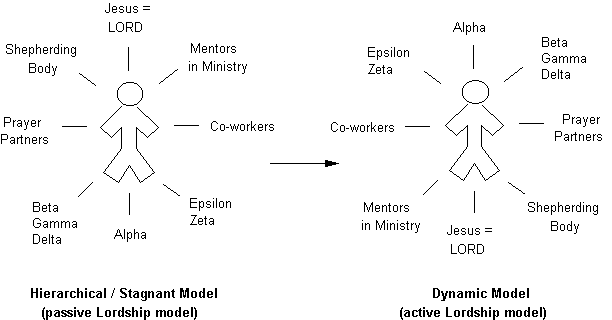
· Seeing oneself as part of a dynamic web of relationships
eg consider the following webs for an apostle / missionary. The dynamic model serves to show that Jesus came to serve us, and that our mentors and shepherding body are there to support us (instead of just being people to 'report to'), and we are to serve others, considering them more important than ourselves:
The Top Ten Mistakes Leaders Make
(by Hans Finzel)
1. The Top-down attitude
2. Putting Paperwork before Peoplework
3. The Absence of Affirmation
4. No Room for Mavericks
5. Dictatorship in Decision-making
6. Dirty Delegation
7. Communication Chaos
8. Missing the Clues of Corporate Culture
9. Success without Successors
10. Failure to Focus on the Future.
A Big Picture Narrative of Salvation
In the beginning God created the heavens and the earth ... and it was all very good, including humans. This has never been reversed; humans and all creation are in essence still very good by virtue of creation, even though there is none that doeth good (Ps 14:1). When Jesus says that there is none good except one, and that is God, I believe He is meaning the character, the adjectival description. Where it says that a good tree cannot bear bad fruit, and a bad tree cannot bear good fruit, he is referring to our sinful nature which we have, but this does not counter who we are by virtue of creation: made in God's image, and along with the rest still very good "in essence".
Christ was crucified "from before the foundation of the world". God's plan was always that we should be one in Christ. The Law was given because of transgressions, to determine/show the boundaries, but gave no power to fulfil. They allowed societal order, and highlighted and reckoned sin.
Christ came in order to fulfil the Law, taking all its stipulations and fulfilling them, and was the 'telos' to which the Law pointed. The Law never offered salvation: it was always through faith.
The regime of the Law, with its stipulations, is now ended; we don't follow circumcision, the sacrifices, etc, but it still reveals the righteous requirements of God. The Holy Spirit now is God's empowering presence to fulfil the Law and its just requirements (which Jesus showed in his Sermon on the Mount is actually much narrower than the 10 Commandments).
We are justified by faith, reconciled through Christ's death.
Paul, as to the righteousness under the Law, was blameless, meaning that he fulfilled all its sacrificial obligations, but it could never save and give power to live a righteous life! "Hence I find in my body a law which is contrary to what I hold in my mind. Aaah! Who will deliver me from this body of death?! I thank God, through Jesus Christ our Lord". It is now the Holy Spirit who enables us to fulfil the Law's requirements.
We now can live in love (the presence of the future age!); the Law is still holy & just & good, ordering 'evil society' and providing the boundaries which people need in order to realise they are transgressing, but it is never through keeping the Law that we are saved!
Christ died for all! All has been done! It is only through faith that we are made right with God, and all people should have the opportunity to hear and respond: just believe! But it is not merely predestination of the individual, but a predestination to be in Christ, and not apart from Him. The Spirit still blows where it wishes, and there are still hard hearts, but it is not a 'dualism' of predestination - 'us' & 'them'. We all need to repent (not a negative, heavy thing, but a metanoia - a change of mind - toward God (don't worship the creature, but worship the Creator)) and have faith in our Lord Jesus Christ. Pride and unbelief are the biggest obstacles to coming to Christ, the biggest sins.
The Holy Spirit is in the world, talking to people; people are free to make a choice; the strong man sometimes has to be bound. Remember, we are dealing with RELATIONSHIP at ALL LEVELS; we are not robots. God can also choose not to talk to a person and leave them to their own destructive ways! (cf Romans 1). But can also choose to overrule by so influencing our minds through the Spirit part of us (or to our minds directly, or through 'circumstances') that we cannot but do what He wills.
The Father is directing the unfolding plan of salvation across the world. God even uses 'hardened Pharaoh' to try to get His glory to all the world to save the world (the great Exodus would be spoken about in all the world, as a trigger to believe in this God !!). God even uses hardened hearts for the purpose of saving. God can and is using evil for good, not as His prime tool, but as His only/best/respectful tool (maintaining/upholding the rights of people to be free) to achieve the greatest good in the long run (ie the most people in heaven). God's divine strategy is His choosing!! WOW! And who are we to question God (cf Romans 11:33-36).
[Note that in the above I have tried to integrate Divine Sovereignty with Human Responsibility. But perhaps ultimately they cannot be brought together. I don't know.]
This world (& the possibility of death, rebellion, etc) was necessary in order to be able to create a "faithful bride" for Christ.
Consider Satan and his fall; God is wanting to create a people who will never be rebellious [again] like Satan, so He had to create a cosmos like this in which death was possible, so that it is only through mercy, humility, etc that people are saved/eternally secure, & NOT just by divine creation; it seems that a created personality in the image of God can only not usurp God by means of having humility taught to him/her (but in the process of humility being taught, sin must arise, & death, which thus have to be conquered). Thus we read that it was already before the foundation of the world that we were destined to be in Christ, indicating that His whole saving work was already foreordained (cf Eph 1:4,5; Rev 13:8; Mt 25:34). And thus we read that in heaven we shall always be beholding the Lamb that was slain (cf Revelation 5).
The only way God would not have had to have Christ slain from the foundation of the world was if He created us as other Gods, which is impossible, for He alone is and can be God!!
"The thief comes only to steal and kill and destroy; I have come that they may have life, and have it to the full." Jesus (John 10:10)
"Now this is eternal life: that they may know you, the only true God, and Jesus Christ whom you have sent. I have brought you glory on earth by completing the work you gave me to do. And now, Father, glorify me in your presence with the glory I had with you before the world began." Jesus (John 17:3-5)
"So do not worry, saying, 'What shall we eat?' or 'What shall we drink?' or 'What shall we wear?' For the pagans run after all these things, and your heavenly Father knows that you need them. But seek first his kingdom and his righteousness, and all these things will be given to you as well." Jesus (Matthew 6:31-33)
As Brian Houston says: "Your life was meant for living". There is no other purpose than that (if one may even label that phrase as a purpose). We were not made to be God's slaves, just as women were not made to be men's slaves. Life is all about relationship and walking hand-in-hand in harmony with each other as we go about doing the delightful beautiful tasks God has laid before us, which by definition bring glory to God.
But ever since Adam & Eve's fall into sin, God has been working out a plan of salvation on the earth, and those who now join with Him are also entrusted with this work as well.
There is, as we may define it, a 'shift in task emphasis'. The task has been expanded beyond (but I believe not annulling) the original "be fruitful and multiply, fill the earth and subdue it". Not only are we now to personally seek entry into God's kingdom, and submit to His means of obtaining righteousness (which is through faith in the death and resurrection of Jesus), but we are also called to be co-workers in bringing others into the Kingdom of God and practising His righteousness in the world, in accordance with the gifts and talents He gives us. This is the new 'number one priority task' which is delightful and beautiful in God's eyes, to which we should and must direct all of our creative and ingenious abilities. This earth can no longer be our focus since it is riddled with sin and evil, and will soon be done away with (cf 2 Peter 3).
The six steps help us, I believe, to fulfill all the above.
Allow me to use two final illustrations to help us grasp the process.
First, using a gardening analogy, Alpha buys the land back from the enemy, Beta gets rid of all the large deep roots to enemy territory, and many finer ones at the surface, and rocks etc, which will only keep the land unproductive, and replaces the bad soil with good, fertilised soil. Gamma & Delta is seed sowing and watering into the new land, along with pruning of the new growth. Epsilon is pruning and controlling the direction of the growth. Zeta equips one to be a co-helper with God in all the previous processes.
Secondly, the dynamics of human sexuality and child upbringing provide remarkable parallels with Alpha to Zeta. Consider the following scant outline as a guide:
There must first be covenant relationship, ideally between a loving and caring man and woman, else the child is just the product of rape or lust, and thus there will be no good environment for the child to grow up in.
Seed must sown for the baby to be born
Conception does not always occur
- timing must be right
- defence mechanisms removed
Once conception occurs, need to avoid dangers
- natural abortion
- forced abortion
- right diet
- mother really does change in her moods, etc
The growing baby and mother need careful attention
Birth is a bloody, messy, tiring, screaming, but joyful affair in the end
The resulting baby is just the beginning
- needs constant care; it is totally dependent on its parents; needs parents to direct, teach, specifically input into their lives
- teaching and discipline is needed from day zero, whether the baby realises it or not, all in a constant attitude and atmosphere of loving care
- the growing baby gets its values, and grows in the right way, virtually by osmosis
- it comes to love being part of the family, without even realising why
- diet begins with milk, and then expands to other foods
Only much later in life does it make many many conscious decisions and finally come to maturity, able to stand on its own two feet, able to discern good from evil.
Discipline from birth to maturity all occurs because it is a part of the family; its birth origins are pointed back: "Being part of this family, you do things this way"
This family unit is inter-connected with other family units, either by blood or by friendship, and thus the child has genuine siblings, cousins, uncles & aunties, and 'pseudo' cousins, uncles, aunties etc. All these relationships are necessary for overall growth. The more the family grows, the more these increase, grandparents come on the scene, and so much more.
The Bible is our primary textbook when it comes to all matters of faith and life. Yet to many people it seems to be so complicated, and this concept is perhaps enhanced by the numerous books and 'Bible-study helps' that have been published for (would-be) disciples. Whilst not wishing to undermine all the abundant material available (to which this document also becomes an addition!), my concern is to show how the Bible itself really already is a fantastic 'text-book' in the alpha to zeta stages.
Considering the NT in the first instance, I have noticed and discerned the following structure:
|
NT portion |
Essential theme |
Corresponding Discipleship phase |
|
Matthew |
The Gospel and its spread |
A |
|
Romans |
The Gospel |
A |
|
1 & 2 Corinthians |
Letters to the churches for their encouragement & building up in the faith. |
B,C,D: phase 1 |
|
1 & 2 Timothy |
Personal letters to leaders |
E,F |
|
Hebrews |
Surviving attack from within and without |
B,C,D: phase 2 |
Noting the above, I suggest the following bible-based curriculum to aid 'conversion' and ongoing growth in the Christian life:
Alpha
· Mark (+ any other of Matthew through Romans) (+ essential background from Genesis 1-11 and other OT texts) to lead to conversion and being saved! We must communicate some understanding of what the Kingdom of God is and the nature of Messiahship (see 'The Gospel' earlier), which may require first of all clarification of the fact of God's existence, the nature of humanity and the form of the universe (both of which point to the veracity of the necessity for the biblically revealed God) - ie. coming to hold a true worldview.
I would thus say that the following steps could most reasonably be expected to be followed:
a) Pre-evangelism (laying a foundation of trust, integrity, interest, "shifting the mind onto spiritual things", showing that there is someone who is interested in them);
b) Evangelism (the four evangelistic steps);
c) Foundations (Genesis 1-3, 4-12, Isaiah 61:1-2 & Luke 4:14-21, an overview of this whole document and stages Alpha through Zeta)
d) Discipleship Contract (read Mark's gospel)
e) Sealing the Contract (water baptism in response to verbal faith in Jesus Christ)
The following two diagrams give helpful big-picture overviews of world history and the way of salvation:
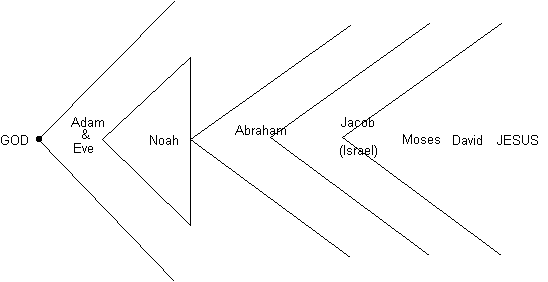
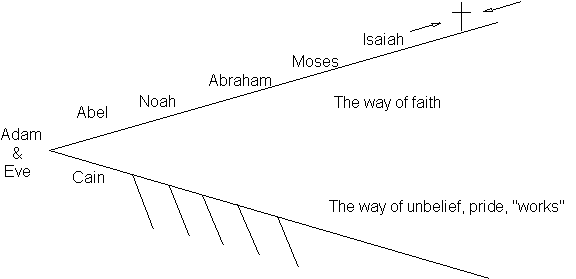
(The two paths of Abel-Cain, above, is derived from Edith Schaeffer's book "L'Abri")
Beta, Gamma, Delta: phase 1
· Ephesians & Philippians for an understanding of your identity in Christ, plus any of Romans 1-11.
· Luke-Acts as a prelude to studying Colossians, Galatians, 1 & 2 Corinthians, 1 & 2 Thessalonians, for an understanding of life by the Spirit and not in the flesh and not under law.
Epsilon
· In the context of seeking advice from other Christians who know you, and whilst being aware of the desires of your heart, your established abilities, your personality and your experience, study Romans 12, Ephesians 4, 1 Corinthians 12, and 1 Peter 4 (here we find lists of spiritual gifts) and ask God to reveal to you what gifts you have. Then study 1 & 2 Timothy, Titus, and Philemon putting yourself in the shoes of the recipients of those letters and discern how one should exercise the gift one has received.
Beta, Gamma, Delta: phase 2
· John as a prelude to studying Hebrews, James, 1 & 2 Peter, 1 & 2 & 3 John, Jude, Revelation, for an understanding that Jesus alone is the Messiah, and that He really is all sufficient, and that we should never swerve away from Him, and that truly in Him we know what God is like!
Zeta
· Matthew as prelude to 1 & 2 Timothy, Titus, Philemon, then followed by Romans, putting yourself in the shoes of the writer and the recipients, so that as witnesses, evangelists, and leaders, we know the right use of the law, what the Christian life is, and how / how not to teach and lead in the above.
Whilst having divided the NT up in such a fashion, allow me say that I believe all the elements of alpha through zeta can be found in the four Gospels, in the 'narrative alpha', since Jesus' life necessarily encompassed all these things. He taught concerning the Kingdom of God, He lived it out in practice, and made it possible for us to be a part of this Kingdom through His death and resurrection. We are called to emulate all these things - teach, live, even sacrifice ourselves for others that they may enter the Kingdom - and the rest of the NT is basically extrapolation or application to new converts around the world of all Jesus said and did! Narrative alpha encompasses systematic alpha plus beta through zeta.
(I also sense that in Romans, the systematic alpha, we also have all of alpha through zeta; A being in chapters 1-11, and B,C,D,E,F being in chapters 12-16.)
Furthermore, the Gospels are what the whole OT always looked forward to, always talked about, and always were pregnant with in its narratives, teaching, and prophecies. Thus the OT is never redundant, and always provides for us rich background and never redundant information for living the Christian life. Thus I suggest a few ways to study and read the OT:
a) in the above curriculum, whenever NT passages refer back to or may be 'similarly found' in OT sections, these sections should be read and studied in their OT context, and then full riches will be abundantly added to you in your faith! (especially when the same themes exist).
b) when reading the OT, note and absorb the following things -
·
the nature of God·
the nature of humanity·
the nature of world history, the cosmos, the spiritual realm·
the nature of how God deals with & relates to mankind.·
the nature of the People of God, in times of obedience and disobedience·
the nature of the future·
the nature of the Messiah & His Kingdom·
the nature of the People of God in the Messianic Kingdom·
God's righteousness (tseddeq), justice (mishpat) and covenant faithfulness (hesed), the three of which produce shalom.May God bless your journey into the Christian life!
Allow me to finish with the words King David once said:
"Taste and see that the Lord is good; blessed is the man who takes refuge in Him"
(Psalm 34:8).
General
Biblia Hebraica Stuttgartensia. 4th rev edn. Ed. Karl Elliger and Wilhelm Rudolph. Stuttgart: Deutsche Bibelgesellschaft, 1990.
The Greek New Testament. 4th rev edn. Ed. Barbara Aland et al. Stuttgart: Deutsche Bibelgesellschaft, 1993.
The NIV Study Bible. Ed. Kenneth Barker et al. Grand Rapids: Zondervan, 1985.
Brenton, Lancelot C. L. The Septuagint with Apocrypha: Greek and English. Peabody, Massachusetts / (London): Hendrickson / (Samuel Bagster & Sons), 1986 (1851).
Clarke, Steve. The Book of Romans: a theological and exegetical study of chapters one to eleven. Lilydale, Victoria: Bible College of Victoria, 1999.
Dennis, Lane T. (ed.). Francis A. Schaeffer: portraits of the man and his work. Westchester, Illinois: Crossway, 1986.
Fee, Gordon D. 1 and 2 Timothy, Titus. New International Biblical Commentary. Peabody, Massachusetts / Carisle, Cumbria: Hendrickson / Paternoster, 1995.
Graham, Billy. Just as I am: the autobiography of Billy Graham. Sydney: HarperCollins, 1997.
Green, Michael. To Corinth with love: contemporary issues in the light of Paul's letter to Corinth. London: Hodder and Stoughton, 1982.
Gumble, Nicky. Alpha Manual. 3rd rev edn. London: HTB Publications, 2000.
Hunter III, George G. Church for the Unchurched. Nashville: Abingdon Press, 1996.
Kruse, Colin G. Paul, the Law and Justification. Leicester: Apollos, 1996.
________. The Letters of John. The Pillar New Testament Commentary. Grand Rapids / Leicester: Eerdmans / Apollos, 2000.
________. The second epistle of Paul to the Corinthians. Tyndale New Testament Commentaries. Leicester / Grand Rapids: Inter-Varsity Press / Eerdmans, 1987.
Ladd, George Eldon. A Theology of the New Testament. rev edn. Ed. Donald A. Hagner. Grand Rapids: Eerdmans, 1993.
Luther, Martin. Commentary on the Epistle to the Romans. Trans. J. Theodore Mueller. Grand Rapids: Kregel, 1976.
Martin, William. A prophet with honor: the Billy Graham story. New York: William Morrow, 1991.
Price, David and Bob Fergie. Discipleship [Lectures and Notes]. Lilydale, Victoria: Bible College of Victoria, 1998.
Ruegsegger, Ronald W. (ed.). Reflections on Francis Schaeffer. Grand Rapids: Zondervan, 1986.
Schaeffer, Francis. A. The Great Evangelical Disaster. Westchester, Illinois: Crossway, 1984.
Shakarian, Demos. The Happiest People on Earth. London: Hodder and Stoughton, 1977.
Warren, Rick. The Purpose Driven Church: growth without compromising your message and mission. Ed. Jack Kuhatschek. Grand Rapids: Zondervan, 1995.
Watson, David. Discipleship. London: Hodder & Stoughton, 1983.
Alpha
Bell, John. Dimensions of Life [Bible Study Handout]. Reservoir, Victoria, Australia: Way of Life Ministries, nd.
Clarke, Steve. Christian Apologetics [Lecture Series]. Lilydale, Victoria: Bible College of Victoria, 2000.
________. Introduction to Evangelism [Lecture Series]. Lilydale, Victoria: Bible College of Victoria, 1998.
Comfort, Ray. Hell's best kept secret. Springdale, Pennsylvania: Whitaker, 1989.
Engel, James F. and Wilbert Norton. What's gone wrong with the harvest?. Grand Rapids: Zondervan, 1975.
Koop, C. Everett and Francis A. Schaeffer. Whatever Happened to the Human Race?. rev edn. Westchester, Illinois: Crossway Books, 1983.
Mackay, Hugh. Why Don't People Listen?. Chippendale, Sydney: Pan Macmillan, 1994.
Newbigin, Lesslie. Foolishness to the Greeks: the Gospel and Western Culture. Grand Rapids: Eerdmans, 1986.
Norling, Allan. Jesus the baptiser with the Holy Spirit. Beecroft, N.S.W.: Allan Norling, 1994.
Pawson, J. David. The Normal Christian Birth. London: Hodder & Stoughton, 1989.
Schaeffer, Edith. L'Abri. Worthing, Sussex: The Norfolk Press & Henry E. Walter Ltd, 1969.
Schaeffer, Francis A. How Should We Then Live?: The rise and decline of Western thought and culture. Old Tappan, New Jersey: Fleming H. Revell, 1976.
Zacharias, Ravi. Can Man Live Without God?. Dallas, Texas: Word, 1994.
Beta
Anderson, Neil T. Set Free. Mill Hill, London: Monarch Books, 1998.
________. Victory over the Darkness: with study guide. Mill Hill, London: Monarch Books, 1998.
Anderson, Neil T. and Dave Park . The Bondage Breaker Youth Edition. Eugene, Oregon: Harvest House, 2001.
Crabb, Larry. Inside Out. Amersham-on-the-Hill, Bucks, England: Scripture Press, 1990.
________. Understanding People. Oakleigh, Victoria: John Bacon, 1987.
Litchfield, Bruce and Petranella Litchfield. Christian Counselling. 4 vols. Dickson, ACT, Australia: Christian Counselling Services, 1992.
Lucado, Max. He Still Moves Stones. Nashville: Word, 1993.
Peck, M. Scott. The Road Less Travelled. London: Arrow, 1990.
Gamma
Burke, Todd and Mike Hudgins. Covenant Life. Oklahoma City, Oklahoma: New Covenant Community, 1980.
Clarke, Steve. Church Planting [Lecture Series]. Lilydale, Victoria: Bible College of Victoria, 2000.
Cymbala, Jim. Fresh wind, fresh fire: what happens when God's Spirit invades the heart of his people. Grand Rapids: Zondervan, 1997.
Schaeffer, Francis A. The Church at the end of the 20th century. Downers Grove, Illinois: Inter-Varsity Press, 1970.
Sherlock, Charles. God on the inside: Trinitarian spirituality. Canberra: Acorn, 1991.
Delta
Betz, Hans Dieter. The Sermon on the Mount: a commentary on the Sermon on the mount, including the Sermon on the plain (Matthew 5:3 - 7:27 and Luke 6:20-49). Hermeneia. Ed. Adela Yarbro Collins. Minneapolis: Fortress, 1995.
Braff, Allan J. Microeconomic Analysis. New York: John Wiley & Sons, 1969.
Chapman, Gary. The Five Love Languages. Sydney: Strand, 2000.
Clarke, Steve. Faith in Contemporary Society [Lecture Series]. Lilydale, Victoria: Bible College of Victoria, 1999.
Cloud, Henry and John Townsend. Boundaries Before Marriage. Sydney: Strand, 2000.
Fee, Gordon D. and Douglas Stuart. How to read the Bible for all its worth: a guide to understanding the Bible. 2nd edn. Grand Rapids: Zondervan, 1981.
Gothard, Bill. Basic Seminar Textbook: Research in Principles of Life. Oak Brook, Illinois: Institute in Basic Life Principles, 1979.
Haan, Roelf. The Economics of Honour. Trans. Nancy Forest-Flier. Geneva: WCC Publications, 1988.
Ham, Kenneth A. The Lie: Evolution. Green Forest, AR: Master Books, 1987.
Ham, Kenneth A. and Paul S. Taylor. The Genesis Solution. Grand Rapids: Baker Book House, 1988.
HH Dalai Lama and Howard C. Cutler. The Essence of Happiness: a guidebook for living. Sydney: Hodder, 2001.
Humphreys, D. Russell. Starlight and Time: solving the puzzle of distant starlight in a young universe. Green Forest, AR: Master Books, 1994.
Hybels, Bill. Fit to be tied: making marriage last a lifetime. Grand Rapids: Zondervan, 1991.
Kutschker, Peter. Evil people, governing authorities, and the Christian [Essay]. np: np, 2000.
________. The Importance of Covenant for Old Testament faith and religion [Essay]. np: np, 1998.
Meyer, Allan. Search for Intimacy. Mt Evelyn, Victoria: Careforce Recovery Ministries, 2000.
Myers, Ched. Who will roll away the stone?: discipleship queries for First World Christians. Maryknoll, New York: Orbis Books, 1994.
Newbigin, Lesslie. The Gospel in a Pluralist Society. Grand Rapids / Geneva: Eerdmans / WCC Publications, 1989.
Rinehart, Stacy and Paula Rinehart. Choices: Finding God's way in dating, sex, singleness, and marriage. Colorado Springs: NavPress, 1982.
Ross, Hugh. Creation and Time: a biblical and scientific perspective on the creation-date controversy. Colorado Springs: NavPress, 1994.
Schaeffer, Edith. What is a family?. East Sussex: Highland Books, 1983.
Schaeffer, Francis A. The Mark of the Christian. Downers Grove, Illinois: InterVarsity Press, 1970.
The Lion Handbook to the Bible. 2nd rev edn. Ed. David Alexander et al. Tring, Herts, England: Lion, 1983.
Trobisch, Walter. I married you. Leicester: InterVarsity Press, 1971.
Zukav, Gary. The Seat of the Soul: an inspiring vision of humanity's spiritual destiny. London: Rider, 1991.
Epsilon
Balwyn Baptist Church S.H.A.P.E. Kit [Photocopy]. Balwyn, Victoria: Balwyn Baptist Church, nd.
Zeta
Davies, Paul. God and the new physics. London: J. M. Dent & Sons, 1983.
Finzel, Hans. The Top Ten Mistakes Leaders Make. Wheaton, Illinois: Victor Books, 1994.
Sanders, J. Oswald. Spiritual Leadership. 2nd rev. Chicago: Moody Press, 1994.
The above references were either referred to directly in the text of this work, have formed the basis for some of the thoughts written therein, or strengthened my convictions. But there are so many other sources which have influenced and inspired my thinking, especially all the sermons I have heard and conversations I have had with people! It would be futile to begin listing them all. But I would like to specifically mention three sources. First, Billy Graham and his preaching. One of the most vivid memories I have is listening to a recording of him preach on New Year's Eve 1957 on dedication and total commitment to Christ. Secondly, Dr. Colin Kruse, whose humble demeanour and even-handed scholarship I experienced whilst sitting under his lectures at the Bible College of Victoria from 1998-2000. His example was an inspiration to me, and I hope that this work is faithful to the example he set. Thirdly, Sherryn & Darren Davies, whose friendship, wisdom and life-example have been a blessing more than they can imagine.
I would also like to honour my parents, Horst & Hanni Kutschker, who love me very much. I offer this work back to them as a gift, in thanks for the life they have given me.
Ultimately, now, I offer this work in humility back to God. To Him I say "thank you". Thank you, Lord, that by Your grace You have enabled me to gain this life-giving insight into how I should be living my life. Help me now to follow this way faithfully. Amen.