
On one occasion an expert in the law stood up to test Jesus. "Teacher," he asked, "what must I do to inherit eternal life?"
"What is written in the Law?" he replied. "How do you read it?"
He answered: " 'Love the Lord your God with all your heart and with all your soul and with all your strength and with all your mind'; and ,'Love your neighbour as yourself.' "
"You have answered correctly," Jesus replied. "Do this and you will live."
(Luke 10:25-28)
"Therefore everyone who hears these words of mine and puts them into practice is like a wise man who built his house on the rock ..."
Jesus (Matthew 7:24ff)
"Come to me, all you who are weary and burdened, and I will give you rest. Take my yoke upon you and learn from me, for I am gentle and humble in heart, and you will find rest for your souls. For my yoke is easy and my burden is light"
Jesus (Matthew 11:28-30)
"You are the salt of the earth ... You are the light of the world"
Jesus (Matthew 5:13,14)
"My prayer is not that you take them out of the world but that you protect them from the evil one"
Jesus (John 17:15)
For the grace of God that brings salvation has appeared to all men. It teaches us to say "No" to ungodliness and worldly passions, and to live self-controlled, upright and godly lives in this present age. (Titus 2:11-12)
So whether you eat or drink or whatever you do, do it all for the glory of God.
(1 Corinthians 10:31)
This step is in actual fact the application and practical outworking of the values of the kingdom discussed in the previous stage to our everyday daily living. It may involve acquiring and learning specific disciplines to live by, but these disciplines are not burdensome, but are actually those which will bring life not only to ourselves but also for others and our environment.
However, we must be clear right at the outset that this can only be achieved and maintained as one abides in Christ; it is the fruit of walking / obeying the Holy Spirit, and not a work that we do autonomously. The ability and desire to obey the demands of the new lifestyle comes from faith and is its fruit. The life of Jesus is not merely an example to follow in our own strength - His life grows within us as we abide in Him!
And abiding in Christ includes fellowship with His body, that is, the church. This step should not be taken (and cannot be successfully) in isolation. We need each other to live as Christ intends us to (see Gamma).
When we realise that our lives are not matching up to the written example of what our lives should be, this should drive us to our knees in prayer, with broken spirits, and we should ask for forgiveness and that the life of Christ would be manifest in us. In response to a prayer such as this, God will speak to us and we just have to do what He says!
As we spend time abiding in Christ and communing with Him, we SHALL be changed from within to be able to live out what His example and the Law of God requires. Then, and only then, can we do anything that will bear fruit. Freedom in Christ comes from abiding in Him and NOT from relying on our own intellect, emotions, and resources to fulfil His will. We become inspired to do as Christ does as we spend time in His company! The Holy Spirit is our counsellor, teaching us how we should walk. "Whether you turn to the right or the left, your ears will hear a voice behind you, saying, "This is the way; walk in it". (Isaiah 30:21). The obedience Christ desires is that which comes from faith. We still have a free will; as we choose to walk in the way the Spirit wishes us to go, then we will experience His fruit.
This being said, let us begin to unravel the areas in which we need to apply the values of the kingdom.
Since all of life is relationally oriented, we can begin by listing all the relationships we find ourselves involved with:
God
Other spiritual beings (angelic, demonic)
Self
Other people
Environment
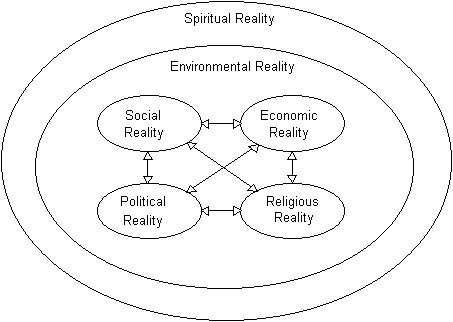
These relationships give birth to and are conducted within political, economic, social, and religious realities, as the following diagram indicates:
Each of these realities in which we currently find ourselves must be ruthlessly critiqued by the values of the Kingdom outlined previously, and we must work to seeing the values of the Kingdom outworked in each realm, at least beginning with ourselves and our own lifestyle.
A help for us in doing this successfully is to note how God Himself has acted in history, as recorded in the Bible, in each of these realms. Therefore, perhaps one of the most important things we should first learn is how to read the Bible.
Reference for Daily Living: the Bible
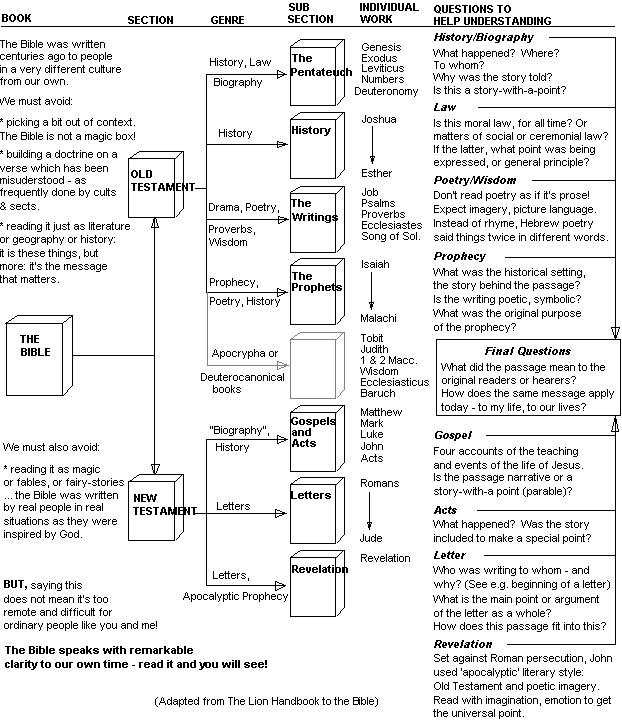
One of the first things we need to understand about the Bible is what sort of literature it is. It is definitely not just a scroll which fell out of the sky for mankind to read and obey!
Overall we can say that it is a collection of 66 smaller works*, each of which in themselves are of different genres, and divided into two great periods of composition (which also effect their thematic content): the period before Jesus lived, which we call the Old Testament, and the period beginning from Jesus' birth, which we call the New Testament.
[* Note: There are a few other works, labelled the Apocrypha or Deuterocanonical books, written in the 400 years before Christ, which most sections of the church do not regard as being fully Scripture, lacking the stamp of divine inspiration. However, they are still regarded as being helpful to some extent, especially since they serve to fill out the historical situation in the period before Christ.]
On top of that, many of the authors wrote in different styles, or genres, and these styles need to be taken into account when reading, understanding, and applying what they wrote for our lives today (we do exactly the same when we read a newspaper, interpreting what we read according ot whether it is a cartoon, headlines, editorials, classifieds, articles, etc). Furthermore, for best interpretation, we need to take account of the historical and cultural situation in which the document was written, so that we don't for example confuse metaphors or illustrations with seemingly similar ones in which we find ourselves in (for example, the biblical expression "his eye is bad" does not mean that the person needed to see a doctor, but rather that he was greedy and stingy, not wanting to see the need of his neighbour). We also need to be strongly aware that we are reading narrative, and should read the text holistically.
The following diagram serves to illustrate all this:
Furthermore, whilst there were over 40 different authors who composed these works, spanning a period of composition greater than 1500 years, there is a unity of message and power behind the words which can only be attributed to the fact that God was the 'inspirer' behind them all (cf 2 Tim 3:16). Thus we can legitimately say that the Bible is the product of man and of God.
The theme or plot which can be traced through the Bible is that of God wanting to have an eternal fruitful relationship with people. From God's perspective, relationship is grounded and built upon covenants, that is, agreements on how we will relate to each other. And we are able to trace a number of covenants which God initiated in the Bible, as the following diagram indicates:
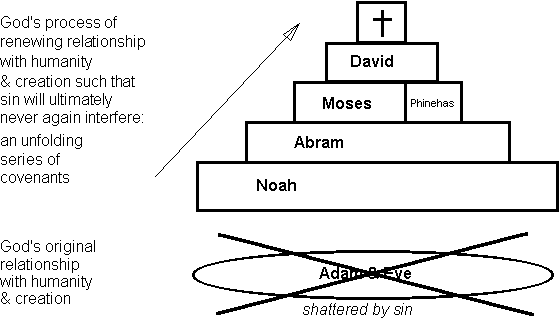
Now the important thing to realise is that all these covenants in the pyramid point to and are fulfilled in the capstone - the final new covenant which God made with us through Jesus Christ (cf Matt 5:17-20; Heb 1:1-2), in which our sins and associated guilt are truly eternally wiped away through the blood of Jesus (cf Heb 10:1-18) and in which we can experience 'new-birth' and have the empowering presence of the Holy Spirit to live lives which fulfill the law (cf Rom 8:13). Therefore understanding and living in accordance with this new covenant is the key for daily living. The detail of this new covenant we find foreshadowed and spoken about in the Old Testament, but fully contained in the New Testament portion of the Bible*.
[* Note: The terms 'Old Testament' and 'New Testament' in themselves mean 'old covenant' and 'new covenant'; all the covenants in the Old Testament are labelled 'old' because with respect to the final one in Christ, that is what they now are!]
So how do we treat and read the Old Testament? It is not redundant, but should be read now as providing paradigms for living, as providing the 'law' which the Holy Spirit is now helping us to fulfill in a non-legalistic fashion, and as providing the background and context for life as we know it today. If we want to understand and apply what we read in the Old Testament for our lives today, it must only be done 'through the eyes' of the New Testament.
Having now provided an overview of how we can use the Bible to help us in our daily living in the political, economic, social, and religious realms, we can begin to make some pertinent comments about our relational living within them.
Living midst a spiritual reality
Here I wish to briefly talk about God, angels, satan & demons, eschatology, and how we live in the present with respect to all these.
God (Trinity)
Our God is the creator and sustainer of the universe, in whom all things consist, and who has revealed Himself to us as Father, Son, and Holy Spirit (see Gamma). His self disclosed name is "I AM", personalised in the Tetragrammaton YHWH. The Bible also emphatically says that there is no other God besides Him (see for example 1 Corinthians 8-10; Isaiah 43:10-13; Isaiah 45:5-7). Therefore idols are nothing. In fact, people who worship idols are submitting themselves to demonic powers.
Jesus Christ has been exalted to the highest place in heaven and earth, being seated at the right hand of God the Father. All authority in heaven and earth has been given to Jesus, as well as a name above every other name, that at the name of Jesus every knee should bow, of those in heaven, on earth, and those under the earth, and that every tongue should confess that Jesus Christ is Lord to the glory of God the Father (cf Philippians 2:9-11).
Angels
The Bible also teaches that there are other spiritual beings, called angels. These are not on the same level as God, although they are much more powerful than human beings. They are actually designated to be ministering spirits for us people who are inheriting salvation (cf Hebrews 1:14).
Satan & Demons
Satan and his demons are other evil spiritual beings, and there is every reason to believe from Scripture that they are fallen angels who rebelled against God, with the devil being the archangel Lucifer who was cast out of an exalted place in heaven because of pride (cf Ezekiel 28:11-15; Isaiah 14:12-15). The devil wants all to worship him (cf Matthew 4:9-10), and some people do (cf 1 Cor 8-10).
The devil's traditional role included appearing in heavenly councils (cf Job 1) to accuse the saints. The word 'satan' actually means 'accuser'.
The devil has been given authority over this world (cf Matt 4:9), and it seems that this was granted him through Adam's sin. Demons can also possess and oppress people. However Jesus and Christians using Jesus' name can cast demons out of people (but beware, seven fold can return into a person if the person is not thereafter filled with the Holy Spirit).
Since the death and resurrection of Jesus Christ, there has been a further defeat of the demonic powers, with a public spectacle having been made over them through Christ's triumph on the cross. The Book of Revelation also describes a 'war in heaven' in which the devil was cast out from there, no longer being able to accuse the saints!! However, the devil is still the god of this world, and still seeks to devour the saints, knowing that his time is short. With this knowledge, the Bible tells Christians to submit to God and resist the devil, and he will then flee from you.
God also uses / allows the devil to purify / test the saints (cf 1 Corinthians 5). But we can be assured that God is directing and working in all our situations for the good of those who love Him (Romans 8:28).
Eschatology
The Bibles teaches that there will be a new heaven and a new earth. The Bible also teaches that there is a hell, a place designed for the devil and his angels, but to which also all people who refuse the overtures of God to them to repent and turn to Him will also go (by their own choice therefore).
For us who are Christians, at the resurrection of the dead, we will to some extent be like the angels in heaven (neither marrying or giving in marriage), but more significantly we will be like Christ, for we shall see Him as He now is. In fact, the Bible describes the whole Christian assembly in heaven as Christ's bride.
Personally, I believe that the 'new heavens and earth' mark a so-called new creation week. That is, I sense there is evidence biblically to believe that we are presently in God's seventh day of rest from His original creation week (remembering that to God a day is as 1000 - 6000 years [see 2 Peter 3:8; Psalm 90:4]).
Present Living
We as Christians may strongly assert the following:
· the Father loves us, and will grant us our prayers prayed according to His will (therefore by definition having been prayed in the Spirit and in Jesus' name, to whom all authority has been given!)
· Jesus intercedes for us in heaven, as Lord of all and also our great High Priest. We can therefore stand 100% assured that our sins and guilt are totally washed away (Hebrews 10)
· The Holy Spirit has been given to empower, guide and gift us for Kingdom living in the midst of this dark world. We therefore can be salt and light to not only preserve our society (cf Abraham's dialogue with God, in which God promised Abraham that He would not destroy Sodom if there were 10 righteous people in it) but also to be beacons to attract and call people to the truth of the gospel and God's grace for us in Jesus Christ.
Living midst an environmental reality
When looking at our environment around us, we must be clear that we are not observing the original pristine state which God created in the beginning (even if we go to some beautiful tropical island)! The Bible clearly states that what we are now observing is the aftermath of God's total destruction of every living thing on earth by means of a global flood (Genesis 6-8). There is every reason to believe from Scripture that the great mountain chains we see, the vast oceans and their depths, the massive canyons, and even the polar ice-caps, came into existence as a result of the catastrophic events during the flood and thereafter. In fact, it is reasonable to postulate that most of our world's fossil deposits and coal / oil reserves were created as a result of this massive cataclysm.
Furthermore, when looking at the animal kingdom, the so-called struggle for the survival of the fittest is itself a fall from God's original creation. From Genesis 1:29-30, it is most reasonable to postulate that originally all animals (and humans) were vegetarian, and that the 'carnivore' phenomenon we see everywhere around us is only a later addition into the scheme of things. Indeed, we read that only after the flood did God specifically mention to humankind that they could / should now eat meat (but without its blood). Perhaps this was because the now drastically altered climatic conditions on earth demanded that other sources of protein etc be found, or that plants alone could no longer produce the vitamins etc needed for human survival. This is not a far-fetched hypothesis, since if before the flood the earth was surrounded by a water-canopy (as Genesis 1:6-8 seems to indicate), this not only may have caused the earth to be like a greenhouse, but could also have raised the air-pressure level by a factor of two. If this is so, I have heard that it has been scientifically demonstrated that under such high-pressure conditions, plants grow bigger, fruit is more scrumptious with more vitamins etc, and people's lung's absorb more oxygen, thus causing them to be healthier and live longer.
Combining this information with what we read about Jesus implying of the devil: "The thief comes only to steal, kill, and destroy" (John 10:10a), and also that Jesus said that His words were spirit and life (John 6:63), I can see that when Adam & Eve walked in unbelief and listened to the devil's schemes, they actually handed the control of the earth over to the devil. No longer was faith the active principal on earth, but now it was unbelief, which leads to death. Therefore I postulate that the whole 'cycle of life (death)' which we now see outworking around us is the final evolutionary decay result of people handing over the earth to the devil's authority. Everything was pristine in the beginning, but now we see a new harmony of life vs death principles. In fact when I observe animal behaviour around the world, I notice that the scale is tilted to 'more death and violence' in behaviour where there is more contact with human-kind. And in remote Congo jungles where human civilisation has been absent for centuries, perhaps millennia, animals are living in a peaceful co-existence virtually Eden-like! No wonder Paul writes that the creation itself will be liberated from its bondage to decay and brought into the glorious freedom of the children of God (Romans 8:21), because the children of God are humans who walk by faith - that life giving force!! This scenario seems to also be confirmed by Jesus when He describes people of faith in God as "salt of the earth", that is, preserving agents!
(see also 'Living midst an economic reality' below).
No person is an island. We all exist within a network of relationships, extending from our immediate family to that of the global community, and a Christian is called to live out the values of the Kingdom of God in every sphere.
Consider the following table which attempts to give the broad scope of the human dynamics of which we are all a part:
|
Sex |
« |
Life-stage |
« |
Friendship-level |
« |
Family-stage |
« |
Culture |
|
Male |
infancy |
stranger |
singleness |
same culture |
In light of the above table and the abounding combinations, God's command to us really does seem to be the best solution for peace and harmony: Love your neighbour as yourself.
But unlike the expert in the law, whose problem to his mind was not what love entailed but to whom he should show it (cf Luke 10:25-37), we often sense that we lack in what love really looks like in practice. But at this point we must remember that God's command to love one another is the fruit of walking in the Spirit (cf Galatians 5:22), therefore the command first of all resolves into one of loving God first with all your heart, soul, mind and strength, and only then can you love your neighbour! (little wonder God always gave this as His first command to us!) The fact that the expert in the law who came to Jesus had to ask who his neighbour was reveals that he was not in a right relationship with God and had a false understanding therefore not only of Him but also of himself, therefore being limited in his scope of showing love.
We may thus say that our sense of lack in defining what love looks like in practice is actually a manifestation that we, too, are not walking in love with God! Hence this document has first of all focussed on getting our relationship with God right, and establishing our identity in Him (see Beta).
But this being said, we may add some pertinent comments and remarks concerning each of these aspects of interpersonal dynamics to help us undo the false thought patterns that may have been established in our lives prior to entering into a close relationship with God. The following remarks, whilst not exhaustive, hopefully will provide some helpful tools in leading us into blessing in our inter-personal relationships.
Our sex
To be male is different to being female. There is true difference beyond just the physical form and strength of our bodies and the organs we have been given. To a significant extent our personalities are also shaped by our sex and our intended sex roles in copulation and parenthood, with males often having more of a desire to strongly enter their world and make a difference, and females often having a strong desire to be nurturing and welcoming of others into their sphere of existence. These innate differences seem to be the reason for the different roles men and women assume or are allotted within society for the glory of God.
These differences do nothing to undermine the fact of a status of equality between the sexes. Men and women, both individually and as couples, reveal and display the image of God. The differences should be seen as complementary rather than as signs of privilege, power, prestige, or position. We must also remember that when required, females are able to exercise personality traits of men, and men are able to exercise personality traits of women.
Life-stages
To be a child is different to being an adult. The journey is often marked as one from total dependence, through radical independence, to the realisation that we are all inter-dependent and where one acknowledges and assumes one's responsibilities in life. This is what it means to be mature in Christ (Col 1:28). I suggest therefore that one can only truly be adult when one is truly Christian.
We gain further insight, however, into adulthood, when we consider Jesus' words: "I tell you the truth, anyone who will not receive the kingdom of God like a little child will never enter it." (Mark 10:15). This indicates that to be an adult does not mean we abandon child-like trust, innocence, faith, wonder, excitement, etc. To be sure we put away 'childish ways', those that are marked by jealousy and selfishness and immaturity of mind, but we are always to be people of faith, people under authority. This is evidenced by the truth that we never graduate from being children of our Heavenly Father.
Perhaps the best way of describing God's original plan for human development is how Jesus' growth was described: one of growth in wisdom and stature, and in favour with God and people (cf Luke 2:52).
When we analyse this statement, and reflect on our own lives, the only element which can really be controlled and influenced by other humans is our growth in wisdom, that is, our mental growth. We will end up behaving in the way we were trained.
When we think about this, we can easily see the importance and benefits of disciplining and training up a child in the ways of the Lord, because then there is less undoing of false thought and behaviour patterns after they come to believe in Christ and have their own personal counsellor, the Holy Spirit, to guide and direct them.
Therefore the role of parents is absolutely essential in a person's development, as is the necessity of discipline from birth to always counteract and put in perspective the negative destructive ways of our covetous flesh desires which are there from birth to death (see Alpha). We never should try and escape discipline in our lives, and even God disciplines us. In fact, to not be disciplined is not to be treated as a son (cf Hebrews 12:7-11).
Finally, the stage we cannot avoid in life is death. But this is not the end for the Christian - because of Jesus we shall all be resurrected! (cf 1 Cor 15). Therefore we have nothing to fear in this life - whether hunger, persecution, disaster, cot-death, etc. We know that in all things God works for the good of those who love Him (Romans 8:28), and that to be with Christ is far better than remaining on this earth (Philippians 1:23).
Friendship levels
When God created humans, He said that it was not good for the human to be alone, and that he needed a helper (cf Genesis 2:18). And so God created for Adam a friend, who also became his spouse. Ultimately we are all designed to be someone's spouse (even Jesus is described as the bridegroom, and we who are born again are collectively and individually his 'bride'), and yet we live much of our lives in the unmarried state, so first and foremost we need friends to conquer our aloneness (note that God Himself admitted that He Himself was not enough for Adam).
Note also the definition of friend here: a helper. That is, if I may paraphrase, 'a walking together in fulfilling a certain task or goal', over against purely a focus on each other. Friendship begins with a common destination in view.
However many people fail to achieve meaningful friendships, even though they are surrounded with people! The greatest cause of this is our sinfulness, our selfishness, which desires to have no common destination in view. As one person has put it: "sin is anything that lowers the relational harmony in the universe". That's why it is so important for a person to be born again, have their sins dealt with, and have their minds renewed so that they can be free again to explore wholesome relationships with people through the taking of their eyes off themselves (see Alpha, Beta).
But there will always be sin in the world until Christ comes back, because we are still living in fleshly bodies which always desire to tempt us away to selfish ends (cf Galatians 5:17; James 1:14,15), and thus cause rifts and barriers in relationships. Therefore the greatest first quality any person needs to have a handle on is that of forgiveness.
Forgiveness
Jesus taught us to pray: "Our Father in heaven ... forgive us our sins as we forgive those who sin against us .." and even went so far as to additionally comment "For if you forgive men when they sin against you, your heavenly Father will also forgive you. But if you do not forgive men their sins, you Father will not forgive your sins." (cf Matthew 6:9-15). He also to taught us to make right with others as soon as it comes to your attention - whether it was you or they at fault (cf Matt 5:23,24; 18:15).
I don't think the gravity or the freeing power of this concept need be emphasised any more. But allow me to impart some tips on how to forgive from the heart [from the work of Neil Anderson, The Bondage Breaker, and Bruce and Petranella Litchfield, Christian Counselling]:
First, we must admit the hurt and hatred we feel, instead of burying them deep inside. If forgiveness doesn't include your emotions, it will be incomplete.
Second, don't wait to forgive until you feel like forgiving. You will never get there. Feelings take time to heal; this will happen after the choice to forgive is made.
Third, you can know when forgiveness is from the heart when you:
- expect nothing in return
- do not insist on them changing
- act our forgiveness
- bless them, and pray for their prosperity
- release the person from saying "I'm sorry"
- overcome evil with good
(and remember, restoring trust takes time)
(Note: if these traits do not follow your attempt at forgiving, it is a sign that your own relationship with God is still not totally secure, and stage Beta should again be addressed).
Truth
But after having the quality of forgiveness, the next most important thing to practise is the trait of truthfulness. We need to require and embody truth and honesty, for where there is deception there is no relationship. And again, if you are not able to be honest about feelings, desires, opinions, preferences etc it is a sign that you still need to grow in your identity in Christ (see Beta).
In light of the above, it is little wonder that Jesus' ministry is characterised as being one of grace and truth (cf John 1:17) and that grace, which embodies forgiveness, is listed first before truth, being the essential context in which truth is best shared. Why? Because the truth often hurts, and we need to be comforted. Praise God that we can always go to Jesus for comfort!
Levels of friendship
But beyond our sinfulness, many people fail to achieve meaningful friendships because they do not have a clear understanding of the levels of friendship and how to progress from one stage to the next, and with whom.
Note that many friendships are built or destroyed at the first meeting. Lasting friendships can be begun to be built with the right attitudes (Worth: He/she is important to God; Interest: I want to learn from this friendship; Acceptance: I want to help him/her reach God's potential for his/her life) over against wrong attitudes (Fear: Will he/she accept me?; Selfishness: How will I gain from this friendship?). Note that the wrong attitudes stem from a heart which is still longing for fulfilment instead of one humbly submitted to Christ as Lord. Remember, we are to love the Lord with all our heart, and we are to follow the Spirit, not our hearts!!
The following is a simple table which aims to give an overview of the levels of friendship and how to progress from one stage to the next:
|
Levels of Friendships |
Distinguishing Characteristics |
Accompanying Responsibilities |
Development Tips |
|
Acquaintance |
· Based on occasional contacts.· Freedom to ask general questions: public information. |
§ View each acquaintance as a "divine appointment".§ Design appropriate general questions for new acquaintances (eg concerning family facts, school, work, church, interests). |
A. Be alert to each new person around you. B. Have a cheerful, friendly countenance - smile. C. Learn and remember their name. D. Greet them by name. E. Ask appropriate questions which reflect interest and acceptance. F. Be a good listener. G. Remind yourself of the interest God has in this person. |
|
Casual Friendship |
· Based on common interests, activities and concerns.· Freedom to ask specific questions: opinions, ideas, wishes and goals |
¨ Learn to identify and praise positive qualities.¨ Design appropriate specific questions for children, youth and adults (eg concerning family memories, future, faith). |
A. Discover their strong points. B. Learn about the hopes and desires they have for their life. C. Develop and ask appropriate specific questions. D. Show interest and concern if they share problems with you. E. Be honest about yourself and acknowledge your faults to them when appropriate. F. Reflect interest and trustworthiness in being their friend. G. Talk with God about them and their needs. |
|
Close Friendship and Fellowship |
· Based on mutual life goals.· Freedom to suggest mutual projects toward reaching life goals. |
ª Visualise achievement in each other's life.ª Discern and develop appropriate projects to gain this achievement (1. should be practical, measurable and achievable; 2. should be to strengthen character qualities; 3. should be the basis for meaningful dating). |
A. See potential achievement in their life. B. Discover and discuss the specific goals they have. C. Assume a personal responsibility for the development of their goals. D. Discern the conflicts which hinder the development of these goals. E. Be creative in designing projects which would help them achieve their goals. F. Learn how to build their interest for the projects you have designed for them. G. Be alert to Scripture which would encourage or guide them. |
|
Intimate Friendship and Fellowship |
· Based on commitment to the development of each other's character.· Freedom to correct each other. |
© Have open honesty with discretion.© Discern basic causes of character deficiencies and suggest solutions (note the difference between discernment and judgement). |
A. Learn how to give comfort to them through their trials and sorrows. B. Assume personal responsibility for their reputation. C. Be sensitive to traits and attitudes which need improvement in each other. D. Discern basic causes of character deficiencies. E. Build interest for correction of those deficiencies. Ask them to tell you about your faults. F. Search the Scriptures for a key to the solution. G. Be committed to faithfulness, loyalty, and availability. |
(Adapted from Basic Life Principles Seminar notes)
Note that from the above table it becomes obvious that Close and Intimate friendships cannot be sustained in the long run with people who have not yet accepted Jesus Christ as their Lord and Saviour, because they will not ultimately have the same vision, mission, and values that you have as part of the Kingdom of God. Thus we are able to come up with some basic commitments we should make when it comes to establishing friendships:
1. Purpose that those who reject Jesus Christ must also reject you (for close or intimate friendships), and those who love Jesus Christ should also love you.
2. Purpose to verbally explain your relationship to Jesus Christ whenever you are asked to compromise your standards.
3. Purpose to let God choose your friends; remember, God knows both your needs and the needs of others intimately, and is able to bring you together with others at the right times.
And when it comes to the choosing of friends, we must be very careful to not reject those whom God really may be wanting us to meet! Consider the twelve disciples of Jesus. Whilst the first four were all fishermen, probably having many things in common and able to relate to each other freely, pretty soon thereafter Jesus called Matthew the tax-collector to join them. Now Jew working as tax-collectors for the Romans were considered scum-sucking pigs, and yet Jesus wanted to redeem this man as well. Jesus challenged his fishermen followers to look beyond surface level issues and get to the heart of a person. Matthew became an outcast from his own fellow countrymen - of course, it seems, by his own choice (but you never know - it may have been a desperate financial situation that drove him to this job in the first place) - and Jesus was wanting to restore him to fellowship, to restore him to becoming an insider again. Don't be surprised if the people whom Jesus actually wants you to start to get to know are those who are the oppressed, outcast, and ones on the sidelines in society. In fact, I suggest that the Spirit of God within you will actually draw you to them in compassion, for He is the Spirit of justice and righteousness toward the poor and oppressed.
This being said, a final word can be said about the quantity of friends we should have. Perhaps the best thing to do is just ponder life of Jesus. He had many hangers-on, twelve close ministry friends, three of whom were intimate, and he also had three 'non-ministry' close friends in Mary, Martha, and Lazarus. A dispersed model like this also seems to be a viable healthy option for us to pray for today.
Family stage
All of us start out in life being single and end up being single (for example, when our spouse dies), so the most important thing we need to first learn is how to be contentedly single! (see Levels of Friendship earlier).
We must also note that Jesus held out renunciation of marriage for the sake of the Kingdom of God as a viable life option, even encouraging it for those who were able to accept it (cf Matthew 19:12). Thus marriage is a gift, as to is singleness. And both should be seen as privileges to enjoy.
However, we must acknowledge that marriage is the biblical norm, and that fathers were particularly responsible in marrying off their children, initiating the process of selecting a mate for their sons and guiding their daughters in their decision making processes. This is a very liberating practice, freeing the children from undue fear and temptation. It seems that the son also had the right to initiate the marriage process by saying to his father 'get me this woman as my wife' (cf Samson). It seems a very healthy practice to involve your parents in the match-making process, and God Himself took the initiative by designing Eve for Adam, and He is also preparing a bride for His Son!
In an age, however, where this seems to antiquated and limiting, we realise that it is not, once we remove lust from the picture and are just seeking the best total happiness. Let us thus begin to examine the process of 'choosing' a marriage partner with these thoughts in view.
Basic guidelines on dating
First of all, as already indicated in the section on friendships, healthy dating occurs at the third level of friendship, and should have as its focus a growth in spiritual unity. If there is no spiritual unity, then there is no basis for any future life together. As Bill Hybels has noted, if there is no spiritual unity, then the resultant marriage will be like two people trying to build a house from two different sets of plans!
Secondly, never date in a vacuum! If you don't have an established circle of friends already, ask God to provide that first before you consider getting to know only one person as a potential marriage partner. And make sure that you include you parents in this circle (if you still have them)! This circle of friends is essential to provide you with objectivity in the dating process, giving you also others to bounce off ideas and feelings you may be having concerning the other person. And whatever you do, don't date out of loneliness!
Thirdly, when getting to know a person, we should be aware of the five realms in which we are seeking compatibility to some degree: spiritual, social, intellectual, emotional, and physical. Whilst each of these aspects has valid merit, we must be absolutely convinced that the foundation for our relationship should be the spiritual / faith in our Lord Jesus Christ, then soulish aspects (social [including maturity, culture, age], intellectual, emotional) and then body. It is like a pavlova. Whilst the cake has its base, the cream, and the passionfruit spread on top, and the cake needs all three, the base takes up much more volume than the cream, and the cream much more than the passionfruit! The following pyramid seeks to illustrate this, and which aspect of the chain of dating through marriage each level should be kept for:
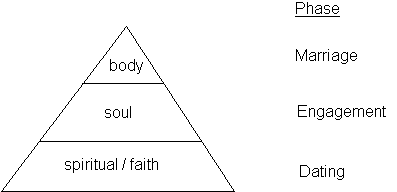
The above is not meant to limit relationships but to help ensure a total wonderful marriage in every respect. If the above order is violated, especially if the physical is entered into before marriage, one can expect the following conflicts:
· an inability to share one's faith after marriage to the same degree that would otherwise have been possible
· a struggle to keep the original emotional feelings intact as the "romance" wears off, and the real personality of the other remains unknown
· a breakdown in communication and the feeling that the other is a stranger; self condemnation and roots of bitterness develop; a coldness develops as memories are reviewed; feelings of guilt bring frustration.
(These points are from the Basic Life Principles Seminar)
When it comes to the physical aspect, it is wise to remember the following: Sexy ¹ Beauty; Lust ¹ Love. In a world in which sex sells, this point can be very difficult to grasp or even want to believe. Jesus does not want us to be sexy. What we consider sexy is a perversion of physical beauty. Can you picture Jesus behaving in a 'sexy' fashion and wanting His wife to be "sexy"? What Jesus wants is beauty, a beauty which comes from the character of a person and thus gives them, their body and whole persona, a radiance which will never end. The essence of beauty is a gentle and quiet spirit (cf 1 Peter 3:4), which all men and women are to have (cf Ephesians 4:2). Beyond that, physical beauty is in the eye of the beholder, and cannot be denied! But it also cannot be the eternal focus, because beauty passes with age. It can be appreciated for a season, but over time the 'character beauty' mentioned earlier is what remains and continues to shine.
A great test as to whether you are actually walking in love or lust in a given situation is your ability to talk and relate freely with children at that time. If you are still able to relate with children openly, honestly, and purely, it is a good sign that you have not been walking in lust.
And in a world which seems to be so focussed on sex, we do well to outline some truths concerning it:
a) Sex is not a product of the evolutionary process (the 'official line' in our world).
b) Sex is a creation of God.
c) Sex is God's artwork.
d) Sex is a physical application of the spiritual reality of God's intimacy within Himself as Trinity.
e) Sex is holy.
f) Sex is not ordinary.
g) Sex is powerful.
h) Sex has laws (not rules - laws describe the fabric of reality; when we break a law there is always a consequence).
i) Sex provides an opportunity for one human personality to impress itself on another human personality and leave an indelible mark on the soul and spirit.
j) Sexual immorality is unique. The abuse of sex is not ordinary.
k) Sexual immorality is not just about forgiveness. Since sex is powerful sexual immorality requires healing.
l) Sex was created as a bonding experience and it works. To try avoiding the bonding and just having the physical experience sears the ability to ever experience intimacy.
m) FLEE sexual immorality.
(Adapted from 'Search for Intimacy' by Allan Meyer)
A few words at this stage are also fitting regarding masturbation.
First of all, the Bible doesn't mention anything specifically about masturbation. In fact, it is silent on the issue.
Second, if a person is 'burning with passion', the directive is always to get married (cf 1 Corinthians 7:9) and let your sexual energy be expended with your partner. There is no hint of allowing personal sexual expression on your own.
Third, the fruit of walking in the Spirit is self-control. The Bible says that a person who has his/her mind set on things of the Spirit will not fulfill the desires of the body in an immoral way, and that those who practise immorality will not inherit the Kingdom of God (cf Galatians 5:16-25).
So the question is, is fulfilling your desire for sex via masturbation immoral?
To answer this, let us use another case in life for which we do find precedent in the Bible: the case of alcohol and drunkenness.
Drunkenness is clearly denounced in Scripture (Gal 5:21; Eph 5:18), yet the drinking of alcohol to forget the misery you may be in is included in the Old Testament (Proverbs 31:6,7), but the craving of beer and wine by kings is frowned upon, lest they forget to rule well (Proverbs 31:4,5).
From this we may say that whilst drunkenness is wrong in and of itself, it can actually be the lesser of two evils, helping to avert sorrow. But the solution is not to continue offering alcohol but to begin to address the underlying issue so that alcohol is no longer needed to address the sorrows. The facts are that since we in the New Testament era have the Holy Spirit, our comforter and counsellor, we no longer need alcohol to be that comforter. We need to be renewed in our minds as to the truth, and the rest of Christian community is also to come along and help bear the burden, also interceding and practically working to address the situation the person is in. This, of course, may take time, and reverting to having an excessive drink in the process is certainly not unforgivable. They need to be encouraged to keep on going and growing in the Holy Spirit, and realising that they are now 'kings', seated with Christ at His right hand, and have great responsibility!! As Jesus said, the truth will set you free.
Having said this, I believe we can consider masturbation in the same light. Self-sexual expression is wrong, because the expression of our sexuality is supposed to be a 'community building exercise'. Yet its expression as a sign of relational immaturity, hurt, unwholeness, or deep longing to be in community and to be known intimately and to be totally accepted, is understandable by God, whilst still offensive in His sight. This person needs to grow in their understanding of who they are in Christ, and the rest of the Christian community needs to come along side and be supportive. Note well that the depersonalisation of sex - as expressed in masturbation, voyeurism, the perusing of pornography - which thereby turns people into objects, whilst being totally offensive to God, is often a symptom of people being unable to be personal (often through having experienced much hurt and rejection in life) and yet still deeply wanting to relate to people, and so the only way they can do that is 'at a distance', thus objectifying people in the process. People caught in this trap really need the loving acceptance of another person as part of the process of them being set free. As noted in Alpha, 'here is no conversion without there first being incarnation'.
Further guidelines on the dating process
The first thing we need to remember is the truth that all people are made in the image of God and therefore are incredibly precious and valuable. A man is a person created in the image of God - not just a FACE and a PHYSIQUE. A woman is a person created in the image of God - not just a FACE and a FIGURE. This principle alone would set most relationship problems on the road to healing.
The second thing to remember is that God is a matchmaker - He knows your need for intimacy more than anyone else. How did Adam find Eve? - God brought her to him! Whilst the Scriptures say that we can marry anyone we wish, as long as they are fellow believers (cf 1 Corinthians 7:39), our 'search' is best combined with prayer, always being open to accept and follow God's will, for He knows what is best for us. (See 'How do I know?' later).
Thirdly, we do well to recover the concept of courtship over against today's defective practices in 'dating'. Today, 'dating' is often perceived as providing a partner to experiment with, reducing the search for intimacy to the level of an emotional toy. The motivation is too often lust. Courtship, on the other hand, should be seen as a careful reaching out to explore the possibility of marriage, during which the integrity and welfare of each precious life is guarded, each honourably growing in understanding of the other, laying the foundation of a life commitment. A good tip to remember is that in all we do with another person, if we end up being married to someone else, could we still look that original person in the eye and have peace?
Fourthly, as an aid to behaving honourably, let us have the spirit of a virgin - "I am separated to God's purposes. I am not on the market". Compare this with the attitude of a harlot - "I'm available, on the make, on the market". Modern behaviour trains people to abandon the concept of virginity and live as if they were harlots, moving from one romantic experiment to another. If a young man takes a young woman whom God never intended to be his wife, makes her his girlfriend, holds her hand, kisses her and deliberately acts to rouse her sexual passions, he is making a harlot of somebody else's future wife. He is taking the place of his brother in a manner that God has reserved for her husband alone. Even if they never actually fornicate, the attitude of "harlotry" is so destructive. He is defrauding both his own future wife and the future husband of the woman he is practising his romantic techniques on.
Fifthly, have a mindset which understands that the will of God unfolds in your life, like the unrolling of a scroll as contrasted to the opening of a book. What we are called to do is be faithful and offer up ourselves to God as living sacrifices, and then we will be able to see and approve God's will (cf Romans 12:2). The will of God unfolds a little like the weaving of a tapestry. You have to work your way into the tapestry, with each moment of obedience and faith working like the passing back and forth of a shuttle. You have to work your way into the centre of the tapestry before the motif can be worked into the fabric!
How do I know?
The question then is: How do I know that this person is God's choice for me? Consider the following 'proofs':
a)
The proof of the heart. God's plan for your life is a delight not a dirge. If you aren't thrilled with them, don't inflict your miserable self on them. "What if God wants me to marry someone I don't like?" - this is the response of the person who sees God's will as something imposed on a person's life rather than something which unfolds in a person's life.b)
The proof of the Spirit. As you honestly look heavenward your belly feels as if the spring is bubbling rather than a ship sinking. This twofold witness of heart and spirit has Scriptural precedent (cf Acts 15:28).c)
The proof of mathematics. We need to be 'equally yoked' (cf Deut 22:10; 1 Cor 9:9,10; 2 Cor 6:14). God will never, never, never plan for people to marry into an unequal yoking. A Christian must marry another Christian. But beyond that, there are other areas of life to be considered: Calling, Career, Potential for Unity, View of Family Life, Intelligence, Social Bearing, Emotions, Finances, Recreation, Friendships and Family Ties, Bearing and Raising of Children, Living Space, Sex. Compatibility is such an issue for a life-long marriage, and 3 out of 10 engagements will not proceed to marriage where good pre-marriage counselling takes place.d)
The proof of parents/pastoral leadership. If those who know us closely and well have serious doubts about your relationship, then consider these as significant warning bells. They love us and care for us, and only want the best for us. Each one of us needs to be under authority. So don't try and grow a romance like a mushroom - overnight and in the dark.e)
The proof of discipleship. What is happening to your relationship with Jesus as you begin to draw closer to each other? If you pursue a relationship that Jesus is not in the middle of, the signs will begin to show in a degeneration of your discipleship. If Jesus is the architect of the attraction, the more you grow together the more you want to love and serve God and be available for Him.When all your proofs are saying the same thing, move on and prepare for your wedding day!
(The above material 'Further Guidelines on Dating' and 'How do I know?' is adapted from 'Search for Intimacy' by Allan Meyer)
Marriage
Marriage is an intimate partnership between male and female in which sexual union occurs, thus total integration of personalities becomes possible.
There is a mystery which is very real: two become one flesh (cf Eph 5:31,32a) upon sexual union. This mystery is so profound that the only time a person may be married to another is if their first spouse (ie sexual partner) dies. If their first sexual partner is still alive, then being united to another is considered adultery in God' sight. (It is no wonder, therefore, that in the Old Testament, adulterers, molesters, etc were stoned to death, the only way for the innocent person to be able to go on afresh. The question is, however, are we faced with a new scenario in the New Testament? Consider the case where Jesus does not condemn the woman caught in adultery to death [John 8:1-11] - this, I sense, has a profound impact on our thinking concerning divorce, adultery, molestation, and the way for the innocent person to be free again to have sexual union with another person).
Whilst physical union is to be expected and not withheld from each partner (cf 1 Cor 7:3-5), it is not the only expression of love between two married people. In fact, love is communicated through at least 5 'love languages': Word of affirmation, Quality Time, Receiving Gifts, Acts of Service, Physical Touch, and each partner does well to finding out from the other which language(s) best communicate heartfelt commitment to the other. Remember, it is no good just giving flowers if what the other person really likes or needs is a good long talk!
When talking about marriage, we need to also be clear that a marriage is complete with husband and wife. Full stop. Children are not to 'make a marriage', nor were they designed to 'hold it together'. Children are to be seen as a blessing from the Lord, as a welcome addition to your family, but children are not the centre of the family. God is the centre. And children are to be seen as a blessing and as a responsibility - entrusted to you by God for their development into the people that God wants them to be, and finally to be 'released from the nest' into all that God has in store for them.
So what about 'family planning' and contraception? I don't know. All I know is that children are a blessing, not a curse, and I agree with the person who said "Blessed is the man who has his quiver full of them" (Psalm 127).
Finally, a married couple is to be separate from their own parents. The Bible says 'leave and cleave' (Genesis 2:24). True cleaving can only be had upon 'leaving', which means at least that you are no longer under their jurisdiction. Where once you had to obey your parents, now they no longer have the right to direct your affairs. Their words to you become advice to be highly regarded.
But this leaving does not mean abandonment! You never stop being the child of your parents. You never stop being a part of the human family you were brought up in. The Bible says that it is the responsibility of children and grandchildren to look after their relatives and immediate family when they can no longer do so themselves (1 Tim 5:3-8).
Parenthood
As already indicated, the key role in parenthood is the training of children in the ways of the Lord. This, in light of this document, means to help them come into fullness of life.
As parents one has the privilege of truly gaining an insight into the heart of God, learning firsthand the meaning of long-suffering, forgiveness, and how to exercise discipline in love for the greater good of the child.
Parents also have a key role in the education of their children. No where does the Bible, for instance, invest the authority of education to the state. Evidence also exists to say that key people who have 'changed the world' have been with their mothers till the age of 7 years, and after that have sat under 'the body of elders', listening to their wisdom.
Grand-parenthood
This stage is not to be confused with parenthood, although being in this position definitely accords a measure of respect. There is an accumulated body of wisdom here that ought not be neglected.
Concluding thoughts on family life
Edith Schaeffer paints a helpful picture of what family life actually is:
A Changing Life Mobile
An Ecologically Balanced Environment
The Birthplace of Creativity
A Formation Centre for Human Relationships
A Shelter in the Time of Storm
A Perpetual Relay of Truth
An Economic Unit
An Educational Control
A Museum of Memories
A Door that has Hinges and a Lock
Blended Balances
Furthermore, I can see that the basic elements which comprise family are:
parents: father, mother
children: brothers, sisters (either same, older, younger)
I would also venture to add that once you become a father you join the ranks of fathers (ie you join the level of your own father).
And what of age, maturity, spiritual maturity? I sense that maturity should be correlate with age; if not, it needs to be addressed (cf 'act your age'). Spiritual maturity has its evidence in life maturity (it cannot be evidenced otherwise). Therefore helping one to be 'mature' is ultimately helping one to 'act your age', which needs to be defined by biblical standards!! (Consider that the Jewish Bar-mitzvah was at 12 years old!, and the boys were then consider adult members of the synagogue, with the right to read and comment on the Scriptures.)
A person, however, may be a "baby in Christ", but in a "grown-up" body. They need to discover their identity in Christ, undo their old values, gods etc, engrain the values of the Kingdom, vision, mission, life, apply to daily life. The more they progress, the more I can treat them "their age"!!
Culture
We are often unaware of the prevailing cultural values in which we live until we face others who go about their way of living in ways which are different to us! We can also often unwittingly impose our cultural preferences on others without really knowing why, or worse still, denigrate other's cultures out of fear or prejudice. Our cultural upbringing also colours the way we see the world and how it is / should be, sometimes even making us blind to what God expects us to do.
When it comes to inter-personal relationships amongst Christians, we need to be very careful that we do not insist that 'our way' of doing things is right, or is the gospel! Sometimes it may be, but if we see a difference, we need to realise that the other person is related to us by the blood of Christ - we are all part of the same family, and we should first and foremost seek to have a spirit of understanding, and to cultivate the unity of the Spirit (cf Eph 4:3).
We also need to examine how we go about our lives, being open to critique and change, and not just assume that because 'we were brought up that way', or because 'everyone else is doing it', that we should go about the same practices also.
This being said, unpacking the word 'culture' can help us begin to see the bigger picture in which every person lives.
Culture may be defined as "a people's design for living" (Kluckhohn), or "an integrated system of beliefs, of values, of customs and of institutions which express these beliefs, which binds a society together and gives it a sense of dignity, security, and continuity" (Price). Note the difference between culture and society: society is the people, actors, habits, behaviour; culture is the structures, script, pattern, options, boundaries.
Culture also has levels: a surface level, at which there are overt and covert customs that pattern doing, speaking, and emoting; a deep level, wherein lies the worldview (assumptions, values, allegiances).
These following diagrams serve to enlighten us on culture:
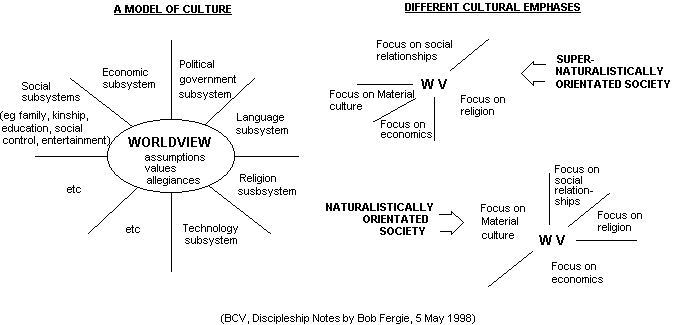
One obvious aspect of culture that we are faced with today more than ever before is that of urbanisation, which is the product of industrialisation. No longer are we village people, but dwellers in cities - 85% of Australians are urban dwellers, with 70% in cities. This is fact that Christians themselves must begin to address.
The question faces us as to how to be community in a city. Is it God's will that we walk past countless hundreds of nameless faces every day, travel on buses, trams, and trains without speaking a word, and have friendship bases no longer grounded in our local geographical area but spread thinly all across town, the country, even the world via internet, whilst not even 'seeing' our neighbours, let alone their needs?
I have noted that whilst it is exciting to have friends scattered as such, and whilst when you are young and single you have the energy and resources to be able to travel and communicate over such vast distances, the older you get you realise you just don't have the time or energy or money to do that travelling. And perhaps also the wiser you get you realise that nothing cuts it like face-to-face personal communication. Ultimately you realise that you need to be part of a 'local village', even midst a city.
And how can we do that? In our urban society, in which our neighbours are often from other parts of the planet and we are confronted with such vastly different cultures all on our doorstep, there needs to be some common factor that is powerful enough to unite us.
And that is exactly what the church claims to have - Jesus Christ. We must remember that the church of Jesus Christ is a heterogeneous entity, comprising people from all races, ages, sexes, nationalities, roles, economic function, etc. In Christ there are no boundaries. We are all part of one body, and God is our Father. And the key unifying factor is only that. Our unity is not based on hobbies, leisure pursuits, work interests, etc. Our unity is in Him, and it is only as we seek first the Kingdom together that we can ever hope to live together.
Thus, I suggest that the existence of 'internet churches', or churches comprised of people travelling half way across the city, is less than God's ideal. Yes, to be sure they cater for the current culture and situation of a person, and can be good evangelistic tools to help unbelievers be saved, but God is ultimately looking for more. I believe God will gently lead each believer to ultimately be working towards the existence of a local Christian community, because only that will truly satisfy our deep needs and really touch those other people who live near us.
Next section