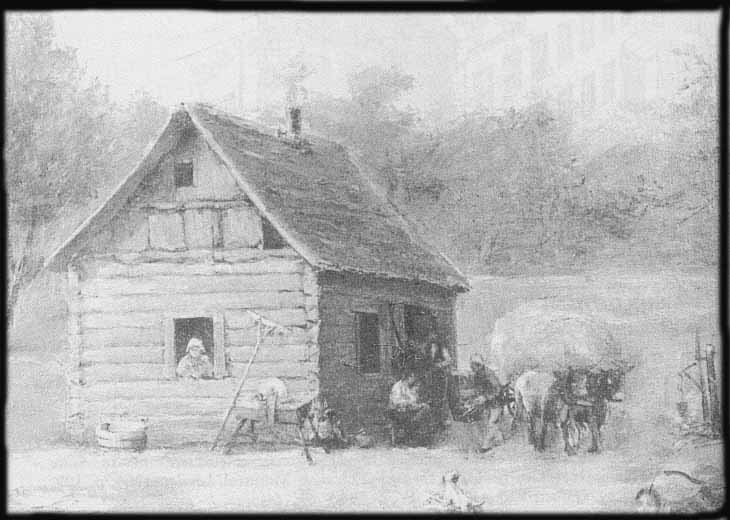
Our ancestor Ambroise Comeau was born February 18, 1704. The youngest of Pierre Comeau dit l'Esturgeon & Jeanne Bourg, he grew up in Port-Royal during the part of Acadian History known as THE GOLDEN AGE.
Around 1732, Ambroise Comeau married Marguerite Cormier and together, they settled in CHIPOUDIE in CHIGNECTOU BAY (SEE MAP) where they had at least nine children.
All genealogists who do research in our Comeau Family line will notice certain documents mentioning Ambroise Comeau as married to Marguerite Cormier while others say that he is married to Marguerite Thibodeau. The first reaction would be to assume that he was married twice. However the same spouses are repeated for his brother Maurice Comeau. This mistake is mentioned not only by amateur researchers but also by well-known Acadian historians & genealogists such as Bona Arsenault & Adrien Bergeron.
Stephen White, G�n�alogist & Professor at the Centre of Acadian Studies at Moncton University has just published his Dictionnaire g�n�alogique des familles acadiennes from which the following note has been translated:
 'In the baptismal registers for their children Olivier & Marie (Rg Beaubassin, April 12, 1733), the priest exchanged the names of the spouses of the brothers Maurice Comeau and Ambroise Comeau. However, subsequent documents demonstrate that Marguerite Thibodeau is the wife of Maurice Comeau and Marguerite Cormier the wife of Ambroise.'
This mistake made by a Priest in baptismal records of 1733, continues to be repeated even nowadays.
Maurice Comeau, brother of our ancestor, was found in the 1767 census of St-Pierre-et-Miquelon. He died in France the following year on January 16, 1768 in the hospital of St-Pol-de-L�on.
We find Ambroise Comeau and his wife with 3 sons & 4 daughters on 1754-55 census, still in Chipoudie in Chignectou Bay near Beaubassin during the deportation era.
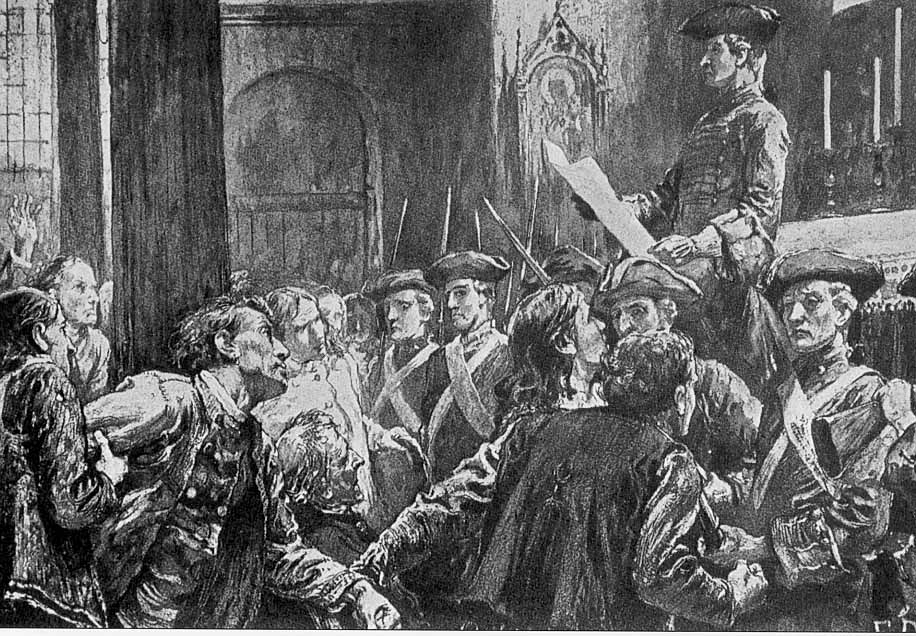
The first call following the order of Lawrence was on August 9, 1755, in the region of Beaubassin and Chignectou Bay. Residents of this area were told to assemble at Fort Cumberland (Beaus�jour), to 'receive the orders of His Excellency the Governor'.
 The acadian population was suspicious and ignored this first call. The assembly was postponed to the following day when 400 Acadians showed up at Fort Cumberland (Beaus�jour), after obtaining the assurance that this summons was to provide arrangements from the Governor of Halifax for the conservation of their land. Upon arrival at Fort Cumberland, they were all taken prisonner.
(Arsenault 179)
Room at Fort Beaus�jour where
Acadians were kept as prisonners
Our ancestor Ambroise Comeau and his family were among those who escaped this fate thanks to their Priest L'Abb� LeGuerne and Lieutenant Boish�bert from the French Militia.
Detachments of English soldiers were then sent in the surrounding country to arrest the population but a majority of the inhabitants in the region of Beaubassin, as well as the families established along the rivers of Chipoudie, Petitcoudiac and Memrancook, were hidden in the woods on the advice of l'Abb� LeGuerne.
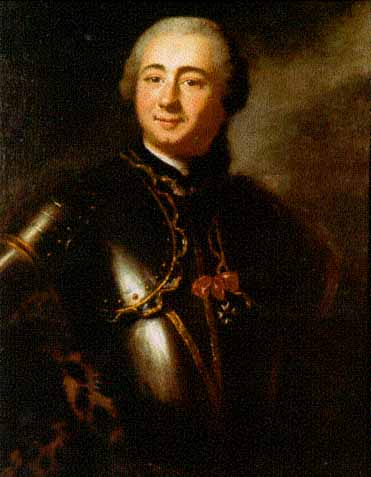
On August 26 1755, Lieutenant Boish�bert of the French Militia surprised 200 British soldiers, commanded by Major Frye. After setting fire to the Church in Chipoudie and the surrounding homes, the British soldiers were just about to set fire to the houses in Petitcoudiac. They were caught unexpectedly... and had to retreat....
This is how 200 families who lived on the rivers of Chipoudie, Petitcoudiac & Memrancook were able to escape deportation.
(Arsenault 180)
Charles de Boish�bert
We find a trace of Ambroise Comeau's family two years later in Port La Joye, �le Saint-Jean (Prince Edward Island).
L'abb� Fran�ois LeGuerne wrote that many people, young and old with five or six men who escaped from Beaus�jour started to cross the woods under horrible conditions through marshlands, following a distance of ten leagues to access the sea. It took them one month, hiding from the English, to reach Baie Verte and cross the channel to �le Saint-Jean (Prince Edward Island).
(Arsenault 181)
Ambroise Comeau and his family were among the refugees on �le St-Jean as on January 21, 1757, a daughter Marguerite Comeau would marry Michel Brun in Port La Joye, �le Saint-Jean. Marie Comeau, sister of the bride, was witness at the wedding. However, this family will not be able to remain there for very long as when the English occupied Prince Edward Island on September 8, 1758, thousands of acadian refugees living on �le Saint-Jean were deported to France and England. Two of the nine English vessels transporting the Acadians to Europe, the Violet and the Duke William would perish with their human cargo at sea.
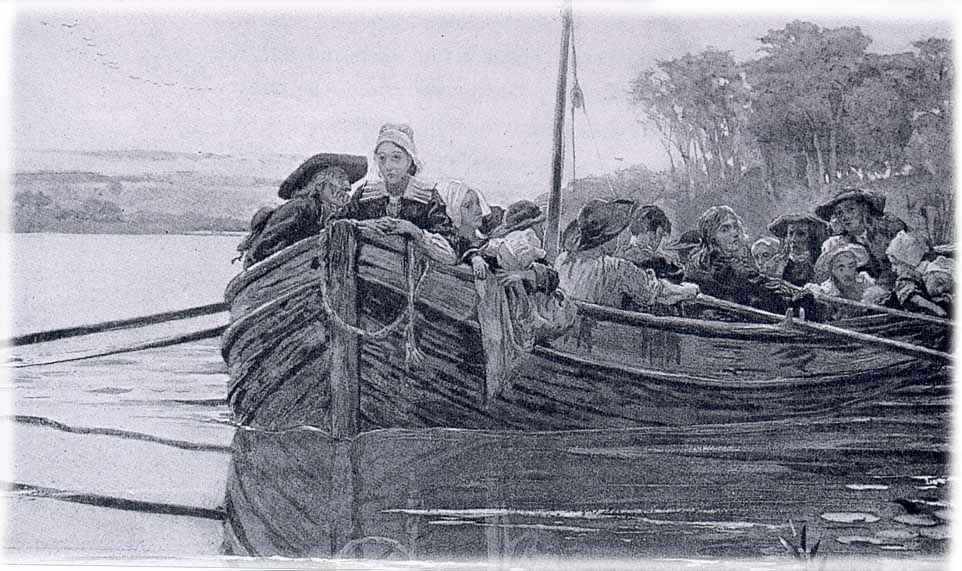 Commandant Bourdon of the French Militia had wed an Acadian refugee on �le Saint-Jean and organized with the help of Lieutenant Boish�bert, the immediate evacuation of many acadian refugees from �le Saint-Jean. They made their way to the Post of Petite-Rochelle during the summer of 1758.
This is how one more time Ambroise Comeau and his family would escape deportation. We find them on the census of La Petite Rochelle (Restigouche) in 1760. Three children no longer live with their parents. Their young son, Fran�ois Comeau may have disappeared sometime between 1755 and 1760 ?
 Six members Ambroise COMEAU's family are listed on the census at La Petite Rochelle de Restigouche in 1760.
In May of the same year, only six months after the fall of Quebec City, two French ships en route for Quebec were intercepted by a British fleet. The French ships hid deep inside the ' Baie des Chaleurs' at La Petite-Rochelle (Restigouche).
About 200 natives and 800 Acadians were at La Petite-Rochelle (Restigouche). The arrival of the French ships were a God send after these families had spent the winter with very little food wrote Antoine Bernard in l'Histoire de la Survivance acadienne The French ships brought supplies and ammunition, with the protection of three vessels with cannons.
By June, the British learned of the arrival of the French Ships at La Petite-Rochelle (Restigouche). A few weeks later, a British fleet of three war ships arrive in la Baie des Chaleurs. The cannons boomed from June 27 to July 8. The British won the battle, set fire to La Petite-Rochelle and took 300 Acadians prisoners to Halifax.
(Arsenault 220)
Ambroise and his family were among the Acadians who escaped this battle. Like their compatriots, they would hide along the coast of the Baie des Chaleurs.
In 1761, Ambroise Comeau was found in Nipisiguit (today Bathurst) with his wife, two sons and two daughters. In the autumn of that year, a surprise expedition by the English army under the command of Captain Roderick MacKenzie would take hundreds of Acadians prisonners in Nipisiguit. By faith or preventativeness, earlier that year, Ambroise and his family would seek the safety of the Gasp� shores on the Baie des Chaleurs. Later, in a letter sent by Louis Bourdon to Lord Dorchester, Ambroise Comeau is mentioned as being a resident of Bonaventure since 1761. We do find Ambroise Comeau and his family in Bonaventure in 1765.

The war was over in 1763 and a few years later in 1765, Ambroise Comeau and his family are counted on the census of Bonaventure (on the north shore of the Baie des Chaleurs). That year, the Acadians of Bonaventure will be forced to leave their land when an English concessionary obtained this territory and chased them out. The Acadians started negotiations with the English Authorities to occupy the land situated about forty miles from Bonaventure.
This is how Ambroise Comeau and his family became one of the first pioneers in Tracadi�che (Carleton). In that town, a monument was erected in memory of the first Acadian residents and among on the monument we find the name Comeau in honour of our ancestor.

HISTORICAL TIDBITS
During the first half of the 18th century, the Acadian birth rate was relatively high and the child mortality rate was low. This period of Acadian history ( 1680- 1740 ) is known as the Golden Age. Large families were not uncommon and often many generations lived under on roof.
Source: Centre Acadien, Universit� Sainte-Anne, N.S

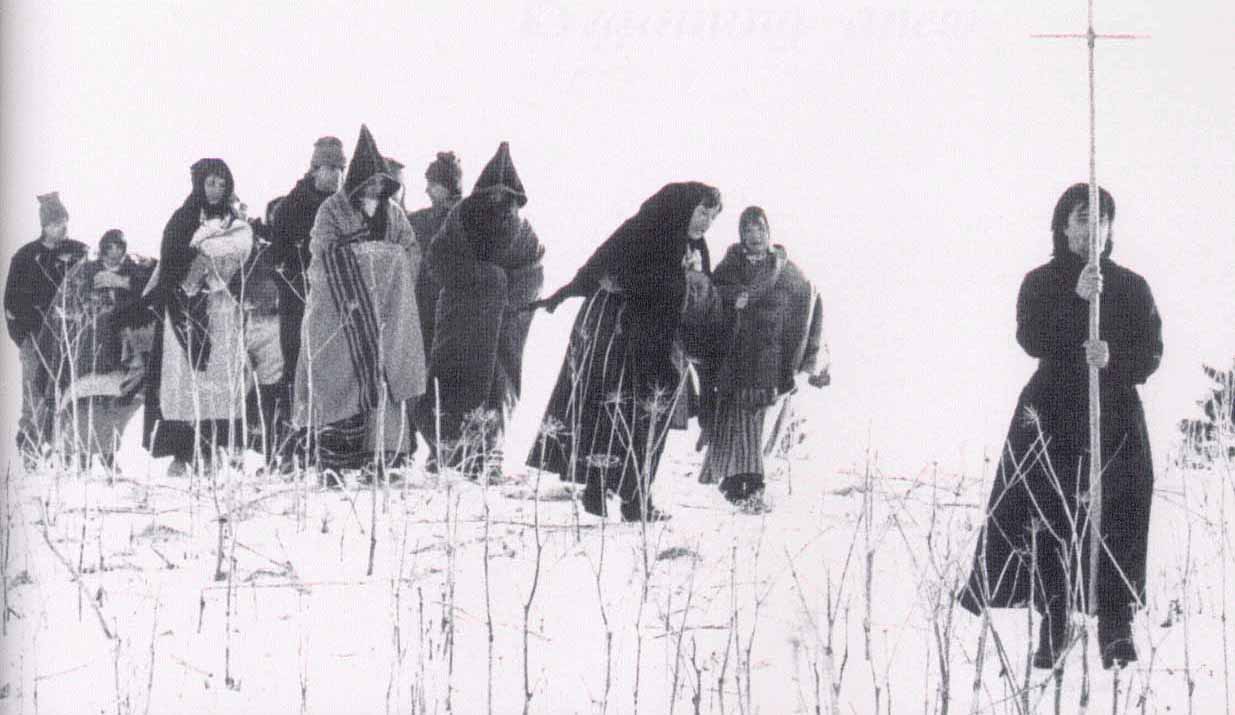 L'�le St-Jean (maintenant l'�le du Prince Edouard)